Thursday, 27 December 2018

It was a day of mist and hazy sunlight. You wouldn't think this picture of the Italian Garden fountains was taken at 11.30 am.


To the despair of the park gardeners, all kinds of creatures dig up the bulbs they have carefully planted -- squirrels, rats, and in this case a Carrion Crow which was making a really thorough job of wrecking a planter in the Italian Garden.


There is still perhaps two days' supply of fruit on the rowan tree on Buck Hill, perhaps less if the Blackbirds have a serious go at it. A Redwing made the most of what was left.


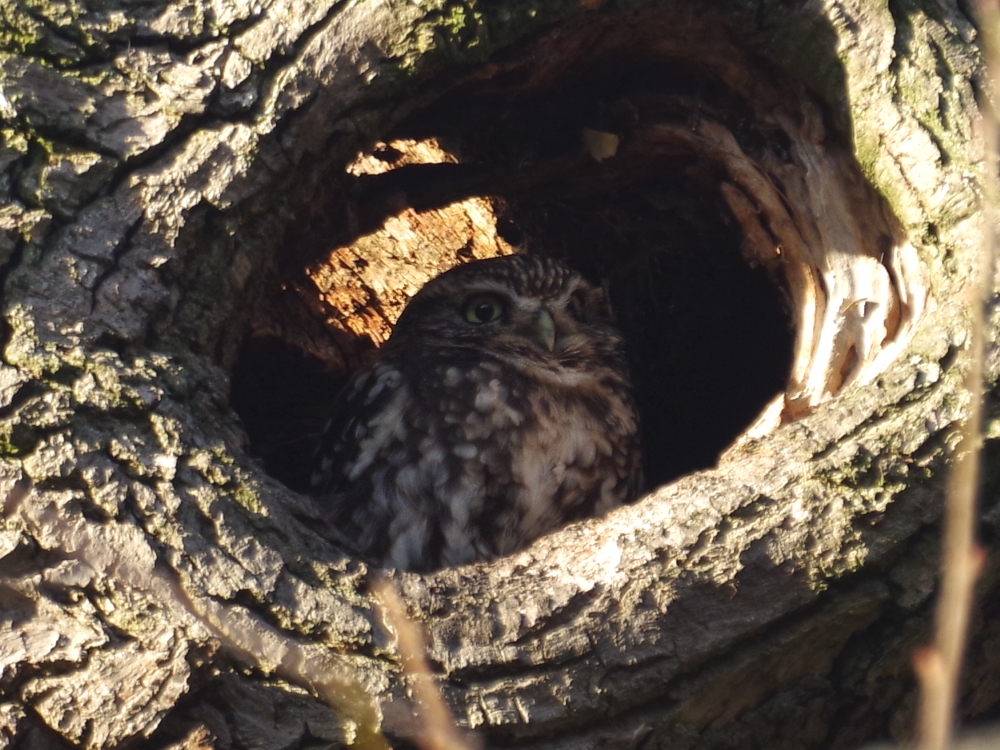
The female Little Owl at the Queen's Temple looked down from her hole.


Her mate was also on the treee, but was frightened by a crow and fled into the hole before I could get into position for a photograph. One of the owls on Buck Hill was also visible, twice but only for seconds at at time, vanishing into the hole while I was still a long way off.

In the leaf yard, only the female Nuthatch of the pair appeared. She is the one that I can't tempt to come to my hand, no matter how I try. I put down some pine nuts for her on the railings.


There is a fourth Grey Heron nest on the island, on the south side and hard to see from the north shore. But a few days of cold weather will finish off all these premature attempts.


A pair of Great Crested Grebes were building a nest in the fallen willow tree next to the bridge. Probably they're not serious about nesting -- they often play around for months before they get going properly.


There is a new pair of Lesser Black-Backed Gulls on the lake. This is the smaller of the two, presumably the female, finishing off one of the pigeon-eater's kills. They are both of the darker intermedius morph, with almost black backs. She has a distinctive irregular dark bar across the yellow iris of her eye.


The other stayed farther out in the lake, but he too seems to have unusual eyes of a dusky colour. It seems likely that the darker variety of Lesser Black-Backs is more prone to having dark eyes.


This Black-Headed Gull now developing its dark head is a longstanding winter visitor to the park. The ring is numbered EX63683, and it was put on by Roy Sanderson here a decade ago.


Two Black-Headed Gulls paid a little attention to a lemon before deciding it wasn't good to eat.


A Moorhen gave it one look and walked off. It's alway interesting to discover something that a Moorhen won't eat.


A pair of Egyptian Geese stood on a weeping beech in the Dell and performed their noisy display. The female makes most of the racket with her honking call. The male makes a hoarse panting noise.


Of all the drakes on the lake the Gadwall is the least showy, a model of sober elegance.

Wednesday, 26 December 2018

The fruit was rapidly disappearing from the rowan tree on Buck Hill as several Blackbirds constantly flew in to eat it.


A few Redwings helped to finish it.


A Blue Tit visited the tree, probably looking mainly for larvae, but settled for a withered fruit.


A Jay collected a peanut and flew up to a secluded branch to eat it in privacy.


A Green Woodpecker flew up into a tree near the Queen's Temple.


 A pair of Rose-Ringed Parakeets examined a possible nest hole in a plane tree. Many birds are starting much too early. A spell of cold weather is needed to reset their timing before they waste any further effort.


All three Grey Heron nests are also on the go. The pair from the upper nest perched side by side at the top of the tree.


A pair of Egyptian Geese had a loud display on the stonework at the outflow of the Serpentine. But Egyptians breed at crazy times anyway.


The Peregrines were both on the barracks tower, as usual taking little notice of each other. They are not cosy birds.


A Herring Gull on the island picked up a beakful of dead leaves ...


... and carefully selected a feather from it ...


... then decided that this wasn't an interesting toy and played with a twig instead.


A few bits of bread thrown in the air produced wild excitement from the Black-Headed Gulls.


Whatever fish this Cormorant has caught, it isn't a perch. These have to be turned round to swallow head first because of the spiky dorsal fin. Any other fish goes down straight away and you have to be quick to get a picture.


A Shoveller ...


... and a Pochard brightened up a grey day.

Tuesday, 25 December 2018

The rescued Great Crested Grebe was in the middle of the Serpentine, fishing busily.


We've already had a video of this pair of grebes dancing. Today they were trying to build a nest against a wire basket, and not making much headway in getting it to stick ...


... so they had another little dance to keep their enthusiasm going.


The park was crowded with families having a Christmas stroll, but many of the regular birds could be seen. The Little Owl at the leaf yard was at the front of her hole, though there was no sunlight for her to enjoy.


One of the Peregrines was on the barracks tower.


The familiar Jay on Buck Hill raised its crest and fluffed itself up.


Blondie saw someone feeding the geese and came over for her share.


The pigeon-eating Lesser Black-Backed Gull was near the shore, choosing his Christmas dinner.


The moored pedalos ...


... and the buoys at the Lido were thronged with gulls, mostly Black-Headed.


All the Grey Heron nests on the island were occupied.


A Cormorant drying its wings on a post flapped more and more frantically. Presumably this helps with drying, but they seem to like flapping for its own sake.


A pair of Feral Pigeons were nuzzling one another affectionately.


There is still some fruit on the rowan tree on Buck Hill, and several Blackbirds were making the most of it.


A Blue Tit ate a withered berry. Birds like rowan berries overripe and dried up, which must be extra sweet like raisins.


A slow-motion video by Neil of me feeding a Nuthatch and some Great Tits at the leaf yard, and of himself feeding a Coal Tit in the shrubbery next to the bridge.

Monday, 24 December 2018

This Great Crested Grebe stuck in the stream in the Dell has been rescued by Hugh Smith the Wildlife Officer. He had a hard time trying to catch it and take it up to the lake. Grebes can swim at 15 mph under water, and dodge effortlessly between your feet. This video shows only the beginning of the attempt, which eventually took almost two hours, seven people in three vans, and a roll of plastic netting. But he succeeded and the grebe is now on the lake none the worse for its experience.


The Little Owl in the oak tree near the Albert Memorial lurked at the back of her hole ...


... but the owl at the Queen's Temple came out to bask in the sunshine.


A pair of Egyptian Geese displayed noisily in the next tree.


In the leaf yard, a Great Tit picked little pieces out of a pine nut.


A Blue Tit came out to be fed.


A Starling shone in the sunlight.


A Dunnock lurked in the fallen leaves.


Two Magpies searched for insects and worms among dead leaves at the edge of the Vista.


A Mistle Thrush ate fruit in the rowan tree on Buck Hill, then flew away with its rattling flight call, startling a Blackbird which you can hear calling out of shot.


There was also a Redwing in the tree.


A Jay waited in the next tree for me to stop photographing and produce a peanut.


There were two Grey Herons on the middle nest on the island, hard to see through the twigs. All three nests are now active.


A Mute Swan dozed in the middle of a path in the Italian Garden. Swans know who's boss, and expect you to walk around them.


A pair of Mallards rested on the dead willow in the Long Water.


A Tufted Duck turned upside down to preen.


I wish a very happy Christmas and a successful New Year to all readers.

Sunday, 23 December 2018

The Great Crested Grebe that is stranded in the stream in the Dell was busy fishing. It seems to be finding food, possibly small invertebrates rather than fish.


This dark Mallard drake doesn't associate with the inseparable dark Mallard brothers, and is probably not related to them. But, like them, he doesn't have a mate. Perhaps female Mallards are prejudiced against dark drakes. The white Mallard, a much odder bird, does have a mate.


All the usual duck species were present today: Gadwall ...


... Shoveller ...


... Tufted Duck ...


... Pochard ...


... and Red-Crested Pochard.


Red-Crested Pochards, though orginally park escapes, are now included on the list of British birds as they have established a stable breeding population.

The number of Cormorants using the raft as a fishing station is now up to five.


A Herring Gull called continuously as others followed it across the lake. The young gull immediately behind it made the upward nod of assent that mates make to each other, but I don't think these two are mates. I can't figure out what kind of social interaction is going on here.


Both the Peregrines were on the barracks tower, preched too far apart to get them into one shot.


The Little Owl near the Henry Moore statue came out of her hole briefly.


The owl near the Queen's Temple was also visible.


A Blackbird ate fruit in the rowan tree on Buck Hill.


A Redwing also made a brief foray into the tree.


The Blackbird at the bottom of the hill now comes out every time I pass and waits to be given some sultanas. Bribery will get you everywhere with these normally shy birds.


Long-Tailed Tits jumped around in a nearby tree. It's a Winged Elm (Ulmus alata), whose peculiar ridged bark harbours insects.


Something had upset the birds in the leaf yard, and they were all nervous. The Nuthatch was hesitant about coming to my hand, though it eventually came down twice. And it was very difficult to entice the timid Coal Tit down to the railings to take a pine nut.


A Robin in the Rose Garden had to raise its voice to be heard over the din of the funfair a few yards away -- the directional microphone on the camera has muted the extraneous noise to some extent. Urban Robins are known to sing louder than rural ones.