Tuesday, 27 March 2018

The pair of Great Crested Grebes at the Serpentine island stole a Coot's nest -- the Coot left when it heard them arriving -- and mated on it, exchanging many affectionate head shakes. This is quite a slow business by the hasty standards of birds, and this video has been excerpted from an original 4 minutes long. Although Great Crested Grebes can always chase Coots off a  nest, the Coots will get it back in the end, with their typical dogged persistence.


Moorhens, like Coots, are much less ceremonious about mating. Here a male chases a female, who isn't in the mood.


Another Moorhen was stealing twigs from a temporarily unoccupied Coots' nest near the bridge.


Johanna had borrowed my video camera and was filming some Mute Swans courting, with a pair of Greylags washing in the background. It didn't look as if anything was going to happen, but suddenly the Greylags started mating, and luckily she caught the moment.


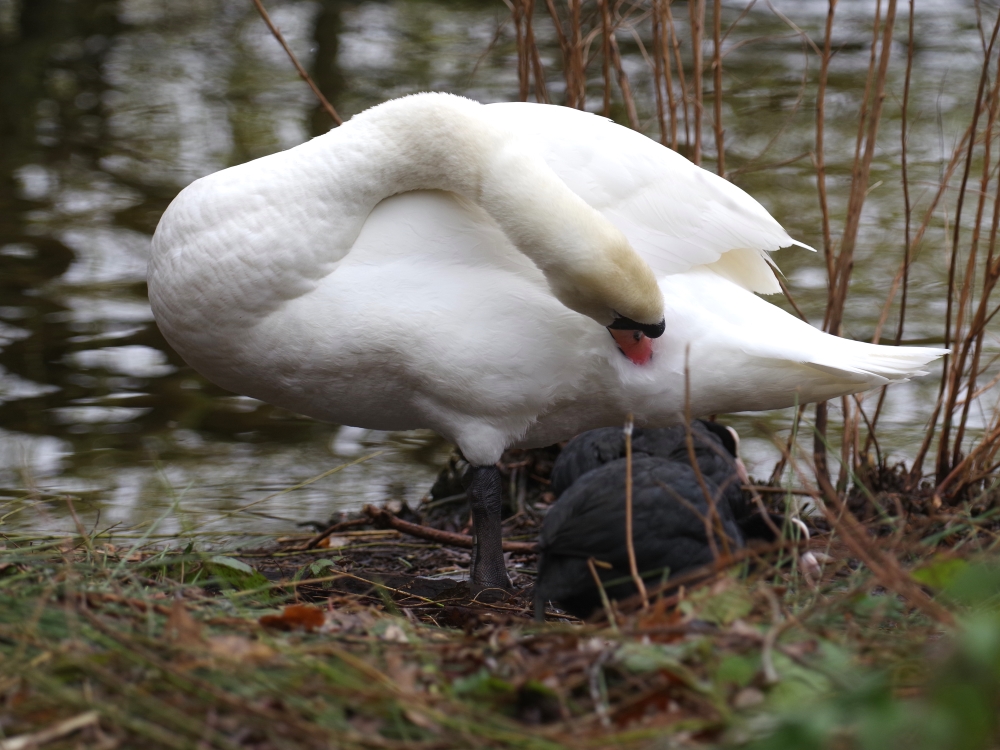
This nesting swan near the bridge was closely attended by a pair of Coots. Johanna mentioned that in California hummingbirds often nest near the nests of Red-Tailed Hawks. The tiny birds are too small to interest the hawk as food, and they get the protection of being near a dangerous predator.

A young swan was enjoying itself in the spray of the water inlet of the Round Pond. It seems odd to see one of these moody birds having fun.


One of the female Pochard--Tufted Duck hybrids was cruising around at Peter Pan. They have interesting marmalade-coloured eyes, intermediate between the yellow of a Tufted Duck and the brown of a female Pochard.


The mild grunting noise of an annoyed Mandarin drake is as near as these quiet birds get to quacking. They also make a gentle peep-peep-peep noise as a social call.


Grey Herons seem endlessly patient as they wait for fish, but this one on a post under the bridge had a moment of boredom.


Most of the Black-Headed Gulls have left for their breeding grounds, which may be as far away as Finland or as near as the Pitsea landfill site just to the east of London. There was just one on the Serpentine, and no Common Gulls. But there still were several of both species at the Round Pond, here mixing with the local Herring Gulls which don't migrate.


On the edge of the Round Pond a Carrion Crow played with a round seed. Its wings are faded, probably as result of a bad diet of junk food from the restaurants in Queensway. This happens particularly with young crows, which need good nutrition as they grow.


Both Peregrines were on the tower of the Household Cavalry barracks, but one left before I could get close.


The female Little Owl near the Henry Moore sculpture was in her usual place in the lime tree.


The overnight rain left the soil soggy -- good conditions for Blackbirds to get worms.


One of the regular Robins beside the Long Water came out to be fed.


Goldfinches came down to the feeder in the Rose Garden.


Work on the shelter at the bottom of Buck Hill is finished at last, just in time for Starlings to start nesting under the eaves.


A pair of Long-Tailed Tits gathered lichen to make one of their complex spherical nests. They are built of spider webs filled in with lichen and moss, and lined with literally thousands of little feathers, all of which they diligently collect.

Monday, 26 March 2018

A pair of Magpies nesting in a tree near the bridge gathered small twigs to make a smooth lining for the inside of the nest.


The final touch, if they can find any, is tufts of dog hair from where someone has been combing a woolly dog in the park.

Usually Jackdaws can pick through the shell of a peanut in a few seconds, but this nut was putting up a stiff resistance.


A Blackbird was eating oatmeal and clearly enjoying it, as it was ignoring fallen berries on the path nearby.


A Wren hopped around under a tree north of the Round Pond. There are many Wrens in the lime avenues here.


A Treecreeper walked along the underside of a branch on a tree next to the Little Owls' tree near the Albert Memorial.


The owl herself was enjoying the morning sunshine. Little Owls' big shaggy eyebrows shield their eyes from the sun.


The owl near the Henry Moore sculpture was in the shade as usual. You hardly ever see her in direct sunlight.


A pair of Mute Swans made a nest near the bridge. A pair of Coots hung around in the background, not close enough to goad a swan into chasing them away. Do they nest next to swans to protect themselves from predators?


The dominant male Mute Swan was at the Vista rounding up other swans to shoo them off his territory when an irresponsible dog owner let his dogs into the lake. This is the swan who was badly injured by a dog a couple of years ago, and he has a short way with them now. This dramatic picture was taken by Johanna, who edits the longer videos on my YouTube channel.


On the Serpentine, three big male swans were cruising around aggressively. The lower ranking swans fled.


A male Tufted Duck stood as tall as possible to impress some passing females.


A Gadwall looked quietly elegant in the sunshine.


All the Shovellers have left the Long Water and Serpentine, but there are still three on the Round Pond.


A Cormorant caught a fish under the marble fountain on the edge of the Italian Garden.


The Grey Heron is still on the nest on the island. Maybe the pair are serious about nesting again after they were driven off their nest first by the cold spell and then by Egyptian Geese.


The pigeon-eating Lesser Black-Backed Gull strode ashore with a hungry glint in his pale eye.


Another Lesser Black-Back knocked a Common Gull off a post.

Sunday, 25 March 2018

The nest site on the baskets in front of the Serpentine island, disputed between Coots and Great Crested Grebes, was being built on by a Coot.


But it left when it heard the grebes arriving.


They mated on the nest ...


... and exchanged the usual courtesies afterwards.


But the Coots will win in the end, by sheer persistence. They always do.

A Coot began to build a nest on a chain between two posts at the Serpentine bridge. It may look vague, but a strong and durable structure will emerge.


The male of the pair of Coots nesting on the Mute Swans' little island chased the female. This is all the courtship a female Coot gets.


The blue-eyed Greylag Goose was at Peter Pan with his mate.


There were Mallards in the oak tree near the Albert Memorial where the Little Owls nest. I don't know what they thought they were doing up there.


But when I came back later, the female owl was back in control.


The owl near the Henry Moore sculpture was also in place. So far, there is no sign of Carrion Crows taking over the tree.


A Starling sang outside a nest hole in a plane tree near the small boathouses. It's is already in use, as shown by the droppings. At one time it looked as if Rose-Ringed Parakeets were going to take over these trees, with their many holes suitable for nests, but there was no sign of them today.


The Grey Herons' nest on the north side of the island is occupied again.


The nest on the other side also had a heron in it.

Jackdaws searched for insects and worms in the fertile, well maintained turf of the Diana fountain enclosure.


A female Chaffinch foraged in the shrubbery near the bridge.


On the other side of the bridge, a Chiffchaff sang in a treetop ...


... and a Blue Tit came to be fed.


A Blackbird hauled up a worm under a tree near the leaf yard.

Saturday, 24 March 2018

Mateusz at Bluebird Boats found a Water Rail on the boat platform early yesterday morning, and took this picture.


I would guess that it's mostly on the Serpentine island, where it would be very hard to see from the shore.

A pair of Great Crested Grebes were trying to start a nest on one of the floating baskets of plants set around the island. They don'thave the skill to fix twigs into the wire mesh, something a Coot could do easily.


But this Coot nest under the balcony of the Dell restaurant is a puzzle. It doesn't seem to be fixed to anything.


I hung over the edge of the balcony and took this picture of it from above.


The water here is perhaps 20 inches deep, looking shallower because of refraction. The Coots have somehow managed to pile twigs, which would normally float, on the bed of the lake. Perhaps they have dived for some waterlogged twigs that had sunk to the bottom. Anyway, it's another example of Coots' nest building skill.

A pair of Cormorants on a fallen tree on the Long Water were courting with harsh cries which I suppose were music to their ears.


The male Mute Swan of the Long Water pair was guarding their nest while his mate took time off to feed.


There must be eggs in the nest, but they are surrounded by bits of reed and invisible from the shore.

A female Gadwall was doing nothing at all, allowing her beautiful markings to be admired.


A Mandarin drake at Peter Pan didn't want another one getting too close to his mate, and escorted him out of the area.


There were only two Grey Herons on the Serpentine, probably the pair that built the nest on the south side of the island. But they were paying no attention to the nest, and flying around and landing in other trees. I think they've given up, and we shan't have any young herons here this year. But I would love to be wrong.


A Pied Wagtail hunted on the grass to the east of the Triangle car park.


They like this area, which was relaid with new topsoil and high quality turf after the 2012 Olympics. Now that the grass has matured, it is full of small invertebrates for them to eat. They also like the Diana fountain enclosure, another area that was relaid and returfed several years ago. The main areas of the park, where grass is growing on the London clay, are not so productive.

A Song Thrush sang on a tree near the bridge. I couldn't get a clear view of him through the twigs, but at least I managed to record his cheerful song.


A Goldcrest was also singing in the Dell. He has a particularly fine crest.


A few feet away, a Coal Tit had to wait its turn on the feeder because a Great Tit was glaring at it in a proprietorial way.


The Robin in the Rose Garden whose territory includes the feeder does its best to hang on to the metal bar, but often loses its grip and falls off. Their feet are not nearly as strong as those of tits.


There was just one Little Owl to be seen today, the female in the lime tree near the Henry Moore sculpture.