All the Little Owl family near the leaf yard were on view. The two owlets obligingly posed on their nest tree.
Their father was in the same tree.
And their mother was in a horse chestnut on the other side of the path.
There was also the sound of a Little owlet calling from an oak tree 30 yards southwest of the oak with the nest hole near the Albert Memorial, but I couldn't see it through the leaves.
The Moorhen family in the Italian Garden pond have seven chicks.
A Grey Heron was fishing in one of the other ponds, and caught a small perch tangled in weed, which it expertly removed and discarded before eating the fish.
The Coot family under the Bluebird Boats platform still have four chicks, thanks to their excellently sheltered nest.
The Black Swan had been preening and was flapping his wings, showing his smart new white feathers.
A lone Mute Swan cygnet was following its mother on the Serpentine. There are now only three cygnets on the Serpentine and three on the Long Water.
The Greylag Geese are in much better shape, and as far as I know have only lost one gosling. Here are the youngest four in the goose nursery near the Lido.
A Painted Lady butterfly was resting on a blade of grass on the west side of the Long Water.
A pair of Common Blue damselflies were mating near the bridge, a long and complicated business. The female is the one on the right.
This bright insect was on Buck Hill. I have no idea what it is, and the rear view, the only way I was able to photograph it before it flew off, doesn't help identification. It seems to have only one pair of wings, and therefore to be a fly of some kind. It has a remarkably long proboscis.
Update: David Element has just told me that it's a stingless parasitic wasp, Amblyteles armatorius. What I thought was a probsoscis is one of its antennae. It seems to have lost the other one.
Saturday, 25 June 2016
Friday, 24 June 2016
The pigeon-eating Lesser Black-Backed Gull was hunting in his usual spot near the Dell restaurant. He ran through a crowd of pigeons, scattering them ...
... seized one as it tried to fly away ...
... and killed it in the lake.
He finishes them off in a few seconds now by a quick bite to the neck, so he doesn't have to drown them and the struggle is mercifully shorter (for the pigeon, that is -- gulls don't do mercy).
Just along the restaurant terrace, two Moorhens were fighting while their mates looked on.
There are also two pairs of Moorhens nesting in one of the Italian Garden ponds, but it was a peaceful scene. The chicks have hatched in one of the nests and their parents were feeding them.
There is another new family on the Serpentine. A pair of Coots have nested out of sight under the platform of Bluebird Boats.
The goose nursery east of the Lido was as active as ever, with four families of Greylags on the shore and in the water.
The Canada family were out of sight on the grassy bank inside the Lido swimming area, which is now closed to the non-paying public.
The Black Swan was also unphotographable, as he was working his way up the edge of the Lido restaurant terrace touting for food, and I would have had to evict people from their tables to get a picture.
The Bar-Headed Goose was on the north shore of the Serpentine. Its new wing feathers have started to emerge.
The drakes of all the duck species on the lake are looking tatty as they go into eclipse. But the females are as smart as ever. Here a Mallard preens her wings, showing off her fine iridescent blue secondaries.
The male Little Owl was on his usual branch in the chestnut tree.
Only one of the owlets was visible, in the other chestnut.
A male Black-Tailed Skimmer dragonfly was sunning himself on a grass stem near the bridge.
... seized one as it tried to fly away ...
... and killed it in the lake.
He finishes them off in a few seconds now by a quick bite to the neck, so he doesn't have to drown them and the struggle is mercifully shorter (for the pigeon, that is -- gulls don't do mercy).
Just along the restaurant terrace, two Moorhens were fighting while their mates looked on.
There are also two pairs of Moorhens nesting in one of the Italian Garden ponds, but it was a peaceful scene. The chicks have hatched in one of the nests and their parents were feeding them.
There is another new family on the Serpentine. A pair of Coots have nested out of sight under the platform of Bluebird Boats.
The goose nursery east of the Lido was as active as ever, with four families of Greylags on the shore and in the water.
The Canada family were out of sight on the grassy bank inside the Lido swimming area, which is now closed to the non-paying public.
The Black Swan was also unphotographable, as he was working his way up the edge of the Lido restaurant terrace touting for food, and I would have had to evict people from their tables to get a picture.
The Bar-Headed Goose was on the north shore of the Serpentine. Its new wing feathers have started to emerge.
The drakes of all the duck species on the lake are looking tatty as they go into eclipse. But the females are as smart as ever. Here a Mallard preens her wings, showing off her fine iridescent blue secondaries.
The male Little Owl was on his usual branch in the chestnut tree.
Only one of the owlets was visible, in the other chestnut.
A male Black-Tailed Skimmer dragonfly was sunning himself on a grass stem near the bridge.
Thursday, 23 June 2016
The female Little Owl was on her favourite branch ...
... far away enough from her boisterous youngsters not to be bothered by them. Both were in a horse chestnut on the other side of the path, leaping around and begging for food.
But in the next tree there was no peace for a Great Tit being chased by a fledgling.
A family of Long-Tailed Tits flew over at the back of the Lido. From the way this young one stayed still on a twig for several seconds, it was clear that it was still expecting its parents to bring food.
The heavy rain caused the land drain at the Vista to overflow as usual, bringing up an abundance of worms for this Blackbird to collect for his young.
The Great Crested Grebe chick was by itself in the middle of the Serpentine, also calling loudly to be fed.
The notorious pigeon-killing Lesser Black-Backed Gull had just removed the last shred of meat from its latest victim. It took off at once and went in search of another.
It must be a great relief for a Greylag Goose with nine goslings that they can feed themselves.
The Black Swan graciously accepted a digestive biscuit, then went for a cruise on the Serpentine.
It was good not having to photograph him in the sordid mess of shed feathers and droppings that the Mute Swans have created on the shore near the bridge, which can't be cleaned up until the swans have stopped using it as their living room.
A Grey Heron was perched on an improbably thin twig, surveying the surroundings for a juicy rat or a dropped sandwich.
There are clouds of insects all over the lake for the Reed Warblers to eat. This one, in the reed bed at the east end of the Serpentine, felt safe enough to perch out in the open because it was fifty yards from the path.
... far away enough from her boisterous youngsters not to be bothered by them. Both were in a horse chestnut on the other side of the path, leaping around and begging for food.
But in the next tree there was no peace for a Great Tit being chased by a fledgling.
A family of Long-Tailed Tits flew over at the back of the Lido. From the way this young one stayed still on a twig for several seconds, it was clear that it was still expecting its parents to bring food.
The heavy rain caused the land drain at the Vista to overflow as usual, bringing up an abundance of worms for this Blackbird to collect for his young.
The Great Crested Grebe chick was by itself in the middle of the Serpentine, also calling loudly to be fed.
The notorious pigeon-killing Lesser Black-Backed Gull had just removed the last shred of meat from its latest victim. It took off at once and went in search of another.
It must be a great relief for a Greylag Goose with nine goslings that they can feed themselves.
The Black Swan graciously accepted a digestive biscuit, then went for a cruise on the Serpentine.
It was good not having to photograph him in the sordid mess of shed feathers and droppings that the Mute Swans have created on the shore near the bridge, which can't be cleaned up until the swans have stopped using it as their living room.
A Grey Heron was perched on an improbably thin twig, surveying the surroundings for a juicy rat or a dropped sandwich.
There are clouds of insects all over the lake for the Reed Warblers to eat. This one, in the reed bed at the east end of the Serpentine, felt safe enough to perch out in the open because it was fifty yards from the path.
Wednesday, 22 June 2016
A pair of Great Crested Grebes were busy building a nest inside one of the rafts of water plants at the east end of the Serpentine.
The nest can't be seen, just the birds going in and out. It is in a hole in the middle of the raft which forms a small pool, and the grebes are getting to it by diving under the raft.
The Greylag family with nine goslings came ashore to graze.
The Mandarin duckling was by itself at the Vista, looking very adult now, though its wings are not yet grown to their full length.
It ate some Twiglets out of a vistor's hand. The tastes of park birds are very far from normal.
The Black Swan was again lying on the shore with the moulting Mute Swans. When he saw me he got up and trotted over to be given a biscuit.
The pigeon-eating Lesser Black-Backed Gull had almost finished his lunch when I arrived.
The young Grey Heron in the first nest on the island was stretching a wing, looking very old and tatty.
The House Martins at the Kuwaiti embassy were swooping around the building but seldom visiting their nest holes. Evidently many of their young have fledged and are flying around with them.
But a Pied Wagtail beside the Round Pond was still collecting insects to feed his young.
The Little Owl family near the leaf yard were having a lazy day. One of the owlets was yawning ...
... and its mother was asleep, and never woke up the whole time we were there.
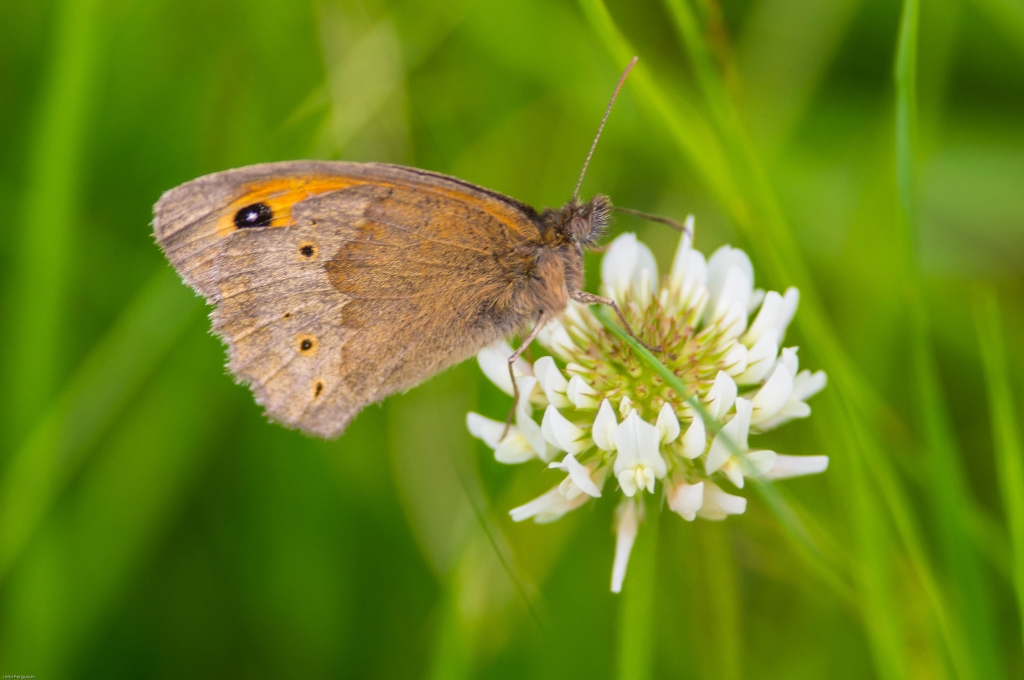
This fine picture of a Meadow Brown butterfly on a clover flower was taken by John Ferguson, who was at the Little Owls' tree with me.
There was a Blue-Tailed Damselfly on a blade of grass near the bridge.
The nest can't be seen, just the birds going in and out. It is in a hole in the middle of the raft which forms a small pool, and the grebes are getting to it by diving under the raft.
The Greylag family with nine goslings came ashore to graze.
The Mandarin duckling was by itself at the Vista, looking very adult now, though its wings are not yet grown to their full length.
It ate some Twiglets out of a vistor's hand. The tastes of park birds are very far from normal.
The Black Swan was again lying on the shore with the moulting Mute Swans. When he saw me he got up and trotted over to be given a biscuit.
The pigeon-eating Lesser Black-Backed Gull had almost finished his lunch when I arrived.
The young Grey Heron in the first nest on the island was stretching a wing, looking very old and tatty.
The House Martins at the Kuwaiti embassy were swooping around the building but seldom visiting their nest holes. Evidently many of their young have fledged and are flying around with them.
But a Pied Wagtail beside the Round Pond was still collecting insects to feed his young.
The Little Owl family near the leaf yard were having a lazy day. One of the owlets was yawning ...
... and its mother was asleep, and never woke up the whole time we were there.
This fine picture of a Meadow Brown butterfly on a clover flower was taken by John Ferguson, who was at the Little Owls' tree with me.
There was a Blue-Tailed Damselfly on a blade of grass near the bridge.
Tuesday, 21 June 2016
The second Grey Heron nest on the Serpentine island was very active, with both young birds flapping around. The one on the left has fully developed wings, but the other's flight feathers have not yet fully emerged from their wrappings, which can be seen at the base of each feather.
Four herons were chasing each other around on the grass between the Serpentine Gallery and the bridge.
The Black Swan has been unusually quiet over the past few days, lounging around with the Mute Swans near the bridge, although he has finished moulting and regrown his flight feathers while the other swans are still in the middle of the process. Perhaps months of aggression have secured him a place high up in the pecking order and he is content with that.
At the far end of the crowd of swans, below the Triangle car park, things were much less peaceful. There is a very aggressive swan that has been chasing the others around for several days. It had driven another swan on to the shore, and then came ashore itself and attacked it again.
The Greylag Geese still have all their nine goslings, and in fact there has only been one casualty amid all four families. This is in spite of the many irresponsible dog owners who break the law by allowing their pets to chase the wildfowl.
The mixed brood of the Canada Geese remains mysterious. You can see that the three small goslings in the middle have mid grey legs, while the one on the right has the black legs of a Canada. Are the small goslings Greylags or perhaps hybrids?
On the little island in the Long Water, a Coot was posing proudly beside its latest acquisition. This ball had been stuck in the reeds on the far side of the island, and there is no way it could have drifted in by accident. The Coot must have dragged it out and pushed it over.
The young Moorhens at the east end of the Serpentine have turned brown. It is remarkable how they are hatched black, turn brown as teenagers, and then go almost completely black again as adults. The bird is beginning to get adult colours on its bill and legs.
The young Magpies are still chasing their parents around flapping and calling to be fed.
Someone had, rather oddly, dropped half a birthday cake on the grass at the Vista. Some Feral Pigeons were warily circling it at a distance, uncertain whether it was edible or not. In the end they wrongly decided that it wasn't, and flew away.
The Reed Warbler in the flowers and shrubs between the Lido restaurant and the Diana memorial was flying around and singing, but never stayed still for a quarter of a second and was impossible to photograph. But I did get a slightly longer glimpse of another one singing in the reeds.
The Little Owls were also being difficult. Only one was visible, in the chestnut tree just uphill from their nest tree. When it looked over its shoulder it was clear that this was the male adult.
Four herons were chasing each other around on the grass between the Serpentine Gallery and the bridge.
The Black Swan has been unusually quiet over the past few days, lounging around with the Mute Swans near the bridge, although he has finished moulting and regrown his flight feathers while the other swans are still in the middle of the process. Perhaps months of aggression have secured him a place high up in the pecking order and he is content with that.
At the far end of the crowd of swans, below the Triangle car park, things were much less peaceful. There is a very aggressive swan that has been chasing the others around for several days. It had driven another swan on to the shore, and then came ashore itself and attacked it again.
The Greylag Geese still have all their nine goslings, and in fact there has only been one casualty amid all four families. This is in spite of the many irresponsible dog owners who break the law by allowing their pets to chase the wildfowl.
The mixed brood of the Canada Geese remains mysterious. You can see that the three small goslings in the middle have mid grey legs, while the one on the right has the black legs of a Canada. Are the small goslings Greylags or perhaps hybrids?
On the little island in the Long Water, a Coot was posing proudly beside its latest acquisition. This ball had been stuck in the reeds on the far side of the island, and there is no way it could have drifted in by accident. The Coot must have dragged it out and pushed it over.
The young Moorhens at the east end of the Serpentine have turned brown. It is remarkable how they are hatched black, turn brown as teenagers, and then go almost completely black again as adults. The bird is beginning to get adult colours on its bill and legs.
The young Magpies are still chasing their parents around flapping and calling to be fed.
Someone had, rather oddly, dropped half a birthday cake on the grass at the Vista. Some Feral Pigeons were warily circling it at a distance, uncertain whether it was edible or not. In the end they wrongly decided that it wasn't, and flew away.
The Reed Warbler in the flowers and shrubs between the Lido restaurant and the Diana memorial was flying around and singing, but never stayed still for a quarter of a second and was impossible to photograph. But I did get a slightly longer glimpse of another one singing in the reeds.
The Little Owls were also being difficult. Only one was visible, in the chestnut tree just uphill from their nest tree. When it looked over its shoulder it was clear that this was the male adult.