Wednesday, 7 January 2015

As I passed the Round Pond on my way to the Tawny Owls' tree, a Jackdaw saw me from 200 yards away and flew over and plonked itself down in front of me, demanding food. It was followed by another. These birds are getting very familiar.


The male Tawny Owl was in his usual place, looking up in annoyance as a Jay screeched at him from an upper branch.


The Coal Tit that came to my hand in the leaf yard has not been there for three days, and there are only the two that need to be given food on the fence. This is one of them.


When the tame Coal Tit appeared in the leaf yard, the one at Rima disappeared, and I think they are the same bird, and that it has moved on again since. These tiny birds move around quite a lot, tagging along with flocks of Long-Tailed Tits as they range all over the park and the adjacent streets.

There was a flock of Long-Tailed Tits working its way along the path on the east side of the Long Water. They are extremely agile among the twigs in spite of the length of their tails.


A couple of Coots were fighting at Peter Pan. They were not using the ordinary jumping and kicking strategy, just seriously trying to drown each other.


A female Pochard regarded them impassively. She is elegant in an understated way, with a beautiful fine pattern.


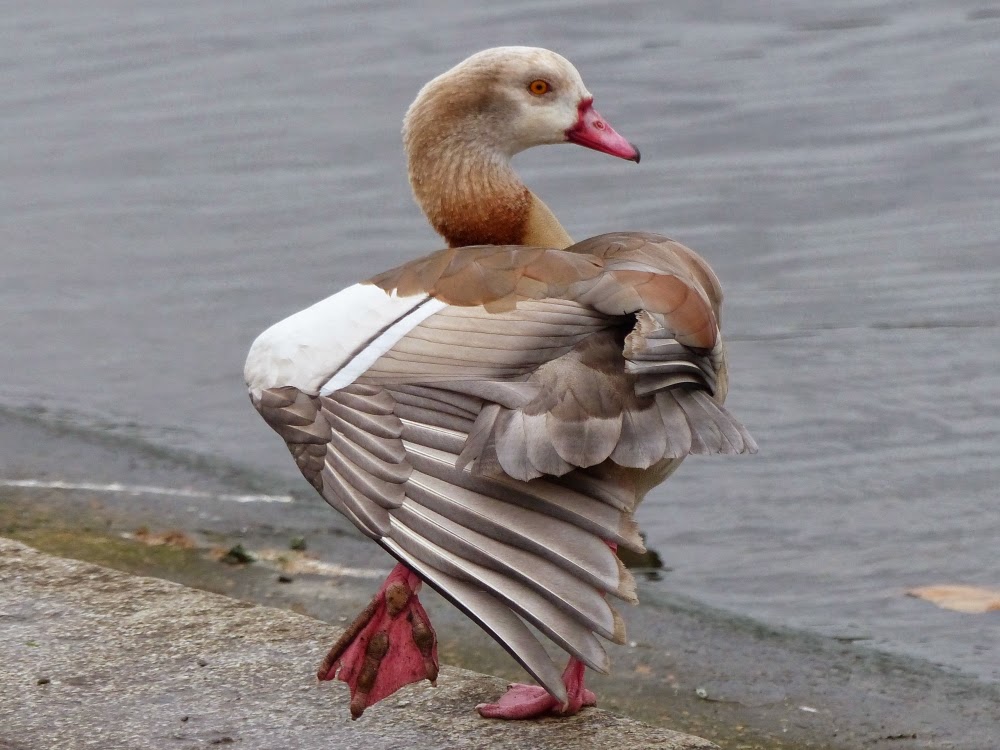
Blondie the Egyptian Goose was in her usual place at the east end of the Serpentine, giving a spirited performance of the Fan Dance.

A pair of Lesser Black-Backed Gulls were hunting for worms in the Diana enclosure. This place is also popular with Herring Gulls, which do their worm dance, pattering their feet to imitate the sound of raindrops to bring up the worms. But the Black-Backs were using the much cruder technique of ripping up chunks of turn and looking for worms in them.


It didn't seem to be as effective as the dance. They should copy their cousins.

Tuesday, 6 January 2015

Inside the fence of the funfair, which is being laboriously and noisily dismantled, a Blue Tit was singing, just audible over the noise of the trucks. It was hanging upside down at the time, which didn't affect its voice.


This was the first Blue Tit I have heard singing this year, but the Great Tits started a few days ago. This one was in full song on the east side of the Long Water until I arrived, when he and his mate came down for a snack.


Two Coots on the Long Water were alarmed as a balloon drifted rapidly past them in the stiff breeze, and retreated to a safe distance.


That isn't always the reaction of Coots. A few years ago, in spring, I watched one trying to fix a shiny silver helium balloon to its nest as an ornament -- picture here.

Under the willow tree near the bridge, a female Mallard was minding her own business when she was suddenly showered with water.


It was a Moorhen washing itself impolitely near. She turned and pecked at it, and it fled.


The pigeon-eating Lesser Black-Backed Gull (note his distinctive deep yellow legs) was hanging around near the Dell restaurant as usual, and though there was disappointingly little action it gave me a stare. From the small amount you can see of its eyes in this position, you would think that its binocular vision was not too wonderful, but it must have some to be able to fly and land with superb accuracy and to peck at things.


The male Tawny Owl was not there when I passed his tree the first and second time, but the third time was luck, and there he was at 3.35. By then the sun had come out and there was still enough light for a reasonable picture.


Ten minutes later the rays of the setting sun picked out a Shoveller and a Pied Wagtail at the edge of the Round Pond.

Monday, 5 January 2015

Just a day after I wrote that we hadn't seen the adult Great Black-Backed Gull for some time, there it was opposite Peter Pan, huge, dark and fierce. They are much blacker than Lesser Black-Backs, which seldom go below charcoal grey.


The water just offshore was a mass of ducks, although no one was feeding them. Most were Pochards ...

... and Tufted Ducks ...


with a few Mallards and a separate group of Shovellers revolving at the far end. The Red Crested Pochards were absent, as they have taken to living around the Serpentine island.

But that was all. A few years ago we had regular visits from Teal, Wigeon, Garganey, Pintail and Goldeneye, which were probably strays from the London Wetland Centre, but I haven't seen any of these for a long time. Still, it is good that there is no sad captive wildfowl collection on the lake, and any bird is there because it wants to be.

The seven young Mute Swans from the Long Water can't go near their father any more because he will chase them off. They were circling on the other side of the bridge in a foul mood with their wings raised to threaten everything in sight.


But at least he hasn't driven them right off the lake yet. When he and his mate nest in the spring, last year's young will probably be banished to the Round Pond, home of low-status swans.

A Great Crested Grebe fishing nearby gave me a severe stare.


This Grey Heron at the edge of the Lido reed bed looked quite decorative in a Japanese print sort of way..


On the path near the bridge, a couple of Magpies had made quite sure that a sandwich bag was empty, and were amusing themselves by ripping it to shreds.


The male Tawny Owl didn't come out to his usual place till after 3 pm, but at least there is a little more light at that time now.

Sunday, 4 January 2015

The Great Black-Backed Gull was paying one of its periodic visits to the Long Water. Here it is playing with a twig while a Black-Headed Gull passes in front. The perspective reduces the apparent difference in size between the small gull and this huge creature.


It is always the same Great Black-Back, very conspicuous as it slowly changes into adult plumage. Where does it spend the rest of its time? We used to be visited by an adult as well, but this has stopped coming.

When a Black-Headed Gull is standing on a post and a Moorhen wants it, normally the Moorhen strolls up the chain and the gull flies away at once. This gull stood its ground, and it was the Moorhen that had to climb down.


On Thursday I showed a picture of a Cormorant in breeding plumage with a great quantity of white feathers on its head. This one, which was at the island, is also in breeding plumage -- note the white thigh patches -- but its a much more normal example.


There was a large flock of Greylag Geese grazing on Buck Hill.


The Greylag population goes up in winter, and there is not enough grass next to the lake for them all, especially now that the east end of Hyde Park has been ruined by the funfair. So they look for other feeding grounds. The grass on Buck Hill is particularly good, since a large area had to be replanted a few years ago after it was wrecked by another of the commercial intrusions that now foul our park.

This Greylag with very bright orange feet was using a different feeding strategy. A woman was walking beside the lake, throwing bread around vaguely every now and then. The goose was running after her, scattering Egyptian and Canada Geese, children and small dogs in its headlong rush to keep up with her. It took a moment to trot down to the water for a drink to wash the bread down, frightening off a couple of Black-Headed Gulls.


The ring on its left leg is an ordinary BTO one. I couldn't read the number, because it ran off again immediately.

This Pied Wagtail was on the roof of one of the small boathouses looking for insects between the slates, but flew away as I approached. To my surprise, it landed on the edge of the Serpentine where hundreds of funfair visitors were milling around, as if it could sense that none of them could see it. The little black dots it is looking at seem to be in the air rather than the water. Are they very hardy small flying insects feeding on the detritus at the water's edge?


The male Tawny Owl was in his accustomed place, looking magnificent but sleepy.


This is the Elephant Tree, a beech on Buck Hill, on the edge of the road a hundred yards from the allotment. For some time I have been looking for the light that brings out the elephants, and a grey soggy day seems to do it best.

Saturday, 3 January 2015

The persistent drizzle didn't bother the male Tawny Owl, who was in his usual place on the horse chestnut tree,  his feathers beaded with raindrops.


And Great Crested Grebes remain warm and dry even when the water is streaming off their outer feathers.


But the rain does keep away people, and that allowed a Pied Wagtail to have a free run along the edge of the Serpentine.


Between the small boathouses, two Grey Herons were having one of their standoffs, chasing and shrieking and jumping at each other.


Presumably this behaviour ensures that they have a large enough fishing ground, but the herons in Regent's Park, which are much more numerous, seem to be able to stand and fish quite close to each other without dissent.

The young Mute Swan is still in the Italian Garden pond.


It is not the first time that a swan, usually a young one, has taken up residence here. They seem to be able to get enough nourishment from the algae in the pond, at least for a while. And they can leave when they want to, though I have never seen how they do so. They are capable of taking off from land, though only just and it is clearly a strain for them.

This is an immature Shoveller drake, seen at Peter Pan. His plumage still has traces of the juvenile barred pattern, similar to that of a female.


A Mistle Thrush was hopping around Buck Hill. This picture shows the typical pattern of spots, which are pointed and arranged in longitudinal rows at the top, but lower down become rounded and horizontally organised. Song Thrushes have pointed longitudinal spots all the way down.


The reliable Green Woodpeckers were on the Archery Field.


They seem to be there every day now except during archery practice, when they understandably move into the bushes behind the Orangery.

Friday, 2 January 2015

The sunshine had started a Great Tit singing near Queen's Gate and a Song Thrush near the Orangery, both of them out of sight but a welcome foretaste of spring. And one of the Coal Tits in the leaf yard came to my hand to feed for the first time.


It has taken several months for this shy little bird to pluck up courage, but it will get more food now as it doesn't have to compete for a place on the railings. The other Coal Tit is still holding out but now I think it is only a matter of time before it too comes down.

A Blackbird in front of the Rima relief was doing very well unaided.


Apart from this worm, he was clearly getting insects out of the leaves with great ease. This area is usually not excessively tidied up, which of course is very good for Blackbirds and other birds that forage in leaf litter.

A dozen Shovellers were revolving in front of Peter Pan.


There were more elsewhere on the Long Water, and some at the Serpentine island, and more on the Round Pond. There must be about 50 in all, a better total than last year when the most I ever saw was 12. But in some years there have been over 200.

There are also plenty of Pied Wagtails to be seen in various places, perhaps because the funfair has driven them off their home on the Parade Ground -- though I did see one passing overhead in this area. Here is one in its usual hunting ground on the Lido jetty.


And here is another sprinting over the lawn in front of the Orangery with that athletic long stride.


Some Starlings were washing on the edge of the Round Pond ...


... and so were the six young Egyptian Geese.


The male Tawny Owl was in his proper place on the horse chestnut tree.


No one has seen the female for a long time. Can they have started nesting early this year? They have been known to begin in late December.

Thursday, 1 January 2015

A very happy New Year to all readers.

It would not be a proper New Year without a glimpse of the male Tawny Owl, who came out to his usual place around 2 pm, when the light was beginning to fail on a dark grey day.


Apart from that there was nothing unusual to see, and the light was so dim that it was only possible to photograph birds out in the open.

The Cormorant with the brightly coloured face which I photographed in the water yesterday came out on to a post, revealing that it was in full breeding plumage, as shown by the white patches on the thighs. All the other Cormorants on the lake today are still in their ordinary dull winter plumage.


A pair of Great Crested Grebes across the lake from Peter Pan are not only in full breeding plumage but displaying to each other. Naturally I hoped they would do their dance, but after a couple of minutes of the preliminary display they lost interest and swam off side by side. If they are going to dance they swim off in opposite directions before diving and collecting a bit of weed to wave.


A Grey Heron was preening on the fallen horse chestnut tree in the Long Water, a common sight but an elegant one.


The two hundred or so Starlings that scavenge food from the funfair always operate in a flock. They gather in a tall plane tree overlooking the enclosure, fly in together, grab what they can get and return to their tree.


I went to the Round Pond to check on the Egyptian Geese. There have been no further casualties. Here are four of the six young ones.


A Pied Wagtail was investigating the grooves in the wooden platform in the pond.


Anything with fissures in it may harbour insects. I saw a Grey Wagtail working over the grooved wooden deck of the electric boat moored at the island, but it was too far away for a picture.

For several days a Wren has often been visible in the Flower Walk, at the place where the path from Queen's Gate crosses it.


Apparently this place has a name, 'Snobs' Crossing', but no one uses these old names any more, if they ever did.