Tuesday, 14 October 2014

The Ring-Necked Parakeets have discovered that the seeds in the long pods on the catalpa trees near the Italian Garden are edible. They have been pulling the pods off the tree and opening them on the ground. When Eleanor Culver passed by, she found a whole group of them and took this striking picture.


When I came past there were only two, but I got a close shot of how they hold the pod with one foot to rip it open.


There are reports of large numbers of Redwings arriving in London, so I looked over the south end of the Parade Ground and the Archery Field north of Kensington Palce, which are their favourite spots in the park. No sign of them, but on the Archery Field there were two Mistle Thrushes, a pair of Pied Wagtails, half a dozen Magpies and a Green Woodpecker, all hunting for small creatures in the grass.


Later the wagtails flew to the lawn behind the pond in front of Kensington Palace, where there is a rather odd-looking statue of Queen Victoria sculpted by her daughter Princess Louise. Here is the female of the pair having a stretch.


A flock of Long-Tailed Tits flew by on the south side of the Serpentine. A couple of minutes later there were loud purring calls from the top of a willow tree. One of them had not been paying attention and had been left behind, and was calling to re-establish contact with the flock.


Long-Tailed Tits constantly utter their si-si-si flight call as they move through the trees, so that they keep together. They usually make the purring call when perched.

The male Little Owl was in his favourite place in the pair's nest tree.


The male Tawny Owl was in his almost invisible place in the beech tree when I first passed, but later he moved on to the nest tree and settled down in his favourite place on the broken trunk, above the hole where they nest.


This owl is already famous, but now another of the park birds has become a celebrity. The pigeon-eating Lesser Black-Backed Gull has made it into the papers. Here is the Daily Mail's quite full account of his activities. It is not too sensationalist as newspaper stories go, because I sent the journalists a carefully written email, from which they cut and pasted chunks.

Today the gull himself was sitting on the roof of the Dell restaurant, looking for his next chance.

Monday, 13 October 2014

A wet day on the Serpentine doesn't bother a Red Crested Pochard.


The Little Grebe on the Round Pond is even more waterproof.


It may seem odd that such a fluffy bird should stay dry when diving, until you realise that when it is in diving trim, its outer feathers are clamped down, compressing and covering the fluff. If you look carefully at a Little Grebe diving, you can see it becoming smaller an instant before it submerges.

The eight young Egyptian Geese on the Round Pond are still in good order, and their parents were leading them over the newly laid tarmac to browse on the grass.


(I am deliberately not calling them 'goslings'. The Egyptian Goose is somewhere between a goose and a duck, and its nearest native British relative is the Shelduck.)

The young Grey Wagtail was searching for insects among the autumn leaves at the Lido.


The unattached Mandarin drakes at Peter Pan are still hoping to seduce the solitary female, but she stays close to her mate and he jealously defends her honour.


The abandoned Coots' nest near the Italian Garden makes a good fishing platform for a Grey Heron.


A proud moment: this young Great Crested Grebe, alone at one of the wire baskets near the bridge, has just caught a fish by itself.


The male Little Owl was sitting out in the rain in his usual place in the nest tree.


One of the Tawny Owls was also just visible in the beech tree next to the pair's nest tree, but too obscured by leaves to make a picture possible.

Sunday, 12 October 2014

Most of the large colony of Egyptian Geese at the Round Pond had moved down to the Serpentine, perhaps disturbed by the half marathon this morning. They were being their usual noisy selves all over the Lido and the Diana fountain. Here are a couple displaying.


The family on the Round Pond had remained, of course, and they still have their eight young.


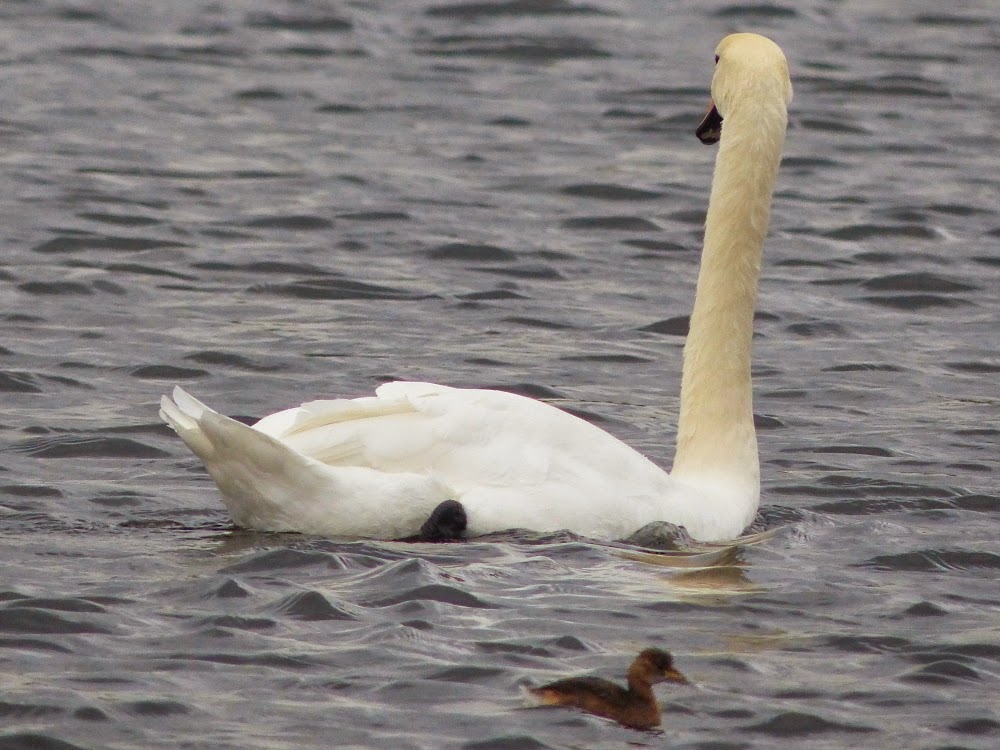
The Little Grebe is still there too. Here it passes a Mute Swan, which shows how very small Little Grebes are -- they weigh just 5 oz or 150 g. Luckily the swan was looking the other way, or it might have pecked at it.


A Cormorant was fishing inside the submerged semicircular stone wall under the marble fountain of the Italian Garden. This confined space holds large quantities of fish, which like the shelter of the wall and the iron gratings overhead. But that doesn't save them when the grating is broken and a Cormorant can dive in.


Both Little Owls were visible, one in each of the two chestnut trees they use. This is the male owl.


He was moving around restlessly because there were two Carrion Crows and some Jays in his tree, though they didn't actually molest him while I was there. The female was taking no chances in her tree, and was almost invisible among the leaves.


One of the Tawny Owls was also poorly visible in the beech tree next to their nest tree, so I don't know which of the pair it was, probably the male. In fact I missed it when I went past the tree first time, but luckily met Wendy, who writes the excellent blog Wino Wendy's Wildlife World, and she pointed out the place to me.


Speaking of owls, the big wooden owl which for many years was an ineffective pigeon scarer on the loggia in the Italian Garden now seems to have become the figurehead of the electric boat on the Serpentine. It is meant to be an Eagle Owl, I think, but is badly discoloured by decades of London soot and needs cleaning and repainting.


Just one autumn migrant: a Meadow Pipit passed over Kensington Gardens.

Saturday, 11 October 2014

The brood of eight Egyptians on the Round Pond is still intact, and their parents had sensibly taken them away from the Saturday crowds to the fenced-off area at the edge of the pond where the path is being resurfaced.


The Little Grebe is still there, fishing around the wooden platform. I am not sure whether I can see traces of juvenile markings on its head, but this picture gives quite a clear image of the side of its face where they would be.


A party of Mute Swans was taking off, not going anywhere in the end but just indulging in high spirits.


On the Long Water, a Great Crested Grebe had caught a fish along with a tangle of weed which had to be shaken off before the bird could give it to a chick.


The teenage Moorhen at Peter Pan was amusing itself by climbing nimbly around chains and fallen branches.


The male Tawny Owl came out on top of the nest tree to oblige numerous weekend visitors. He doesn't mind people or cameras or binoculars; he has seen it all before. There is sometimes a full-scale game of football with cheering spectators a few yards from his tree, which he sleeps through peacefully.


The male Little Owl was also out on his nest tree, mildly interested in the crowd of spectators below him.


Two Grey Wagtails flew overhead at the Lido, but wouldn't stop for a picture.

Friday, 10 October 2014

There has been a Little Grebe on the Round Pond for several days, fishing around the wooden platform with a solar panel on it. The platform provides shade, which makes the fish cluster under it, and also gives the grebe a place to huddle against. They like to be near the edge of the water and to have something to hide under. In fact it's a mystery why they go to the very exposed Round Pond at all. But they have been here in previous years.


This is not the Little Grebe occasionally seen on the Long Water. It's quite young and still has faint traces of its juvenile black and white face.

The eight young Egyptian Geese on the Round Pond were being hustled into the water by their parents as yet another irresponsible dog owner let two spaniels run at the birds.


There are now so many Cormorants on the Long Water that they have run out of perches on the posts, and have started using the fallen horse chestnut tree as well.


Three Grey Wagtails flew on to the dead willow tree near the Italian Garden. This is the familiar young one, well camouflaged against the grey bark and yellow lichen.


I think the other two were its parents, but couldn't get a clear sight of them before they all flew away.

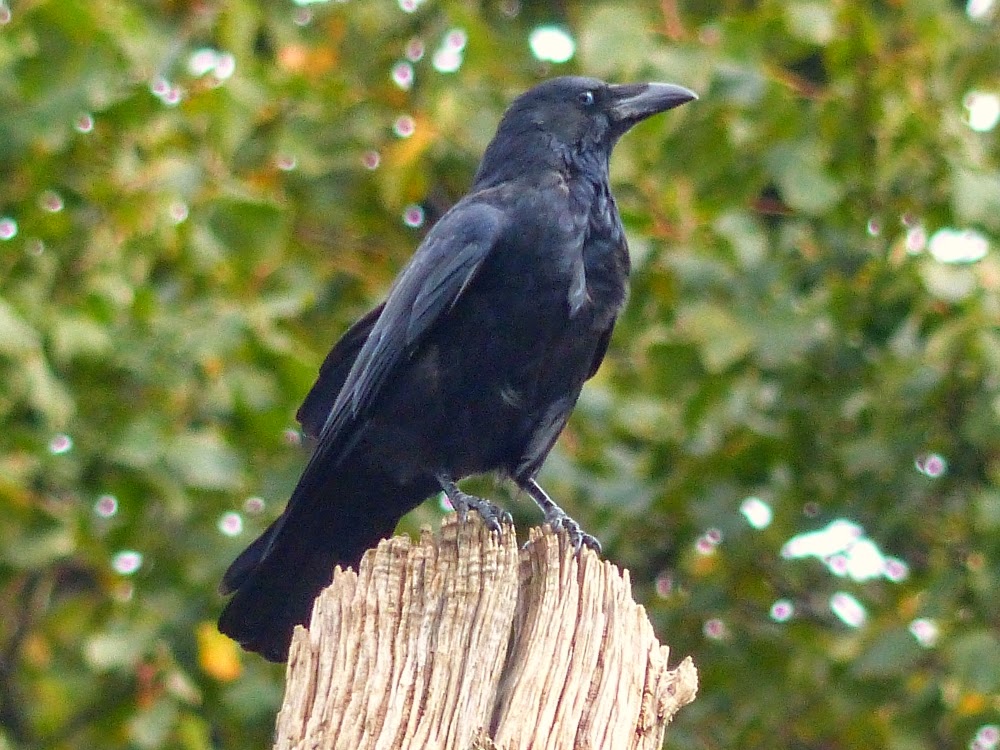
The usual Carrion Crows came down to the Italian Garden. This one is Charlie and Melissa's youngster Kevin, who has won two digestive biscuits. They need to be the original kind -- crows don't like supermarkets' own brand digestives, which are dry and hard.


On the Serpentine near the island, a Great Crested Grebe and a Coot were having a standoff.


And a Black-Headed Gull was playing with an autumn leaf.


The male Tawny Owl came out in his nest tree, and both the Little Owls in theirs, but I had to go home early and missed them.

Thursday, 9 October 2014

Four Mandarin drakes were chasing a female, and each other, on the Long Water. They seem to be unusually boisterous this year. Evidently there is a surplus of unattached males and finding a mate is difficult.


There are lots of Cormorants, both here on the Long Water and on the Serpentine, and more flew overhead, their direction suggesting that they were going from Battersea to Regent's Park.


It was a windy day. As soon as this Moorhen turned the wrong way it was transformed into something resembling a feather duster.


I think that the two Shovellers in the background are drakes coming out of eclipse, and the one in the foreground is further ahead with the transformation, with only a few speckled feathers on his white front and brown sides. They are feeding under the dead willow tree near the Italian Garden.


Just up the path, Charlie, Melissa and Kevin, the Carrion Crows, had turned up to beg for peanuts. They were followed by a bunch of Magpies trying to grab their food. Here six of them are watching for Charlie to make a wrong move.


Magpies are always on the watch and don't miss anything. They are also lightning-fast and frequently beat Crows and Jays to food.

The Nuthatches were out in the leaf yard again, running up and down the branches with their long hooked claws.


The male Tawny Owl was on the beech tree nest to the nest tree, in exactly the same place as yesterday.


The male Little Owl stayed inside his nest tree till the wind died down a bit, then emerged to stand in the rain.


Virginia Grey reports that a pair of Egyptian Geese on the round pond have just hatched eight young. These African birds don't understand the northern seasons, and breed at unpredictable times.

Wednesday, 8 October 2014

After yesterday's episode of the Lesser Black-Backed Gull catching a Feral Pigeon, we really didn't expect to see it again. But as we approached the Dell restaurant, there he was, bloody, bold and resolute, stalking pigeons on the shore. Camera ready, set to 1/2000 second just in case, and just as we arrived the gull ran and pounced again. This is the moment he seized his victim.


Having got a good hold, he wheeled round and trotted off to the lake to drown the struggling pigeon.


When he was in the water two Coots, seeing the struggle, decided to join the fight.


But the gull brushed them off, and soon there was a dead pigeon and his mate turned up to share it with him. This gull has been taking pigeons for about five years now, and has got very good at it. But I am surprised that so far none of the other Lesser Black-Backs or Herring Gulls has managed to copy it, as usually successful feeding behaviour spreads quickly among these intelligent birds.

A pair of Nuthatches came down to take food off the railings of the leaf yard. They were picking up pine nuts three at a time and bearing them off to a secret store.


But then a Jay came down, ate the remaining pine nuts and stared at me expectantly, wanting more. I gave it a peanut in the shell to keep it busy.


The male Tawny Owl was in the beech tree next to the nest tree, well hidden among the leaves. The first time I saw him it was raining torrentially, but when I went back the sun was out and there was a chance of a better picture.


The male Little Owl was also out in his nest tree, and had found a pleasant spot in the sun with a leaf to shade his eyes.