Friday, 19 July 2013

A very quiet day. There was just a glimpse of a Hobby passing overhead through the trees. The Kingfisher previously seen at Peter Pan didn't appear, but everyone who watches Kingfishers knows that you can't just go and see them: they appear magically when least expected. However, a look into the water at Peter Pan showed why they had regained interest in this spot. These abundant young fish are about two inches long, just the right size for a Kingfisher. This picture shows them at about life size.


A pair of Coots nesting in the reed bed at the Italian Garden have brought out two chicks.


These are the Coots that had a long-running territorial dispute with the Mute Swans that nested in these reeds earlier, which of course they lost to the larger birds. But as soon as the swans were gone they built their nest, and this is the result.

A Nuthatch came to peck bits of brazil nut out of the old chesnut tree near the leaf yard. It always lands near the top of the tree and walks down, because Nuthatches prefer to walk down trees, and are quite unconcerned about being upside down.


Treecreepers, on the other hand, walk up trees, and I have seen a Nuthatch and a Treecreeper cross within inches without taking the slightest notice of each other. Both of them can run along the undersides of horizontal branches in their pursuit of insects in crevices in the bark.

When the Nuthatch had gone, a Great Tit came for its share of the nut. It too was quite happy being head downwards on on overhanging surface, and you can see its strong little claws gripping the surface.


The Little Owl was heard calling in the usual sweet chestnut tree, but was impossible to see. It seems to have found a perch out of sight of the ground, perhaps not surprising after so many people have pointed binoculars and cameras at it.

Thursday, 18 July 2013

There was a Grey Wagtail hunting insects over the Long Water, the first seen for some time. I was wondering where they had got to. They are usually seen on the edges of the Serpentine. This one is female; males are more extensively yellow on the underside.


At least one Kingfisher had also returned to the Long Water. At present it is in the Kingfishers' usual place, which makes it hard to see and impossible to photograph. It has two stations, one in a bush on the shore to the north of Peter Pan, beyond the line of posts, and the other directly opposite on the other side of the lake. You would expect to be able to see it in the second of these spots by examining the bush with binoculars. But evidently its perch is masked by a branch because, as far as I know, no one has ever managed to spot it.

The crayfish in the lake have now grown to a substantial size. This one-clawed specimen found by the people at Bluebird Boats is at least 10 inches long, not counting the antennae.


It is a Turkish Crayfish, Astacus leptodactylus. The boat people have also found American Signal Crayfish, Pacifastacus leniusculus, which can grow to a formidable size. Both these species have been introduced to British waters and have become an invasive nuisance, gradually wiping out the native White-Clawed Crayfish, Austropotamobius pallipes.

There is a new family of Egyptian Geese at the Serpentine Island, but sadly their mother doesn't seem to take much care of them. Immediately after I took this picture she started a quarrel with a Greylag Goose and left her young unattended in open water for several minutes.


Carrion Crows, on the other hand, are attentive parents. Here two of a brood of three are pestering their parent, left, for food, and getting it.


They are on the marble fountain in the Italian Garden. All the fountains are off today. The new machinery which was put in to work the fountains when the Italian Garden was restored don't seem to be nearly as reliable at the old ones, and constantly fails.

Wednesday, 17 July 2013

There were more Cormorants on the lake today.


Evidently news is getting out that there are plenty of year-old fish. These could be seen in some numbers at the east end of the Serpentine, where there were also several Great Crested Grebes busily hauling them out.

This one, having eaten enough for the time being, came to the edge of the Serpentine for a bit of preening. Here it lifts a wing to extend its leg, which had been getting cramped by being folded up. Like many water birds, grebes swim with one leg when they are not in a hurry.


A pair of Common Sandpipers had been reported flying over Hyde Park this morning, so I went round the lake to see if they were on the shore, but they weren't.

I also checked the Round Pond, with equal lack of success. The pond is now a mass of green algae, which are beginning to die and stink, providing ideal conditions for a growth of blue-green algae, which smell a lot worse and are also toxic. There are a lot of insects on the rotting mass, which in turn have attracted a good crowd of Swifts. Here are some making a mockery of the lumbering form of a Boeing 767 going to land at Heathrow.


New broods of Mallard ducklings have appeared on the Round Pond and the Serpentine, as well as on the Long Water. There are still not many big gulls -- indeed there were none at all on the Round Pond when I was there -- so it seems likely that a higher number than usual will survive.

The six young Egyptian Geese at the Round Pond are also in good order.

Here one of the three young Greylag Geese from the first brood hatched this year stretches a well developed wing. It is nearly time for their first attempts at flight.


There were also several adult Greylags doing practice runs down the lake to try out their newly regrown flight feathers.

Tuesday, 16 July 2013

On a hot afternoon, a Feral Pigeon was cooling off by taking a shower in the shade of a bush in the Flower Walk.


The Coot chick in the nest near Peter Pan was sheltering in the shade of its mother.


But these Moorhen chicks in the Italian Garden pond were sitting unconcernedly out in full sunlight, with their extraordinarily large feet stretched out in front of them.


They are resting on their tarsi, the joint that corresponds to a human heel. If a human were in this position, he would be standing up, but for a Moorhen it is sitting down.

There were three Hobbies calling in a tree on the Serpentine island, on widely separated branches so it was possible to be sure of the number. I tried hard to see them with binoculars, but they were completely hidden by leaves. Probably they were on the sunny side of the tree, facing away from the shore. There are a lot of dragonflies over the lake, a favourite food of Hobbies.

Both the Great Crested Grebes' nests on the Long Water are still occupied, and we are all hoping that they succeed after so many false starts.

A few Cormorants have returned to the lake, a sign that there is still a useful quantity of medium-sized fish, as Cormorants don't bother to turn up if there is nothing to eat. You often see single Cormorants flying over the park, and I sometimes wonder whether these are scouts, and will bring others if they find enough fish. Since Cormorants often fish in packs, it is not too fanciful to guess that this is so.

This butterfly is a Small Tortoiseshell, Aglais urticae, a common British species but none the less fine looking for that.


Urtica is Latin for nettle, so it is living up to its name by sitting on one.

Monday, 15 July 2013

The male Tawny Owl was calling from a horse chestnut tree west of the nest tree and across the path, and was answered by the female in the horse chestnut next to the nest tree. But both of them were impossible to see. The female Little Owl was seen for a moment yesterday in the usual sweet chestnut tree, but vanished into the hole before she could be photographed. Anyway, we know they are still around.

One of the Nuthatches came down to the sweet chestnut tree at the southeast corner of the leaf yard to pick peanuts out of a crack in the trunk. This is an easy way of getting photographs, and some might call it cheating.


It was joined by a young Great Tit which had just reached the stage of being able to look for food by itself. This bird also came to take pine nuts off my hand.


Other young Great Tits are still chasing their parents through the bushes, crying loudly to be fed.

The two young Pied Wagtails at the east end of the Serpentine are also foraging independently. The middle bird of the three is their mother, not as intensely black and white as a male. When one of them stopped looking for its own insects and appealed to her for food, she cuffed it away.


The solitary young Great Crested Grebe at the Serpentine island is still dependent on its parents, but is now diving to follow them when they are fishing, and staying down for quite a long time. It could probably now catch its own fish if it had to, though it takes the young birds several more months before they gain real skill at the hunt.

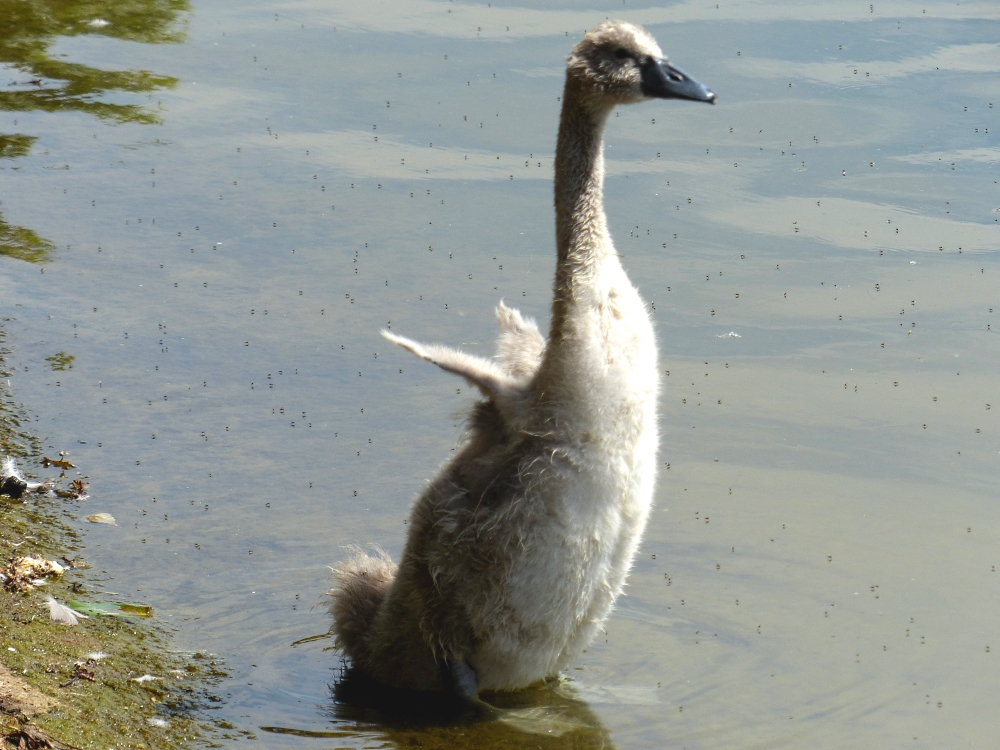
One of the four cygnets of a Mute Swan family on the Serpentine was preening itself and stood up to flap its absurdly small wings.


Young swans are not ready to fly until 4 or 5 months after hatching. Most of their parents are also earthbound at the moment, as they have moulted their flight feathers and not yet grown new ones.

As you can see in the background of this picture, the park is awash with small flies.

Sunday, 14 July 2013

Another Great Crested Grebes' nest is under construction on the Long Water, under the willow tree next to the bridge. This is the seventh grebe nest to be built here this year: the first was washed away by waves raised by a strong east wind, and all subsequent ones have been abandoned after a few days. Let's hope that this one finally succeeds. Here one of the birds brings an inconveniently large stick, far bigger than they usually use in their sloppy nests.


The other grebe nest on the Long Water is also active, and I saw both birds building it up.

There is another addition to the Greylag Geese on the Serpentine, just one brand-new gosling. As usual, its parents were looking after it attentively.


A little farther up the shore, a Greylag revealed an unexpected liking for ice cream. It emptied the cone without eating any of the boring wafer part.


Geese, of course, are not the only birds that like ice cream, and there are now many photographs of Herring Gulls snatching it from cones in people's hands in a Dutch seaside resort. I am told that the habit has now spread to some gulls in Britain, not surprisingly as gulls of all kinds regularly cross the Channel.

There was a Mute Swan on the Serpentine with an unusually black face. The area of black normally present at the base of the bill has extended to the bill itself. The rest of the swan was of a perfectly ordinary colour.


Two swan families, one with four cygnets and one with three, have been driven off the Serpentine by the hideous amplified racket of ten days of pop concerts. They had advanced some way up the Long Water, keeping into the shore on opposite sides, and both families were guarded by male swans in threatening attitudes. The resident pair, with one cygnet, had retreated up the lake and were also looking aggressive. I think that a fight, or at least a very angry display, must have taken place shortly before I arrived.

There were a few Swifts over the lake, the first I have seen here for a while. They were hunting at a considerable height, not bothering to come down for the millions of small insects swarming all over the water.

Saturday, 13 July 2013

A hot day with thousands of hot people milling around, and Hyde Park polluted by amplified pop music, the auditory equivalent of standing downwind from a pig farm. A lot of Greylag Geese had got as far away from the din as they could by moving under the bridge on to the Long Water. Other, less sensitive birds were putting up with it, such as this Grey Heron and Moorhen in the Dell.


The heron is probably wondering whether the other is small enough to swallow -- the answer is no, as I saw a couple of years ago when a Grey Heron actually tried to eat an adult Moorhen and couldn't get it down.

In a more peaceful spot on one of the ponds in the Italian Gardens, a Moorhen chick was eating algae. The chicks are now noticeably larger and have grown some preliminary feathers on their wings, so they look more like proper birds. The reptilian look of the young chicks is rather disturbing.


In the next pond, the female Mallard has still managed to keep three of her ducklings away from the big gulls. Here she is, panting with the heat but sheltering her young both from the sun and from predators.


A family of seven brand-new Mallard ducklings were swimming around near Peter Pan, only a few feet from two Lesser Black-Backed Gulls sitting on the posts. I didn't stay to watch the inevitable result. There are also five new young Egyptian Geese at the Serpentine island whose parents were not paying enough attention to them.

On the other side of the lake from Peter Pan, under a willow bush to the right of the line of posts, there is what looks like the first serious Great Crested Grebes' nest of the midsummer sitting. This distant shot is the nest is the best that I can manage. We shall have to wait to see whether the initiative is kept up, but there are certainly enough small fish now to feed a brood of chicks properly.