A strong wind grew stronger as the day went on, and by 3.30 people were staggering about trying not to be blown over. Shreds of cloud raced past the Albert Memorial in the fading light.
A Blue Tit ...
... and a Great Tit kept a firm grip with their strong little feet on a dogwood bush at Mount Gate.
A Jay perched on a branch above a mahonia bush.
Two Jackdaws searched for worms and insects among newly planted rose bushes in the Rose Garden.
The female Peregrine was on the tower, mostly staying at the back of the ledge out of the wind. This is a terrible picture, as the light was very dim.
The Lesser Black-Backed Gull pair on the Long Water are now usually seen on the raft.
The Grey Heron nesting on the island was presumably well down in the nest as the tree tossed in the wind, but all the other herons were staying well down. This one was on a post at the Vista ...
... and another was farther up the long Water on a branch of the fallen horse chestnut.
Two young Cormorants stood on another branch.
The female of the Great Crested Grebe pair that nested near the bridge was still looking elegant in her plain black and white winter plumage.
The dark male, which I think is one of the pair from the west end of the island, cruised under the bridge, causing a dispute with the resident pair.
A young grebe was peacefully fishing near the Italian Garden.
The Moorhen pair in the Dell stood on the edge of the stream.
The two young Mute Swans that flew on to the Serpentine were at the Dell restaurant hoping to be fed, but there weren't many visitors now that the Winter Wasteland is closed.
On Sunday I put up a picture of a squirrel sharpening its teeth on a piece of wood. Here is an aluminium sign which they have used for the same purpose, gouging out bits of metal.
Our alert readers will know that Metasequoia glyptostroboides is not a Water Fir, it's a Dawn Redwood.
A beautiful freestanding Oyster Mushroom on a fallen tree near the Henry Moore sculpture ...
... made Zaha Hadid's attempt at an organic form just up the hill look clumsy. I did try to photograph the building from its best angle.
The Blackbirds in the Rose Garden shrubbery are very shy and elusive, but I managed to catch a male when he came out in the open for a second.
A Robin was doing its best to be heard over the grisly Christmas songs coming from the Wasteland. But today is the last day of the funfair, and tomorrow the loudspeakers will be silent and the noise will come from enormous lorries hauling the dismantled rides and stalls away down the Serpentine Road. The vast mess takes weeks to clear.
This Robin was in a relatively peaceful place next to the busy road passing Mount Gate.
There was also a Blue Tit ...
... and I found a Coal Tit in the Flower Walk for the first time in months, perched in the corkscrew hazel bush. It must be a different one from the pair often seen here earlier this year, which have disappeared. It didn't want to come down to be fed: Coal Tits need a lot of reassurance before they will approach.
Not so Great Tits, which confidently dart out of the bushes everywhere.
I'm always happy to give peanuts to Jays, but it's good to see one finding a larva by itself.
The Peregrines were on the tower in the morning. I haven't seen them here for a while.
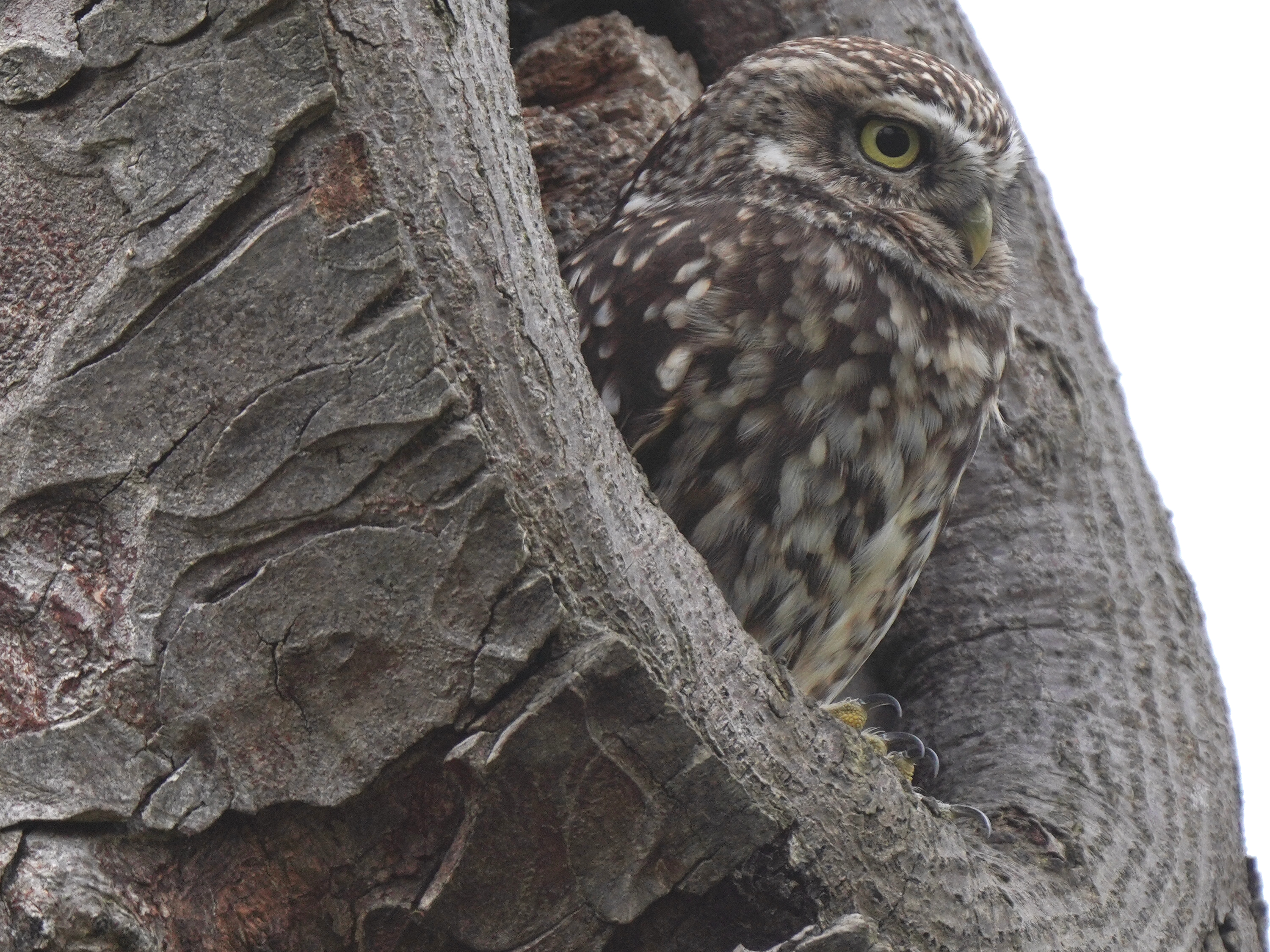
But there was no sign of a Little Owl at the Round Pond, and sadly I heard from Belinda that she had seen the intruding squirrel in the hole this morning. We may not make contact with these owls till the next breeding season. Well, we have had a very good run of sightings and I'm amazed it lasted so long.
One of the nesting pair of Grey Herons on the island waited to change places on the nest. When one is sitting in the nest it's often invisible from the shore, but continued activity shows that they're still going ahead.
A Common Gull perched on a plastic buoy at the Lido. When I went round the Round Pond yesterday I was surprised to find only a dozen Common Gulls instead of the expected 40 or 50. There are never many on the main lake, so it's been a bad year for them.
A second-year Herring Gull, beginning to get some light grey feathers on its back, played with a rotten conker it had dredged up.
The edge of the Serpentine by the Lido restaurant is screened from the terrace by a line of large planters, so birds can hunt for food undisturbed by humans. Here are a Pied Wagtail, a Dunnock and a Moorhen searching for small larvae.
One of the young Moorhens in the Italian Garden preened and stretched on the rail surrounding a planter.
A cluster of Coots collected in a patch of floating leaves under the terrace of the Dell restaurant.
The Great Crested Grebes from the bridge nest were at the Vista. They are recognisable because the male still has the very worn remains of his breeding plumage but the female is in plain winter black and white.
Two Gadwall drakes and a female pulled up algae in the shallows at the edge of the Serpentine.
Two Shoveller drakes and a female were also feeding in their own way.
The female Chaffinch from the Flower Walk, who usually doesn't venture far from home, came out with her mate and followed me up to the Round Pond, demanding pine nuts all the way.
The dominant Robin from the Flower Walk also came out. This Robin, which I photographed inside the walk, is one of several others along the path.
But when I got to the Round Pond there was no Little Owl to be seen, and she hadn't come into view when I went back later. I fear the squirrel which I saw in the hole yesterday has upset her domestic arrangements. But of course I will keep checking in case she returns.
A single Redwing could be seen in a tree near the Speke obelisk ...
... and a Blackbird hauled a worm out of a bit of bare ground.
Something in this patch of weeds and dead leaves below the Triangle car park was attracting a crowd of Feral Pigeons, but although I looked carefully at the place I couldn't see what.
A Magpie checked a clump of cut reeds in the Diana fountain reed bed. It pulled out stems, probably to see if there were any larvae clinging to them.
The mate of the nesting Grey Heron was waiting on a disused nest for its turn on the eggs, and decided to lie down comfortably to get out of the wind.
The old heron at the Henry Moore sculpture was standing next to the fence. It's been seen several times catching rats that carelessly look out of the undergrowth, but I don't know if this elderly and arthritic bird is still capable of it. It is still fishing, and people come and feed it to help keep it going.
The odd couple of a Herring Gull and a Lesser Black-Backed Gull, who have been together for several years, displayed and called on the edge of the Serpentine.
The pigeon eater had just caught a new victim when I arrived on his patch at the Dell restaurant.
The youngest Great Crested Grebe was fishing near the Serpentine outflow.
The gang of five teenage Mute Swans cruised up the edge. These privileged birds are going to have a rude shock in the spring when their parents start nesting again and throw them out.
A clump of dead irises in the Italian Garden, where on Thursday I photographed a Coot which had climbed to the top, had a pair of Mallards resting on it. They certainly flew to get there, as Mallards are useless at climbing.
The Dell, fenced off by railings, is the home of many kinds of birds. Here are a pair of Moorhens, which sometimes breed here; a Wood Pigeon; an Egyptian Goose, one of a pair that visit occasionally; some of the ubiquitous Carrion Crows; a young Grey Wagtail which was hatched in a nest under the waterfall; and a Grey Heron (the last two were filmed earlier).
The layout of the Dell as a carefully staged ideal landscape was the idea of Lord Redesdale (grandfather of the famous Mitford girls) who became Secretary of the Office of Works in 1874. The waterfall at the outflow of the Serpentine already existed, but he replanned the stream below to make it more picturesque and replaced the original scrubby undergrowth with lawns and subtropical plants. Here is a picture of the Dell around 1890, taken by an unknown photographer.
Today these plants have been largely replaced but there are still New Zealand tree ferns and other exotics at the top of the slope, and a Wollemi pine on the lower lawn -- which Redesdale could not have envisaged as this ancient tree, thought to be no more than a fossil, was only discovered growing in Australia in 1994. In the 20th century the waterfall was made a more prominent feature by adding an extra fall at the top, fed by an electric pump.
Here is a picture of the present view, taken by Virginia in the summer of 2018.
A squirrel sharpened its teeth on a bit of wood.
Rodents' teeth grow continuously and have to be ground down to keep them from getting too long. This sharpens them, as the enamel on the front of the tooth is harder than on the back so they wear to a chisel edge. Some of the aluminium signs on trees also show signs of having been gnawed by squirrels.
The sawn-off black poplar tree at Peter Pan has this handsome bracket fungus on it. At first I thought it was a clump of Oyster Mushrooms, which appear in different colours, but the scalloped edge shows that they are something else which I can't identify.
A very happy New Year to all readers, and may it be an improvement on the dismal showing of 2023.
A Pied Wagtail ran around on the rain-wetted edge of the Round Pond.
A Redwing perched in a tree, the only one I saw here.
A Jay dug in the grass. Was it looking for an acorn it had buried? Something scared it off before it came up with anything.
The Little Owl looked out of her hole for a moment. She seemed agitated.
When I had walked round the pond and passed by the tree again, it was clear why. A squirrel had got into the hole.
I'm not at all sure a Little Owl, however angry and defensive, could see off a squirrel. But owls have terrible claws and use them freely.
The Black Swan was on the gravel strip in the pond picking up dead leaves and throwing them around. This is nesting behaviour but I've seen other swans, including an earlier black visitor, doing it at idle moments without any intention of nesting.
There are now twelve teenage Mute Swans here of which only one hatched in the park. The others have all flown in at different times. You can see ten of them here.
One final picture from the Round Pond. The statue of Queen Victoria, made by her daughter Princess Louise, has been repaired. She has a new nose neatly joined to her face, and a new thumb to replace the previous repair, which had been attached on a metal pin and had come loose and revolved till it was facing the wrong way. She's also got her sceptre back, a separate piece which she had been unable to hold.
For a picture of the sad state of the statue before the repair, see my blog for 18 January this year.
A Goldcrest came down to drink from a puddle on the path around the Long Water ...
... a small flock of Blue Tits passed along the edge ...
... and a Green Woodpecker called from a tree on Buck Hill.
A Wren sang from the middle of a bush.
The pigeon eater's son (I'm pretty sure this quite large bird is male) hung around while his father was feeding, hoping to get a bit.
Coots often stand on the edge of the weir where the water flows out of the Serpentine. In previous years they have even built nests here, a terrible idea because the chicks get washed away the moment they leave the nest and can't climb up again.
Mark Williams went to see the Waxwings in Corinne Road near Tufnell Park Tube station and got a good shot.


%20killing%20pigeon%202023%203a.jpg)


%201a.jpg)




's%20son%20waits%20for%20father%20to%20finish%202023%201a.jpg)
%202023%201a.jpg)