Monday, 4 April 2022

Looking up

A Robin brought a couple of midges to its nest behind the Lido.


A Wren hopped around in a bush beside the Long Water.


The Song Thrushes at the Steiner bench were out looking for worms. I've never known Song Thrushes that were so easy to photograph.


A Magpie showed off its iridescent feathers in front of a red-leafed tree. I have not altered the colour in this picture at all.


The Tawny Owl had been sitting out in the morning drizzle, and was a bit soggy when I found him.


A young Herring Gull on the Serpentine found a stick to play with.


The Great Crested Grebe chick on the Long Water had to hurry to keep up with its parent.


The grebes on the new nest certainly have eggs, because one of them was carefully turning them over.


The grebes near the bridge were fishing. They dive so smoothly that they hardly make a ripple.


A Coot brought a bit of reed to the nest near the Italian Garden. Its elegance has been spoilt to our eyes by a plastic bag, but Coots find shiny things ornamental.


The male Mute Swan in the Italian Garden looked out from the marble fountain. Behind the right-hand nymph is his hated rival's nest.


Three swans flew past the Serpentine island.


Swans are very fond of young willow leaves. In a while all the weeping willows beside the lake will be eaten up to the maximum height a swan can reach.


Three fine pictures from Rainham Marshes by Tom: a male Sparrowhawk ...


... a female Bearded Tit ...


... and a Ruff.


And back to Hyde Park for two amazing fisheye lens images by Barry Jones, shot vertically upwards: daffodils beside the Serpentine ...


... and the weeping beech tree near the Rose Garden.

Sunday, 3 April 2022

A new site for a Great Crested Grebes' nest

A Coal Tit perched in a blossoming cherry tree at the back of the Albert Memorial.


This Chaffinch can usually be found there.


The Tawny Owl was having trouble with Jackdaws persecuting him, and had retreated into his hole.


The Jackdaws tired of making a racket, so he came out again to enjoy the sunshine and they left him in peace.


A female Magpie fluttered in front of her mate, imitating a young bird begging for food. She was making sure that he will feed her when she's sitting on the nest.


A Carrion Crow drank rainwater from a little pool in the trunk of the yew tree on the corner of the Dell.


A Wood Pigeon drank from the lake. Most birds would rather drink water from puddles rather than the borehole water in the lake.


Both the young Grey Herons were back in the nest. I think their parents have stopped feeding them here, but it's a cosy and familiar place for them.


The Great Crested Grebes on the Long Water had brought their chick to the fallen poplar at the Vista, a good fishing spot, to make feeding it easier.


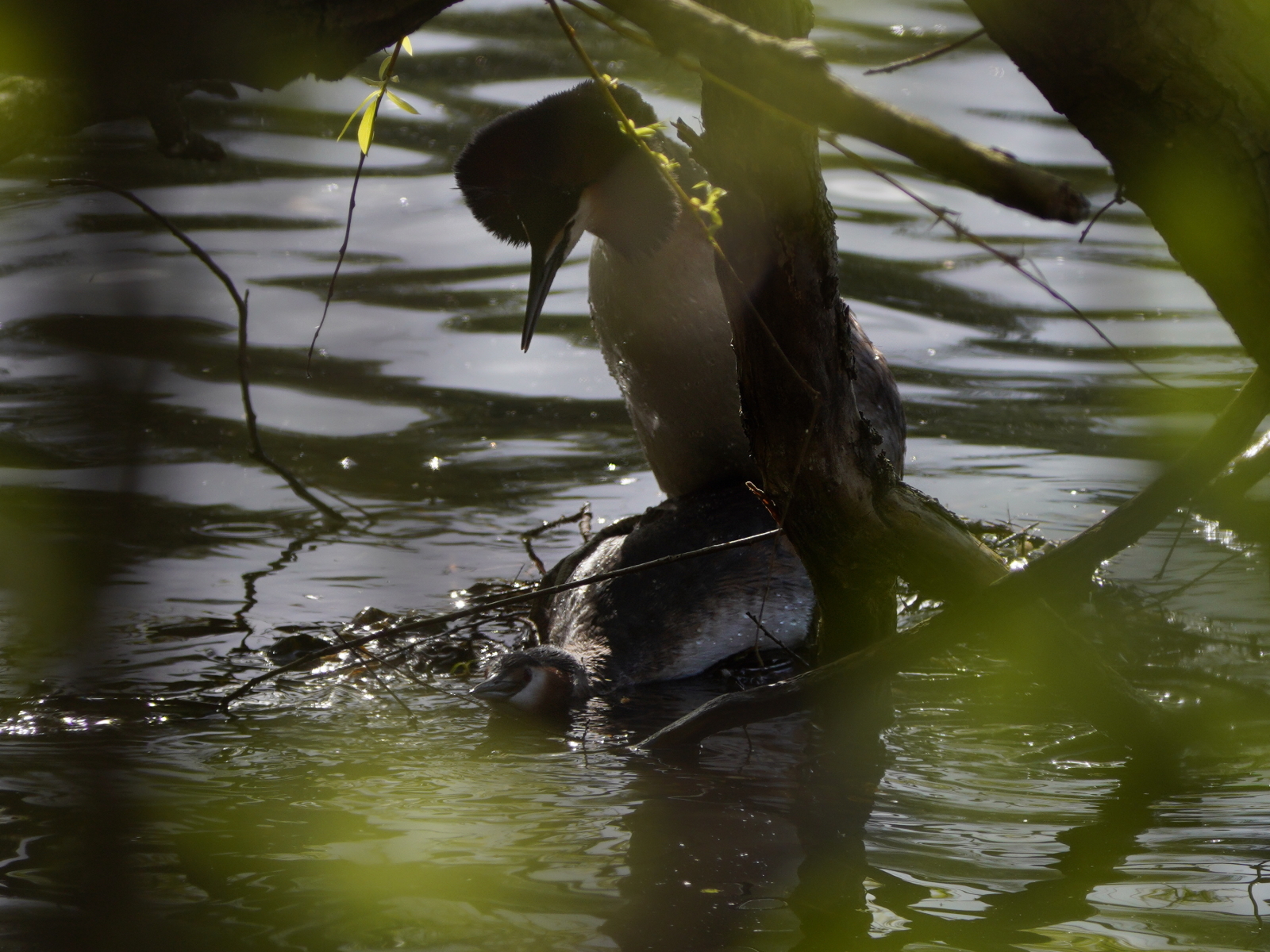
The plastic buoys marking the edge of the swimming area at the Lido often have Coots' nests in the gaps, but this is the first time I've seen Great Crested Grebes trying to nest here. The nest is the usual soggy grebe mess but strong enough for the pair to mate on.


When I passed by later a Coot had claimed the site. One of the grebes was calling for his mate so that they could evict the Coot.


Coots can build a nest out of any available material, including plastic bags and bottles. This well built nest on the dead willow near the Italian Gardens is made of reed stems which were lying around after the work on the Mute Swans' nesting island.


The swans nesting east of the Lido were busy making a nest in their own way, which means ripping down every plant in sight and making a haphazard heap. The male swan had difficulty getting a big stick through the gap in the netting.


Two Egyptians washed on the Serpentine. They are the pair with the blond male, whose goslings were sadly killed by eating poisonous plants in the Triangle car park.


I've spoken to Drew Love-Jones the Wildlife Office about this danger, and he is investigating. I think the plants are probably castor beans that have sprouted from suckers after a plant was used as the centrepiece in a floral arrangement a few years ago.

A pair of Mandarins washed and preened on the other side of the lake. The drake's magnificent plumage needs a lot of maintenance.


The dark Mallard on the Serpentine has a male companion but this one on the Long Water, which is certainly a drake, has a mate.


Wallflowers are coming out in the Flower Walk, though they have been blasted by last night's ground frost. They are popular with bees, and attracted a Southern Cuckoo Bee ...


... and a Hairy-Footed Flower Bee.

Saturday, 2 April 2022

Song Thrushes at work

The Song Thrushes were foraging in the dead leaves near the Rudolf Steiner bench beside the Long Water. They are safe behind railings and allow you to get quite close.


One of them found a worm.


A Wren sang on a twig near the Henry Moore sculpture.


The Tawny Owl was in his usual place, enjoying better weather than yesterday's.


One of the young Grey Herons also has a favourite place, a post at the Serpentine island where it is seen daily.


A Pied Wagtail hunted insects in the fallen plane tree fluff beside the Serpentine.


A Grey Wagtail visited the Italian Garden. They use the rails around the planters as a station when hunting flying insects.


There was also a pair of Mandarins in one of the fountains.


Another pair of Mandarins appeared on the Serpentine ...


... and there was a drake alone under the willow near the bridge. Probably his mate is nesting in a hole in the tree.


The Coot nest under the willow can just be seen from above, looking down from the parapet of the bridge.


A Coot, a Moorhen and a Mallard were nibbling at green shoots discarded after the celebration of Nowruz, the Persian New Year at the vernal equinox, which this year was 20 March . Sprouts (in Persian sabzeh) of wheat or another quick-sprouting plant are displayed on a table as part of seven things beginning with س (Haft-Sin, 'seven esses'). On the thirteenth day they are thrown into water, preferably running water -- the Serpentine can be said to have some kind of flow.


For several days the dark Mallard often seen on the Serpentine has been hanging around with a normal coloured drake. I've always supposed that this bird is male. Maybe they're just good friends.


The report of two Ring-Necked Ducks can almost certainly be dismissed. The person who reported them also claimed to have seen two Scaups. This is a common beginner's mistake when seeing a female Tufted Duck with a white patch on its forehead, not an unusual colouring.


I'm told that there was also a claim of Kittiwakes, a bird that has been seen in the park just once, in 1891.

The male Mute Swan on the nesting island glared at two Cormorants that had intruded on his territory.


The new Great Crested Grebe nest on the Long Water is always occupied. Evidently there are eggs.


The pair nesting under the willow still don't have any eggs, but could be heard fussing around the nest, hidden by the leaves.

The chick of the pair that have already bred was being carried briskly down the lake to a good fishing spot.

Friday, 1 April 2022

April is the cruellest month

It was a freezing day with a sharp north wind. The Tawny Owl made the most of a sunny interval. Two minutes later it started snowing and he went back into his hole.


A Robin fluffed itself up against the cold.


But spring is unstoppable, and there were plenty of midges for a Chaffinch ...


... a Chiffchaff ...


... and a Pied Wagtail.


A Long-Tailed Tit was also on the hunt ...


... and a Blue Tit was exploring leaf buds.


A Blackbird preferred to look for worms, which have become available again after last night's rain.


A Jay in the Flower Walk expected me to give it a peanut, which of course I did.


I never feed Grey Herons, but they still come out looking hopeful when they see someone passing.


One of the young herons was on a post at the island.


A preening Great Crested Grebe stretched its wings several times. They seem to feel cramped when everything is neatly folded, and often stretch their wings and legs.


I was wrong about the grebes under the willow having abandoned their nest. They were back on it and mating. Now that the leaves are coming out it's getting harder to photograph this nest.


So it seems that there are now three pairs of grebes on the Long Water, and another three pairs on the Serpentine. I also saw what may have been an extra single near the island, but it could have come from one of the pairs I saw earlier and flown around the back of the island.

Another Coot nest is going up just south of the waterfront at Peter Pan. It's in a small hawthorn tree that was deliberately overturned into the lake when the gardeners were clearing the scrub, with the intention of creating a nesting place. The tree has survived its rough treatment and is producing leaves.


A male Egyptian Goose attacked another male that has intruded on his territory on the Long Water, while his mate circled around quacking encouragement. The intruder dived to escape and the pair had a little triumph ceremony. When the beaten bird surfaced, the male chased him away and returned to his mate for another triumph.


I didn't find the reported Ring-Necked Ducks.

The patch of Chilean Rhubarb (Gunnera tinctoria) near the Italian Garden is coming up, and very odd it looks as its giant leaves start to expand. The thing in the middle that looks like a giant pine cone is a mass of flowers which will later develop into small berry-like fruits. Although unrelated to European rhubarb it also has edible stems, which in Chile are made into jam.