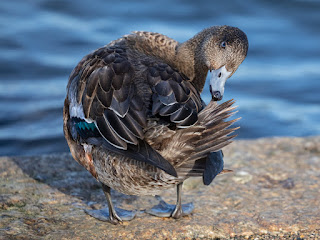
Friday, 5 November 2021

A Pied Wagtail looked for insects between the slates on the boathouse roof.


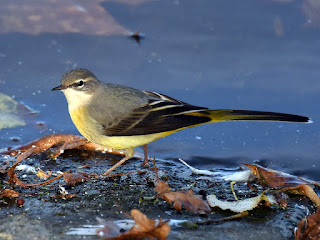
Thanks to Ahmet Amerikali for this picture of the Grey Wagtail on the edge of the Serpentine.

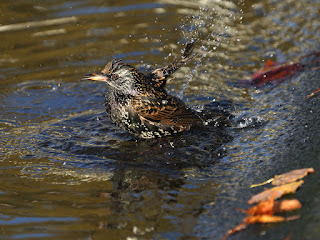
A Starling washed on the edge.

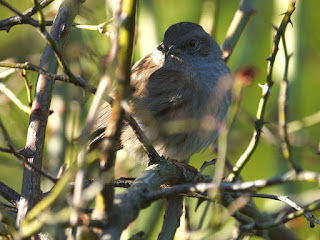
A Dunnock looked out of a rose bush in the Rose Garden.

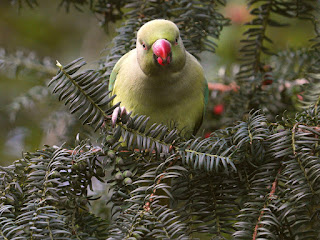
A Rose-Ringed Parakeet in the Flower Walk ate the red outside of a yew fruit. They tear off the whole twig, chew vaguely at the fruit, and then drop it and tear off another twig. The ground underneath is littered with twigs from their destructive habit.

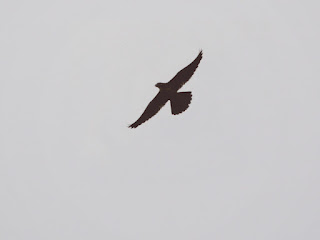
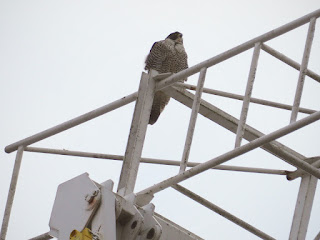
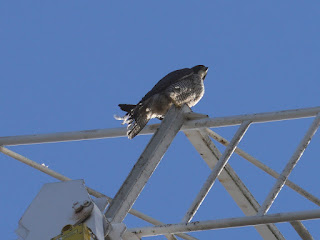
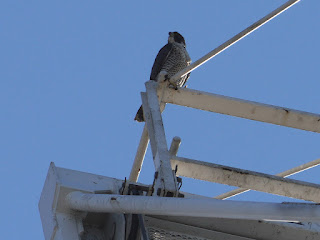
The male Peregrine was on the crane enjoying the sunshine.

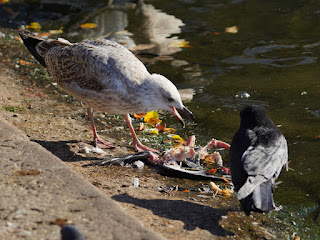
A young Herring Gull ate the pigeon eater's leftovers. It was bothered by a Carrion Crow ...

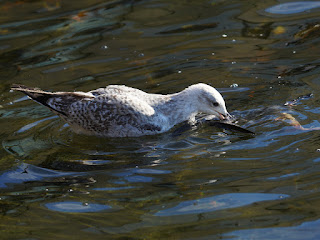
... and took its meal into the water.

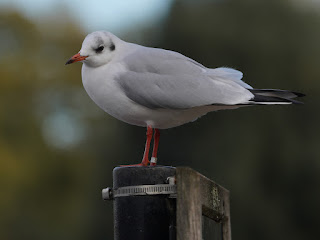
The Black-Headed Gull EZ73323 was on its usual post on the south shore of the Serpentine.

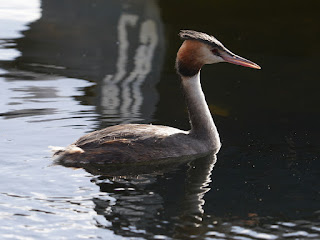
A Great Crested Grebe fished in the wire baskets under the bridge. These baskets serve as fish hatcheries, and even when the young fish have grown up there are some lurking in the shadows.


A Moorhen amused itself by knocking two Black-Headed Gulls off their posts.


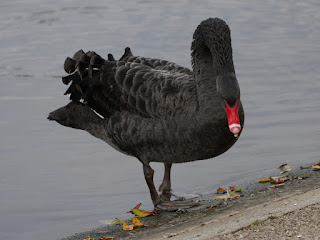
The Black Swan came ashore to get some peanuts, of which it is fond. But, unlike the Mute Swans, it won't touch sunflower hearts. Of course it has the usual unhealthy appetite for the bread that other people give it.

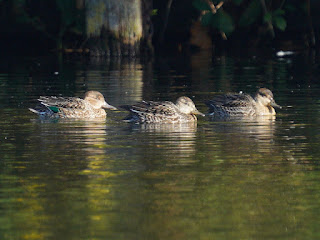
There were three female Teal on the Long Water.

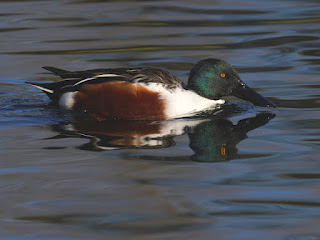
A Shoveller drake cruised past the Vista.

A Tufted drake washed and preened on the Serpentine, doing its tuft with its foot.


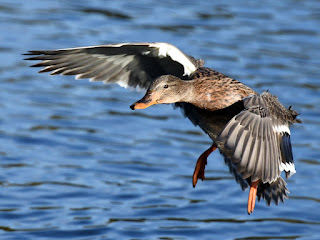
Another picture from Ahmet: a female Mallard about to splash down.

Martin Sacks sent this video from Margate. I think these waders are Turnstones. Update: Tom confirms that they are indeed Turnstones. There are also a couple of Redshanks.

Thursday, 4 November 2021

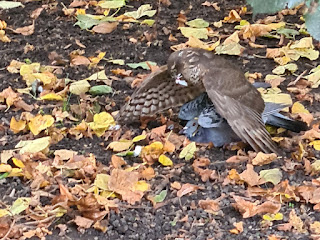
A dramatic picture and video from Virginia. She had just come into Kensington Gardens when she saw a Sparrowhawk holding down its prey. She didn't have her proper camera, but photographed it with her phone. You can see from the victim's dark eye that it's a Stock Dove.


The hawk started to pluck it before eating it. The dove was still alive, and when the hawk was disturbed it escaped, hotly pursued. We don't know whether it was caught later.


A Feral Pigeon had died of natural causes beside the Serpentine. When I went by half an hour later a young Lesser Black-Backed Gull had found it and already eaten a good portion of it.


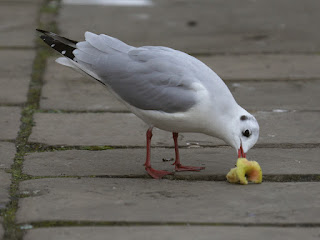
A Black-Headed Gull peacefully ate a bit of apple it had stolen from a Rose-Ringed Parakeet.


A pigeon made itself safe from Diana's arrow by perching on her bow. (This is not an enormous pigeon -- the statue is smaller than life size.)


The familiar bronze pigeon at Peter Pan made friends with one of the white pigeons with black markings on its back, which I call the Rorschach pigeons because the mark looks like one of the psychologist's ink blot tests.
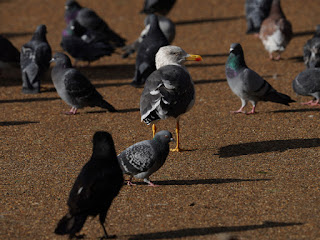

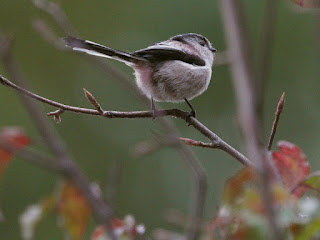
Hunting on a smaller scale: a flock of Long-Tailed Tits searched for insects behind the Lido.
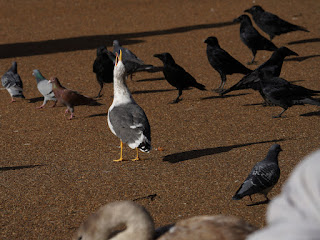

This Grey Wagtail is often seen catching midges in the Italian Garden. I think that both the young wagtails hatched in the summer are going to be permanent residents, unlike their parents who fly in from the old coal wharf at Chelsea Bridge.


A Cormorant took time off from fishing in the fountain pools to dry its wings.


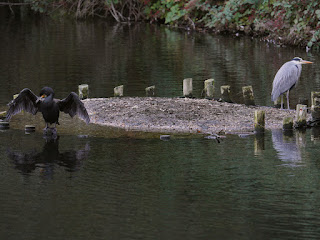
A Cormorant and a Grey Heron pointedly ignored each other on the Mute Swans' nesting island. Each has its own very different style of fishing, so they never come into conflict.


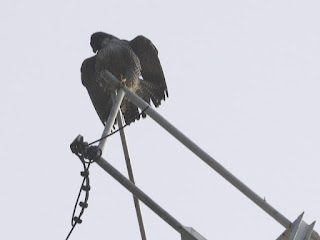
The Peregrine was shifting restlessly on the crane in Knightsbridge ...


... and soon took off and rollicked around in the gusty wind.


Jays are reappearing after being busy burying acorns. The leaves of the horse chestnut it's perching in are brown and withered not with autumn but from the attacks of the Leaf Miner Moth.


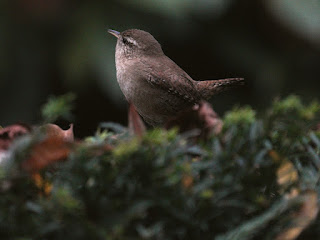
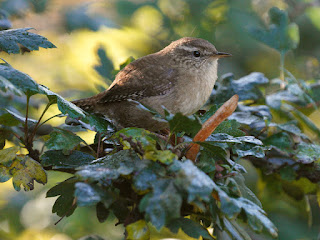
A Wren perched on the yew hedge in the Flower Walk.


The male Mute Swan in the Italian Garden had a faceoff with the dominant male on the Long Water.


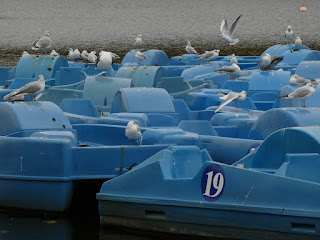
Bluebird Boats have closed down for the winter. They hope to be able to renew their contract and reopen in April, but it's still in the balance. Meanwhile the gulls have started to make an almighty mess of their boats.

Wednesday, 3 November 2021

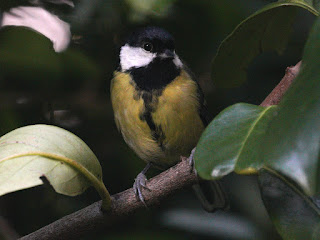
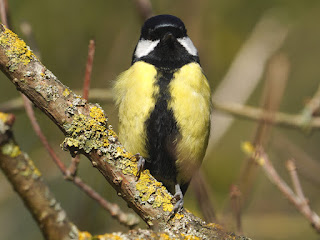
Even at a time of year when the small birds aren't doing much, you can rely on the Flower Walk to have tits expecting to be fed. Here are a Great Tit ...

... a Blue Tit ...

... and a Coal Tit.

A Robin perched on the fence, looking disgruntled because ...

... there was a Magpie on top of its favourite corkscrew hazel bush.

The Blackbird family in the Dell were in the yew tree on the corner, eating the fruit.

A Chaffinch, Goldcrest, Long-Tailed Tit, Grey Wagtail and Robin in various parts of the park -- a compilation of clips too short to show on their own.

The Peregrine was on the crane, which was busily swinging around hauling things to the top of the new building in Knightsbridge. No amount of activity disturbs him, and I'm sure he enjoys the ride.

The pigeon-eating Lesser Black-Backed Gull had enjoyed a good breakfast and a wash and preen, and was shaking down his feathers.

A Great Crested Grebe chick on the Long Water got a generous sized fish for lunch.

There were lots of Cormorants at the island. Numbers are building up to the point where they start fishing in a gang, which is fun to watch as long as you aren't a fish.

The grass in the Dell was being mown. Moorhens could wander easily in the newly cut grass looking for insects and worms.

Another Moorhen made itself comfortable on a bed of leaves in a large crack in the concrete edge of the Serpentine.

The concrete was laid in the early 1970s and subsidence of the ground has moved and cracked it in several places. It's noticeable that the edge of the lake is several inches higher around the southeast corner, where the ground was built up to contain the water held in by the dam. The wise 18th century builders knew about the tendency of London clay to slump over the years, and made a generous allowance for it which has still not been fully taken up. More recently the civil engineers for the Diana fountain, Arup, made little allowance if any. The heavy stonework started sinking into the ground immediately, requiring massive and very expensive work to shore it up. The Henry Moore sculpture was also built on inadequate foundations and soon started to lean. It had to be dismantled a few years after it was set up, and was put back on a huge frame of steel girders buried in the ground.

Greylag Geese flew past the island.

Tuesday, 2 November 2021

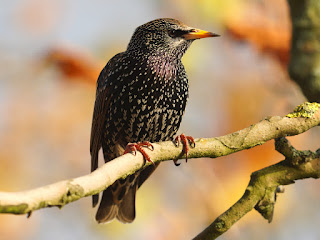
A beautiful day of golden autumn light flattered a Starling in a lime tree beside the Serpentine.


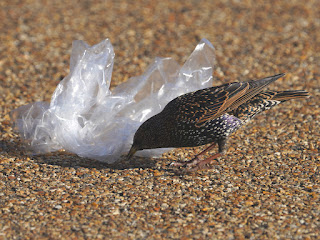
On the ground below another Starling more prosaically investigated a plastic bag some slob had dropped.


A Great Tit stared out from a tree near the bridge.


A Wren had a brief moment of calm beside the Long Water.


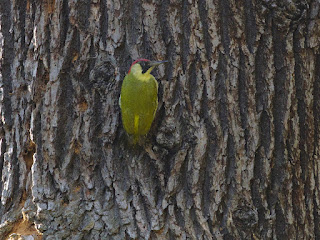
A Green Woodpecker climbed the bark of an oak tree, whose deep fissures harbour many insects. The photographer has asked to remain anonymous.


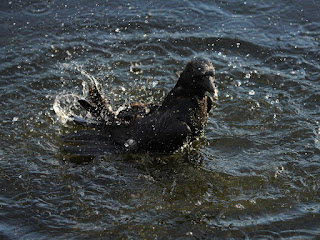
A Carrion Crow washing is always entertaining to watch.


The Peregrine on the crane had some damaged tail feathers. I doubt that a Feral Pigeon had fought back, and it had probably been in a fight with another Peregrine. The pair's territory borders on that of the long established pair on the Houses of Parliament.


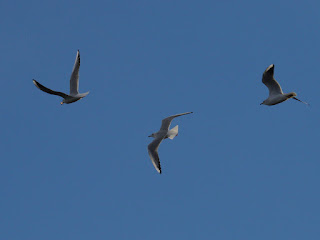
When you see three Black-Headed Gulls in close formation, it's certain that one of them has a bit of food and the others are trying to grab it.


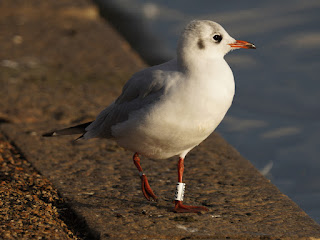
This ringed Black-Headed Gull, 28P1, is a park regular. It isn't from an exotic faraway place. Bill Haines tells me that it was ringed at Hosehill Lake Local Nature Reserve, near Theale, Berkshire. It was ringed as a chick in June 2015 and has been wintering here in most years since.


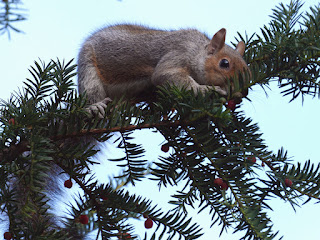
A squirrel in the Dell ate yew fruit. It was being careful to chew the edible red outside off the poisonous centre.


This fox is often seen in the wilderness where the ground near the leaf yard has been fenced off 'for repair', which in practice means leaving it untouched for two years so it's gradually turning into a jungle. The fox feels safe behind the fence and stares curiously at humans.


Near the Henry Moore sculpture, in an exposed and windy place, thousands of young spiders climb up the railings and spin long strands of gossamer so that the wind will carry them to a new home.


Now that the ivy flowers are over, the large population of Common Wasps in the park has switched to Fatsia flowers, which are similar but bigger and come out later. But the insect in the fifth and last shot is not a wasp -- it's a wasp-mimicking hoverfly, the Common Flower Fly, Syrphus ribesii.

Monday, 1 November 2021

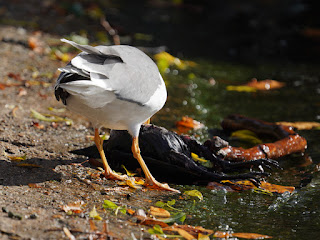
Today the pigeon-eating Lesser Black-Backed Gull was eating a Carrion Crow. I don't know how it had died, but I suspect natural causes.


He seemed not to like the taste and went off to hunt pigeons, followed by a crow.


Soon he was surrounded by vengeful crows.


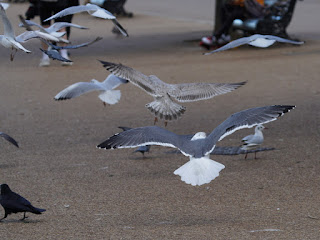
There was no actual attack, but the incident left the gull in a foul mood and he started chasing off all the other gulls.


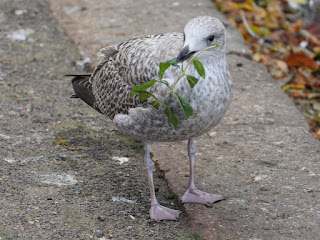
I don't think this young Herring Gull is becoming a vegetarian, despite the speeches of the posturing hypocrites at COP26.


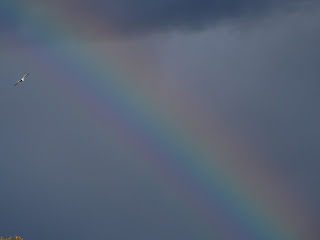
A shower left a rainbow, crossed by a Black-Headed Gull.


A crow looked for insects and worms in a drift of dead leaves.


The male Peregrine on the crane in Knightsbridge surveyed the scene from his 300ft high vantage point.


A Long-Tailed Tit perched in the red oak at the Vista.


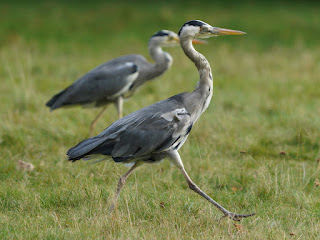
Two Grey Herons ran down Buck Hill towards a chance of being fed.


A Great Crested Grebe was fishing under the moored rowing boats.


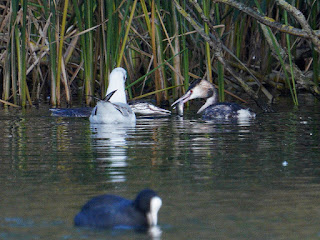
On the Long Water, one of the chicks got fed despite a Black-Headed Gull hanging around to try to snatch the fish.


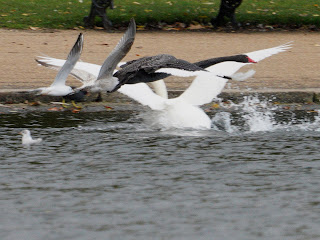
The air traffic control on the Serpentine is not good. The Black Swan had a near miss with a descending Mute Swan, and a Herring Gull and a Black-Headed Gull were involved in the incident.


The visiting Wigeon travelled along the edge of the Serpentine until she was repelled by an aggressive Coot.


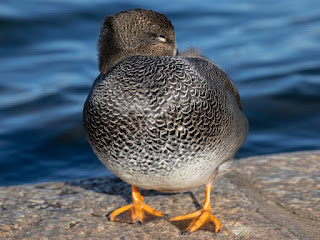
Two fine pictures from today by Virginia: a close-up of the beautiful markings of  a Gadwall drake ...


... and the female Teal preening. She has been here for some time, but often goes unobserved in the bushes along the edge of the Long Water.


A pretty video by Tom of the Dartford Warbler in a wild rose bush at Rainham Marshes.