Wednesday, 8 July 2020

A young Great Spotted Woodpecker, evidently the offspring of the pair near the bridge, came out on a branch.


A female Blackbird furiously scolded a pair of Magpies perched on the railings below her.


A young Great Tit stared curiously at the camera.


The Great Crested Grebes at the bridge are now taking care of one chick each, the usual arrangement when the chicks have stopped riding on their parents' backs -- and are also at their hungriest, so that feeding one is a serious job.


The family at the Vista are still together. As usual they were lurking under a bush.


The dominant Mute Swan pair with three cygnets were also under a bush opposite Peter Pan.


The Black Swan had been having a little expedition on to the Long Water, and came back under the bridge.


The Egyptian family with blonde goslings enjoyed a puddle left by last night's rain. Their father, who provided the blonde genes, is on the right in the first clip.


A closer view of two of the blonde goslings. If I'm right about this colour variation being sex-linked, the eight blondes are female and the two normally coloured ones male.


Two pairs of Mandarins appeared at the Vista. The males in eclipse look much like females, but the one at bottom left is certainly male, as he has a pinkish bill and the remains of a crest.


A patch of lavender in the Rose Garden attracts a lot of Buff-Tailed Bumblebees.


Paul has been watching the Kestrel family and the Little Owls in Richmond Park, and has got some excellent pictures. Here the female Kestrel, on a dead oak tree, is holding a Common Lizard which her mate has brought her to feed the chicks.


The Little Owls also spend much of their time on another dead oak, against which they are practically invisible if you don't know where to look. But here is a female on a live chestnut.


Mark Williams reports that the Little Grebes in St James's Park have bred.


He also sent a fine picture of a Large Tortoiseshell butterfly. Update: this seems to be a rarity now.

Tuesday, 7 July 2020

The pigeon-eating Lesser Black-Backed Gull and his mate shared their latest victim in the usual place near the Dell restaurant. A hungry Carrion Crow took advantage of a moment of inattention and the female shooed it away. The male gull always washes his face after a meal. He is very particular about his appearance.


A strayed racing pigeon wandered around on the path at the foot of Buck Hill. It seemed happy to be with the ordinary Feral Pigeons and showed no sign of wanting to leave.


This is one of the two young Blackbirds on the lawn to the east of the Dell. It's still being fed by its parents.


Here is the first view of a chick in the Great Crested Grebe nest at the east end of the island.


The father of the two chicks near the bridge looked proudly at his offspring.


One of the other set of two chicks was preening its shining white belly.


A Coot fussed around in a nest in one of the planters in the Italian Garden fountains. It's their third nest this year.


The four Mute Swan cygnets were at the Lido. They are now going through the gawky ragged stage, but they will look better when they get their first coat of proper feathers.


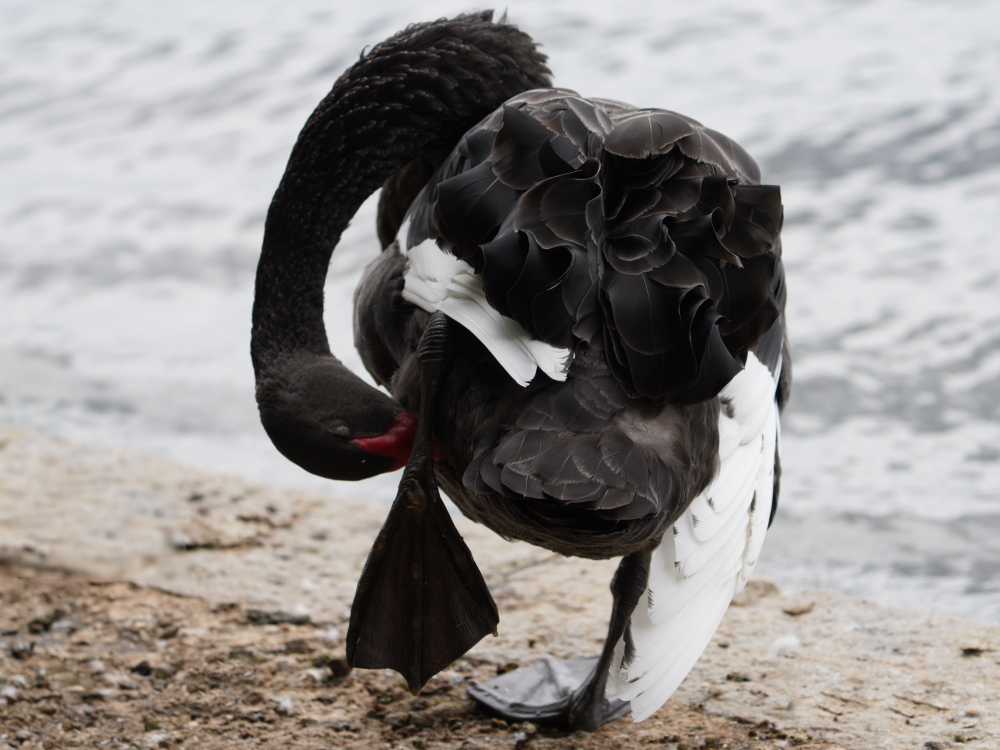
The Black Swan preened, showing off its new white wing feathers which still have the faintest trace of juvenile black tips.


There is an usually high proportion of pale goslings in this new brood of Egyptian Geese. Their father is pale and their mother normal. Pale males are rarer than females, and I'm pretty sure (though I don't actually know) that colour is sex-linked.


A Mallard near the bridge had one unusually dark duckling.


Young perch about two inches long could be seen in the Long Water from the parapet of the Italian Garden. This is a bad picture, but it was very hard to get one at all.


Honeybees were busy in a patch of Meadow Cranesbill at the back of the Lido.


I tried again to get a picture of the tiny multicoloured wasps in the clump of campanulas next to the Triangle car park. They weren't there, but I did find this small bee which I can't identify. Here are two pictures, the second showing distinctive yellow markings on its face.

Update: Duncan Campbell has definitively identified it as a Common Yellow-Face Bee, Hylaeus communis. He remarks that there are 275 species on bee in Britain.


Monday, 6 July 2020

A female Blackbird near the Dell expertly found worms for her two young. They are beginning to look for their own food, but are not much good at it yet.


This male Blackbird in the Rose Garden often comes out to ask for sultanas.


A Blackbird beside the Long Water ate blackberries.


Although the brambles are now producing ripe fruit, there are still a few flowers left for this Honeybee.


A Reed Warbler sang in the reed bed near the Italian Garden.


Below it, a Grey Heron stalked through the undergrowth. It had a stab at something, probably a rat, but missed.


The pigeon-eating Lesser Black-Backed Gull gave me a severe stare.


One of the younger Great Crested Grebe chicks on the Long Water flapped its little wings.


An older chick under the willow is already catching insects.


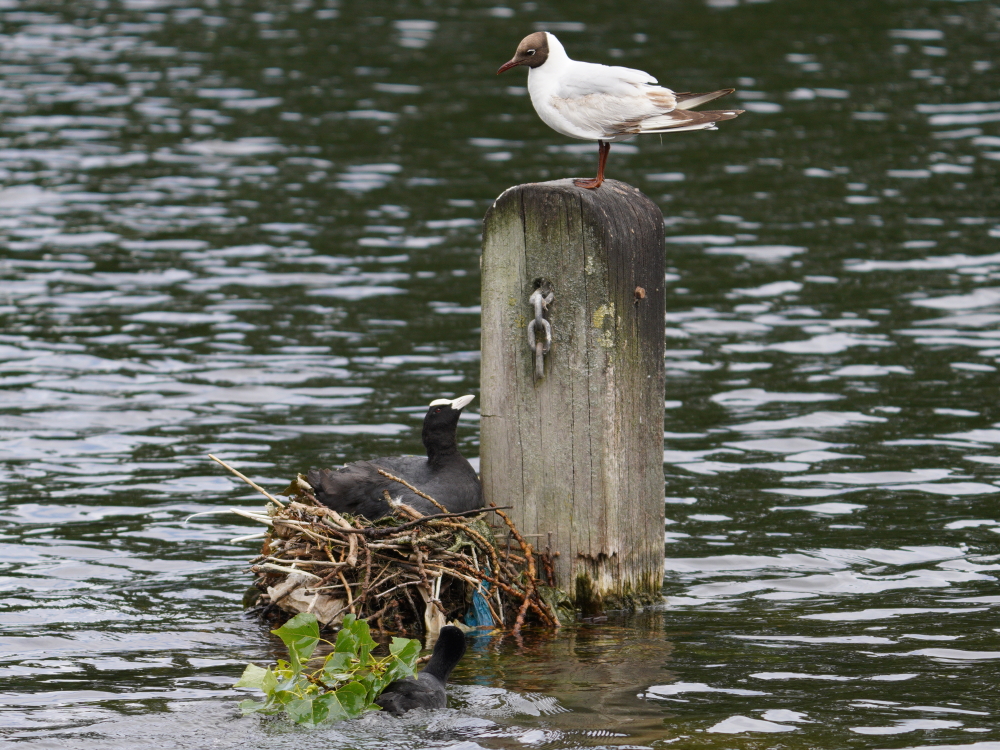
The Coot in the nest on the post at Peter Pan glared at a Black-Headed Gull while its mate brought fresh leaves to the nest.


A young Moorhen crossed the waterfall in the Dell.


The dominant Mute Swan at the west end of the Serpentine was in a foul mood, chasing every swan in sight.


The Greylag Geese on the Serpentine haven't been able to breed at all, probably owing to predation by foxes. Today these teenagers arrived on the lake, newly able to fly and brought in by their parents who had finished moulting and regrown their wing feathers. Geese are intelligent, and it's quite likely that the parents are park residents who assessed the hopeless situation and decided to nest in a safer place.


There is yet another brood of eight Egyptian goslings on the Serpentine. Sadly, they don't last long here, but the 'pile 'em high, sell 'em cheap' breeding strategy of Egyptians is steadily increasing their numbers.


A Pochard drake flapped his wings. He is one of three Pochards, two male and one female, who have not migrated away from the park with the others.


The blond Mallard duckling at Peter Pan is very conspicuous. So far it has avoided the gulls.

Sunday, 5 July 2020

This is the first time the second family of Great Crested Grebes on the Long Water have come over to the west side of the lake where they can be seen from close up. They lurked under a bush. Grebe chicks don't have to be told to keep under cover, they do it naturally.


The family near the bridge came out for a moment from the shelter of the willow.


The Coots nesting on the platform of Bluebird Boats were not bothered by the activity all round them.


There was quite a strong wind, but the waves haven't disturbed the two well made nests at the east end of the Serpentine. This is the one at the top of the weir.


Yet another brood from the prolific Egyptian Geese on the Serpentine, this time eight goslings. They weren't bothered by the wind either.


A pair of Egyptian Geese have occupied the Mute Swans' nest on the gravel bank in the Long Water. The swans have finished with the nest, and didn't seem to mind.


The other pair of swans -- the dominant pair -- brought their three cygnets right up to the mutually agreed frontier between the territories. So far the truce is holding.


One of the brood of two cygnets on the Serpentine rested at the Lido. It's just beginning to go through the awkward shaggy stage before it becomes beautiful again.


A female Mandarin turned up on her own at the Vista. The movements of Mandarins on the Long Water are mysterious. They come down from the Regent's Canal apparently at random.


The new resident Grey Heron in the Dell surveyed his kingdom from the top of the standing stone.


A Carrion Crow drank in the pool at the top of the waterfall.


A Dunnock lurked in the bushes under the feeder in the Rose Garden ...


... while a rat went through the sunflower husks to see if there was any goodness left in them.


The feeder has so far proved to be in a place where the rats can't get at it, hung from a long piece of straight wire. But they'll probably find a way eventually.

A Honeybee worked over a knapweed flower ...


... and a Meadow Brown butterfly perched on a thistle.


Common Blue Damselflies whizzed around in the reeds on the Long Water, catching midges.