
There was also a Cinnabar Moth here. I've seen one in this place several times without managing to get a picture, and once saw a Burnet Moth. There is a good mixture of plants for them in the scrub between the reed bed and the railings.

The Grey Wagtail in the Dell preened on a rock at the bottom of the Dell waterfall. Many midges were flying around, and you can see why the insect-eating bird likes this spot.
The Long-Tailed Tits have gone back into big flocks after the breeding season, and thse were flying along the edge of the Serpentine accompanied by several Blue Tits.

Most of the songbirds have fallen silent now, but a Chiffchaff beside the Long Water is still going.
A Carrion Crow waited for the pigeon-eating Lesser Black-Backed Gull's mate to finish her meal, and then trotted in ...

... and set to with a will.

There was a Lesser Black-Back with dark eyes at the Lido. It's not yet fully adult, I think third-summer, but it has an adult red eye ring and you would expected its eyes to have turned yellow by now.

A handsomely marked Feral Pigeon trotted around near the Big Bird statue.

The Great Crested Grebe chicks near the bridge are now beginning to get off their parent's back and swim around freely.
The nesting Coot is still on the Bluebird Boats platform, and somehow the staff seem to be managing to steer their customers round it.

Sadly their kindness is in vain, because these nests on the platform never succeed. The chicks fall into the water and can't get back up, and even when Mateusz put in a little ramp for them they didn't understand what it was for.
The single cygnet on the Long Water was out by itself while its parents rested on the gravel bank. It amused itself by following a coot around.

The dominant male eyed it from a distance but didn't attack it. Mute Swans are usually all too ready to attack rivals' cygnets. There must be some kind of a truce between the two families.

One of the Bar-Headed x Greylag Goose hybrids has now regrown its flight feathers ...
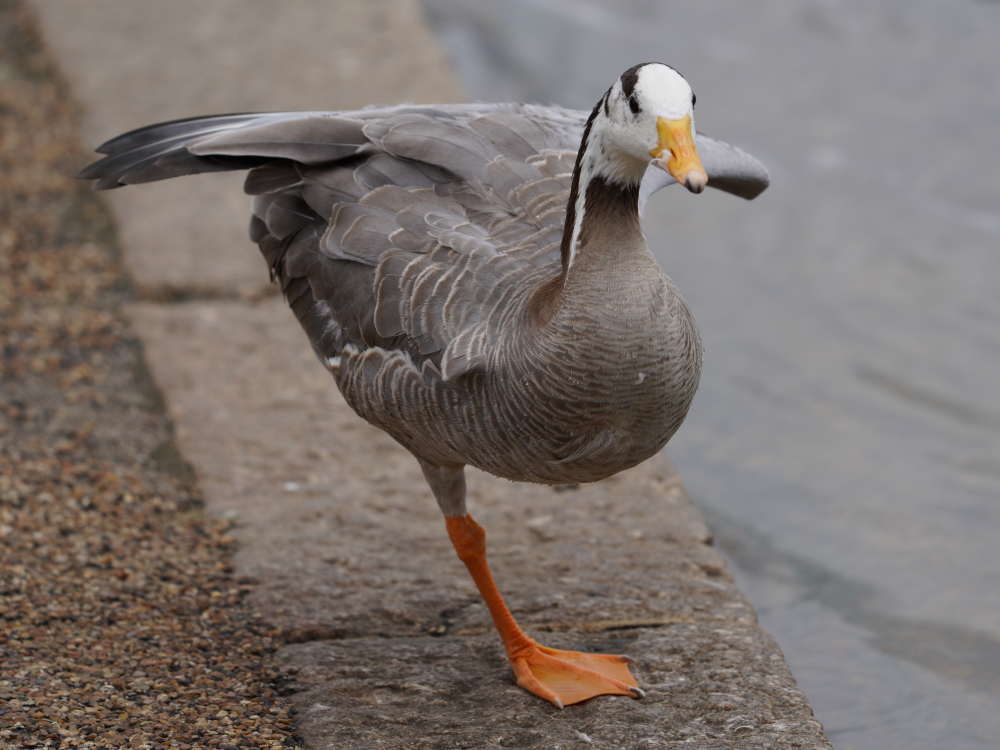
... while the other one is still in mid-moult. This is odd, because they are siblings and you would expect them to moult at the same time.

Some of the Greylags have regrown their wings. I haven't seen any trying to fly yet, but the decision to fly is a committee affair with these gregarious birds and not enough of them are ready to go.

An Egyptian Goose had two goslings of different sizes, probably the result of a mistaken adoption. Egyptians are quite vague about which goslings belong to them.

Bees have strong preferences about the roses in the Rose Garden, and much prefer wild-type single flowers. Probably these have more nectar and pollen than the highly bred fancy roses.

I had never noticed before that the fence-eating tree in the Dell, which has engulfed several bars of the railings on either side, has a face.


