Monday, 8 July 2019

The Coot nest on the weir, repeatedly rebuilt after being washed away, finally has a chick in it. This video was shot straight downwards from the balustrade.


Two pictures from another angle. As usual with Coots, when one bird brings food -- in this case a larva -- it's passed to the other one to give to the chick.


The nest nearby at the Dell restaurant is decorated with a crisp packet. But, typically for the park, it's from Oman.


The nest in the boathouse has two chicks in it. Sad to say, they don't have a chance, because when they fall off the platform into the water they can't get back.


The Great Crested Grebes at the island fed a feather to their chick.


The Mallard with six ducklings brought them up under the parapet of the Italian Garden, where the big fountain stirs up the silt and all kinds of nutritious food is to be found.


A Grey Heron in the Italian Garden fountains stared hungrily down at passing carp, but they are all too big for it to catch.


A Lesser Black-Backed Gull beside the Serpentine pecked at a crayfish head.


Just next to it, a Carrion Crow extracted the last drops of ice cream from the tip of a cone.


Another pulled a Red Bull can out of a bag. It absolutely does not need something that 'gives you wings'.


A Great Spotted Woodpecker perched in an awkward place at the top of a tree beside the Long Water.


The Little Owl was out on the oak tree near the Albert Memorial.


Ahmet Amerikali found what must have been a family of Chiffchaffs in the Rose Garden, but the different angles of the light make them look quite different from each other, and from the accepted image of a Chiffchaff.


He also took this fine shot of a male Black-Tailed Skimmer dragonfly, looking much smarter than these rather drab blue-grey insects usually do.


It was the day the winged ants come out, and they could be seen in several places around the lake. This one was in the Italian Garden.

Sunday, 7 July 2019

The Pochard on the Long Water has managed to keep her two ducklings safe, though their impressive diving performance has also helped to protect them from the gulls. She chased away a Mallard that had got too close.


When the Greylag and Canada Geese are moulting their flight feathers, they tend to rush around and dive frantically. Perhaps their emerging feathers cause an itch which they are trying to relieve.


The six Greylag goslings sprawled on the shore.


The Great Crested Grebes at the island were looking after their chick. At this stage the parent carrying the chick never moves very far, while the other one ranges far and wide to find small fish.


The Grey Heron in the new nest raised its hackles to defy another heron that had landed in the top of the next tree.


The pigeon-eating Lesser Black-Backed Gull was enjoying his lunch. A Carrion Crow would have liked a share and edged up, but it knew that the attempt was hopeless, and the merest gesture from the gull was enough to make it back off.


It was quite warm, and a Carrion Crow was panting to cool down.


The female Little Owl near the Albert Memorial was out in her oak tree all today. In the afternoon she moved into clear view.


A family of Long-Tailed Tits worked their way along the edge of the Long Water.


Rose-Ringed Parakeets and Wood Pigeons share the ability to eat fruit when it's very unripe and hard. If they waited for it to ripen there might not be any left.


Two kinds of willowherb are growing side by side on one of the rafts surrounding the island. The one with flower spikes is Rose Bay Willowherb, which older readers will remember as the typical flower of bomb sites all over London. The one with larger flowers is Greater Willowherb.


A species of dragonfly that hasn't appeared on the blog before: a Norfolk Hawker. David Element took this fine picture at the Barnes Wetland Centre.


Mark Williams was in St James's Park, from which he sent me a remarkable picture of a Crab Spider eating a Honeybee.


The young Great Tits there have been coming to his hand for a couple of weeks now. Ours must have hatched later, because they are still hanging back.

Saturday, 6 July 2019

A view of the Great Crested Grebe family on the Long Water. One parent carried the three chicks while the other fetched small fish for them.


On the Serpentine,  the fishing parent had been unsuccessful, but visited its mate and the chick before diving to continue the hunt.


Later the chick got a feather, but I didn't see it being given a fish.


Neither of the two pairs at the bridge has managed to nest yet, but they are defending their territories tenaciously. On the Serpentine side, one offered a bit of weed to its mate, as if to say 'Let's get going' ...


 ... while one of the other pair glared at them from under the bridge.


Two Coot chicks on the Long Water sat on a rock.


The Mallard on the Long Water is an unusually good mother by the standards of ducks, and her brood of six has survived another day.


Most of the time they are safely out of sight under the bushes.


The Egyptian Goose family at the island had come out of the water to be fed by visitors ...


... not noticing that their sixth gosling had wandered off by itself. I chased it back to them.


A Jay near the Henry Moore sculpture raised its crest and fluffed itself up. This one too has started taking peanuts from my hand.


A Wood Pigeon drank on the edge of the Dell waterfall.


A Wren sang beside the Long Water.


A young Robin in the Rose Garden came confidently out from under the bushes, so I threw it a pine nut.


The Red Arrows flew over unexpectedly.


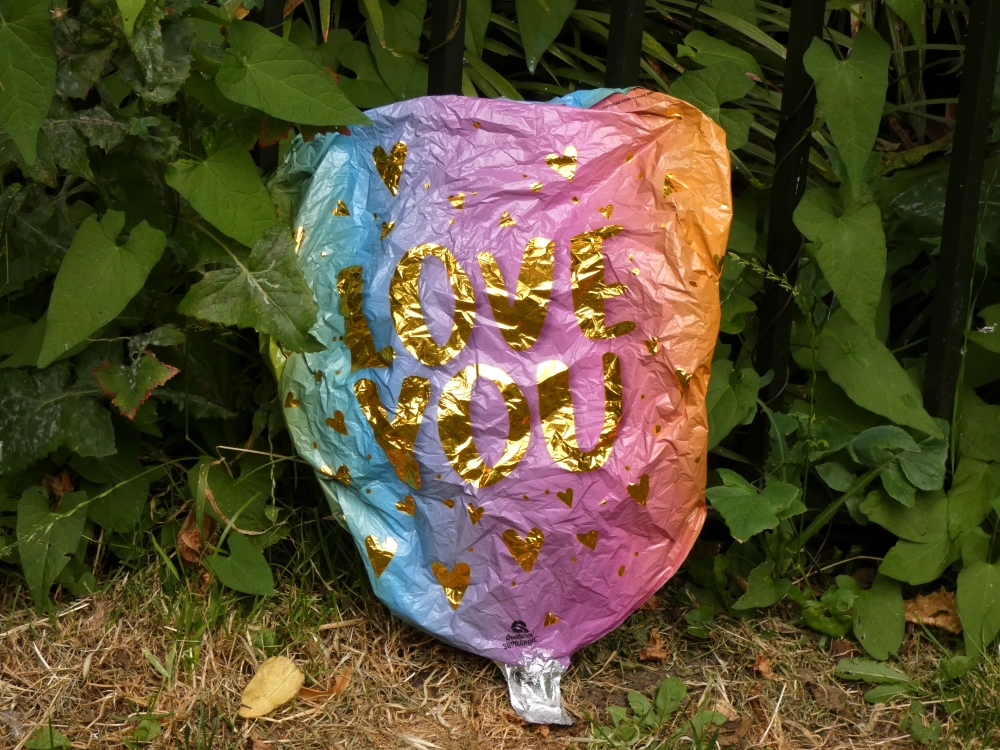
One should really not write a message of this kind on a balloon that is inevitably going to deflate.

Friday, 5 July 2019

There seems to be only one Great Crested Grebe chick from the nest on the wire baskets at the island, though you can never be sure when they are small and can hide under their parents' wings.


When the other parent arrived with a small fish, the chick had evidently gone to sleep in its comfortable cradle, and didn't take it.


The three chicks on the Long Water are older and larger, and easier to see.


A nest on the dead willow near the Italian Garden is disputed between a Great Crested Grebe ...


... and a Coot.


A grebe can always win a fight, but generally the Coots win the war by sheer dogged persistence.

The pair nesting on the post near Peter Pan refuse to give up after two failures. They were trying to add a large twig to their nest in preparation for laying a third clutch of eggs.


The four teenage Coots still using the nest at the Lido restaurant are beginning to break it down. A parent hurried up with some new lining material.


A Moorhen admired its reflection in the shiny plastic surface of a pedalo.


While geese are moulting and can't fly, they have a tendency to rush around flapping their useless wings, perhaps to keep their flight muscles in good order. This is the family on the Serpentine, and one of the young ones joins in.


They enjoyed a vigorous washing session, including turning upside down and diving.


The Mallard on the Long Water has managed to keep her six ducklings by herding them well to the edge of the water and spending most of the time underneath bushes.


The two ducklings near the bridge are still all right.


One of the Grey Heron chicks on the new nest flapped its little wings.


A Starling on the edge of the Serpentine picked up small larvae to feed its insistent young.


A young Long-Tailed Tit on a twig waited to be fed.


The Red-Eyed Damselflies on the algae in the Italian Garden have been succeeded by the later arriving Small Red-Eyed Damselflies. Both are small and they are hard to tell apart, but David Element has put me right on this.


A female Emperor Dragonfly laid eggs on another patch of algae.


Two Buff-Tailed Bumblebees arrived on a hollyhock flower at the same time, and one had to wait.