Wednesday, 8 August 2018

The Kestrels on Buck Hill are not much disturbed by people looking and pointing cameras at them. They just stare back.


They are not even bothered by the arrival of the air ambulance. They can hover too. Thanks to Tom for this picture.


The Little Owl at the leaf yard likes to perch on this branch with an annoying twig in front of his face.


With the arrival of cooler weather, small birds are again coming out of the bushes to be fed. A Great Tit delicately enjoyed a pine nut.


The recent rain has softened the hard ground, and the white-faced female Blackbird can go back to worm hunting.


A young Blackbird landed in a blackberry patch to eat the ripe fruit.


A young Starling had the same idea. It is growing adult plumage, but its head and shoulders are still juvenile beige.


Many of the Jays are tatty-looking at the moment, but this one is immaculate.


My worry yesterday about one of the young Grey Herons having fallen out of the nest turned out to be unfounded. Today they were both there. One of them must have been lying down very flat inside the nest.


The Great Crested Grebe chicks from the east end of the island were out on the open water. Two of these were rescued on 19 July when they got separated from their parents, and had to be brought over to them by boat.


The Coots at the Serpentine outflow decorated their second nest with a purple plastic bag.


The Coots from the nearby reed bed have also built a second nest as a day bed for their chicks. It is a much flimsier thing than the strong nests they make for breeding, and is only intended to last a few days.


In a fountain pool in the Italian Garden, a teenage Moorhen pushed its way through the duckweed to get to a water lily, and two young chicks sheltered in a clump of plants.


Another Moorhen fed a chick on the edge of the Serpentine.


A Tufted duckling realised that its mother was getting too far away and hurried over to join her.


They are not much worried by Black-Headed Gulls, which are too small to snatch the chicks.


A Red-Eyed Damselfly rested on a patch of algae in the Serpentine.

Tuesday, 7 August 2018

There are certainly three Kestrels flying around Buck Hill. The third one, probably male, kept his distance, but the others afforded good views.


One was mildly harassed by a Carrion Crow, which however kept a respectful distance from the smaller bird's powerful talons.


This morning there were two young Grey Herons in the nest on the island as usual.


But this afternoon one of them had gone. I don't think it was just lying down in the nest.


I looked around on the island, as far as it can be seen from the shore with binoculars. There was an adult, but no sign of the young one. I hope it has left the nest in an orderly fashion when it was ready to go. Their wings are certainly well enough developed for at least a safe flutter to the ground.

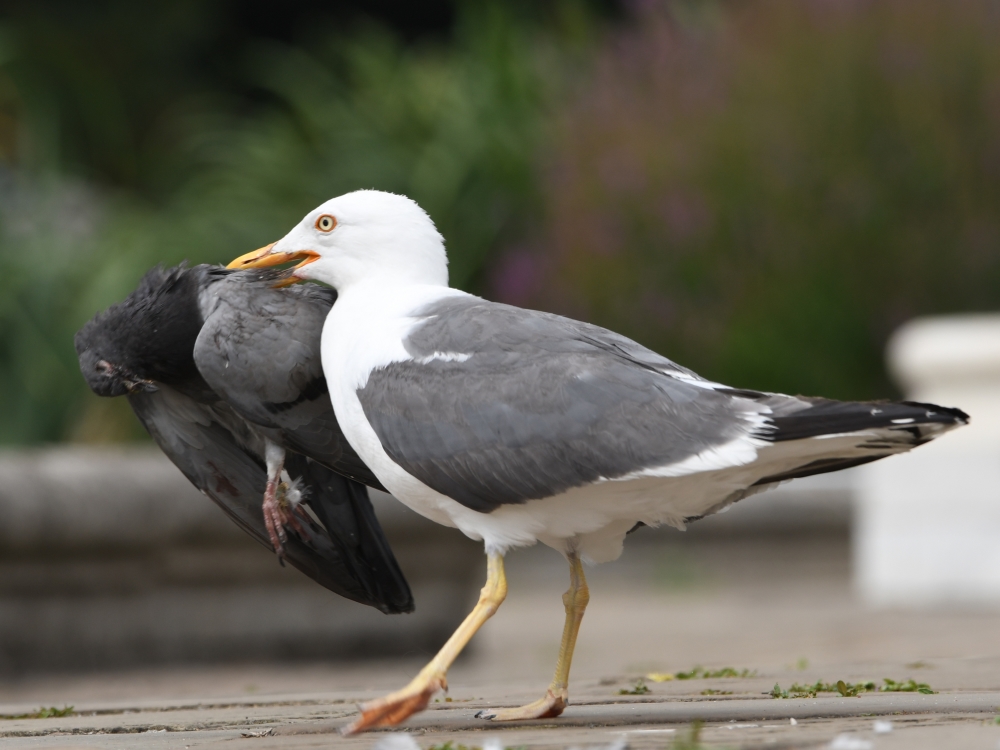
Tom photographed and filmed a Lesser Black-Backed Gull eating a Feral Pigeon which it had caught in the Italian Garden.


Surprisingly, this isn't the familiar pigeon-killing Lesser Black-Backed Gull from Hyde Park. Its legs are much too pale. A couple of other Lesser Black-Backs have had a go at hunting pigeons, but I don't think I've seen this gull before.


The Great Crested Grebes at the island with three chicks were feeding them, but there wasn't much enthusiasm for this fish. The third chick, out of the picture, didn't even bother to come over. They must be very well fed.


When their father caught his next fish he didn't bother to take it to the chicks, and ate it at once.


On the Long Water, one of the four chicks climbed on to its father's back. There's only just room for it now.


Their mother rushed at a rival to chase it away.


One of the Little Grebes, not seen for a while, could be seen through the netting surrounding the reed bed near the bridge. It caught a fish, which came up tangled in fine plastic netting and had to be shaken to remove it.


This netting is turning up everywhere. It doesn't rot, and is a serious hazard to wildlife.

One of the Coots at the Serpentine outflow went down the plank to the lower level of the weir to feed its chick, which could be heard calling.


The Moorhen chicks in the Italian Garden are growing, but they're still small enough to be able to run over the mat of algae without sinking in.


There were two families of Tufted Ducks together at the island. Here's one with six ducklings.


The other one, with seven, came too close and there was a brief flurry as the family was chased away.


A new Mallard family with seven ducklings turned up at the Diana fountain landing stage.


The Little Owl at the leaf yard stared indignantly at a Magpie in his tree.


On the ground underneath, two young Magpies were pestering a parent for food.


Another Magpie had caught a large insect. It held it down with one foot to peck pieces out of it.


Warning: nothing happens in this boring but mercifully short video. It's just to show the remarkable density of water fleas (Daphnia) in the fountain pools in the Italian Garden.

Monday, 6 August 2018

Two Kestrels were hunting over Buck Hill.


But the two we usually see here are not a couple. There is an adult female ...


... and a smaller bird in similar plumage with a less clearly marked stripe on the face. This may be an immature male and the offspring of the other -- male Kestrels are smaller than females. They are not hostile to each other as you would expect if they were rivals. (This picture was taken on 30 July.)


Julia thinks she may have seen a third Kestrel on Buck Hill, but is not sure as they move around quickly and keep disappearing behind trees. If so, it might be the adult female's mate.

A Kestrel's strong legs are not just for seizing prey, but for sprinting. Her keen eyes spottted an insect some way off and she raced to grab it, then flew into a tree.


The Little Owl at the leaf yard could be seen in his usual tree, though it took two visits to find him.


The young Grey Herons were sitting comfortably side by side in their nest on the island.


Heron siblings seem to remain friends for some time. The two teenagers on the Serpentine are still happy in each other's company in a way quite foreign to hostile adults. At present they are usually hanging around the Dell or the Dell restaurant, though I didn't see them today.

The new Great Crested Grebe family at the island were in exactly the same place as yesterday and the day before. Grebe parents tend to be very static while the chicks are small, and only start moving to good fishing grounds after a couple of weeks.


The family from the fallen poplar on the Long Water are now beginning to get around. Their mother stood up to flap her wings, rather tattered by being used as a playpen for the chicks. She will moult and grow new flight feathers in the autumn.


John Mealyer sent a pleasing picture of a grebe resting.


The Coots at the Serpentine outflow were busy adding to their new nest. The chick under the weir was still calling, louder than before as it is growing.


The small Moorhen chicks in the Italian Garden fountain have the same parents as the two teenagers from an earlier brood, which are now feeding themselves. All share the pool on friendly terms.


Two families of Tufted Ducks could be seen at the island. This is the smaller and slightly older one with seven ducklings.


Virginia says that the Mallard ducklings on the Round Pond owe their quite good survival rate to being kept on the platform with the solar panel. The sloping panel gets in the way of swooping Herring Gulls. This is her excellent picture of the family a couple of days ago.


She also sent this picture of a Cormorant flying -- tricky birds to photograph as they charge past at high speed.

Sunday, 5 August 2018

A Kestrel flew down from the trees on Buck Hill to catch grasshoppers and moths in the grass. There is a game of rugby going on in front of it, but it takes no notice at all. Birds know when people are busy, and therefore posing no threat, and to them a rugby ball is a slow moving object easily dodged.


The Great Crested Grebe family from the fallen poplar brought their four chicks out into the middle of the Long Water to catch fish for them.


The new family on the Serpentine with two chicks were in the same place at the west end of the island.


The three young grebes from the family near the bridge were fishing by themselves. Their parents are still feeding them, but it's good practice. Not surprisingly, I didn't see them catch anything.


The Moorhen chicks in the Italian Garden were kept safely behind the netting surrounding the clumps of plants.


A Grey Heron waited for a fish and a family of Coots wandered around under the jets of water from the marble fountain at the edge.


The young herons in the nest on the island were also waiting patiently, both for a parent to bring them a fish and for the glorious moment when they can fly out of the nest where they have been penned up for so long.


A Tufted Duck took her seven ducklings along the edge of the lake to the chained-off area in front of the island where they wouldn't be disturbed by all the pedalos churning around.


A Mallard on the Round Pond has hung on to six ducklings for several days ...


... in spite of several Herring Gulls waiting in the middle of the pond.


The Little Owl isn't spending much time in a visible place in his chestnut tree, and it usually takes several visits to find him. Although Little Owls live around the Mediterranean and even in the desert, like any other birds they can get too hot.


A shoal of young carp swirled about in the shallow water in front of the Peter Pan statue.


A Latin band provided raucous Sunday afternoon entertainment in the Hyde Park bandstand.