Thursday, 5 October 2017

A row of Cormorants on a fallen tree in the Long Water were silhouetted against the sparkling ripples.


At the island,. a Cormorant balanced precariously on a chain and tried to take a place on an already occupied post. Failing, it found a post of its own where it could easily displace a Black-Headed Gull.


A male Mute Swan jumped on a female and tried to mate ...


... but she wasn't in the mood, and struggled free and flapped away, hotly pursued by the male.


The Black Swan, watching this violent activity, started doing his threat display, lowering and raising his head and calling.


When things had quietened down he came over to be fed. Finding some young Mute Swans joining in, he was annoyed and pecked them away.


Some of the Mallard drakes are already back in their fine new breeding plumage.


But when it comes to iridescence, they are outclassed by Starlings.


The Great Crested Grebes under the bridge were feeding their chicks, a peaceful spectacle unless you are a fish.


The Little Grebe on the Round Pond had caught enough, and was idling near the platform with the solar panel.


A Carrion Crow was picking leaves out of the fountain in the Rose Garden. This was not an aimless game, as some of them had litte yellow larvae on them ...


... which it ate.


The beans on the catalpa tree in the Rose Garden ripened later than those in Kensington Gardens, and the tree is now full of Rose-Ringed Parakeets. If they stay still they are practically invisible among the big green leaves.


This parakeet at the leaf yard was lying down in the grass. It looked as if it was sick or injured, and some chldren were tenderly feeding it with expressions of sympathy. When it got bored with this, it stood up, strolled off, and flew away in a perfectly healthy manner.

Wednesday, 4 October 2017

The Little Grebe on the Round Pond sheltered beside the platform. It wasn't sheltering from the waves -- in fact it was on the windward side -- but from the Herring Gulls flying overhead.


David Element sent me a fine close-up of this bird, taken yesterday when the light was better.


One of the Great Crested Grebe chicks was scratching its ear under the bridge. They are still being fed by their parents.


One of this year's young Mute Swans has an unusually dark head.


It isn't as dark as a Black Swan cygnet, but our Black Swan was hanging around it anyway. This close-up is also by David.


The Grey Heron at the Lido restaurant, now completely adult in appearance, is spending most of its time in this place between two floating baskets of plants. It's looking for fish as they swim between one basket and another, forgetting that the pair of legs in between means death from above.


A Carrion Crow finishing off a pigeon killed by the notorious gull didn't want any other crows sharing his meal.


The Mistle Thrushes in the rowan tree on Buck Hill ...


... were joined by a party of Starlings.


There was a loud twittering of Goldfinches from a nearby tree. It turned out to come from just two Goldfinches, and four Starlings accurately mimicking them.


A long line of Starlings enjoyed a communal bath at the Lido restaurant. But they dry themselves separately, as they don't want the others shaking water on to them.


A Jay was digging in a patch of newly strimmed scrub near the Italian Garden. It came up with an earthy thing attached to a leaf, evidently a nut it had buried earlier. It seemed a bit early in the year for Jays to start retrieving their caches.


Both of the pair on Nuthatches in the leaf yard waited in the shadow of the bushes for pine nuts to be put on the railings for them.

Tuesday, 3 October 2017

The Little Grebe on the Round Pond came right to the edge for a close-up view, in spite of a small crowd watching it.


Here it is swimming under water.


Two of the young Great Crested Grebes from the nest on the Long Water were playing at nest building, using the abandoned Coot nest under the willow next to the bridge.


There were plenty of Red-Crested Pochards at the Serpentine island. The drakes are now back in their showy breeding plumage.


The Black Swan can face down any Mute Swan on the lake except for the three dominant males, one on the Long Water and one at each end of the Serpentine.


Blondie the Egyptian Goose had been bathing, and flapped her pale wings to dry them.


This is one of the young Greylags from this year, still not quite adult in appearance and with the butterscotch-coloured feet that birds of this age have.


This Black-Headed Gull's rings show that it's from Germany, and was ringed at the bird observatory on Helgoland island.


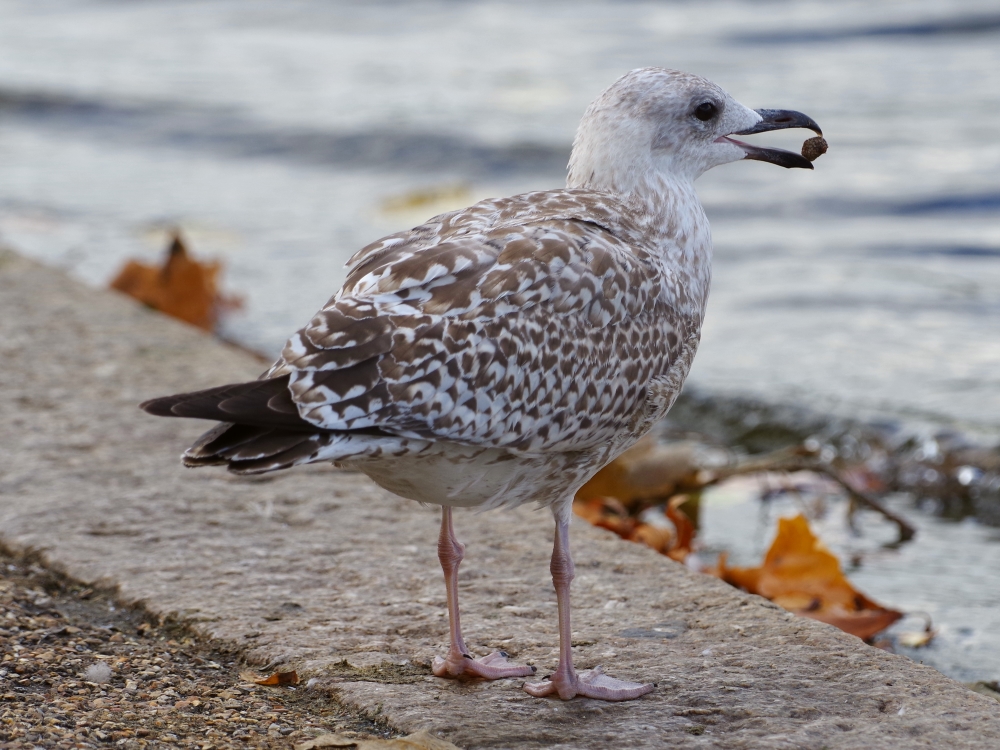
A young Herring Gull was playing with a small seed ...


... but this third-year one had a big plane seed. You'd think it was too old for toys.


A Herring Gull struggled to swallow an enormous piece of bread. It managed in the end.


A Magpie was also having trouble with a bit of bread, in this case because it was very stale, and had to be held down firmly and ripped apart with a considerable effort.


Another Magpie had found more agreeable food in the rowan trees on Buck Hill.


So had a Blackbird.


A Long-Tailed Tit paused in a tree at the foot of the hill. The flocks have quite predicatble routes, dictated by the lines of trees in the park.


No sight of a Little Owl again today. The hole in the oak tree near the Albert Memorial had been invaded by a couple of insolent squirrels.

Monday, 2 October 2017

It was a windy day, and a Cormorant and two young Herring Gulls were getting a bit ruffled while preening on the posts at the Serpentine island.


The Little Grebe was bouncing up and down in the choppy waves on the Round Pond.


A headwind encourages swans to fly, as it reduces their takeoff run. Some young Mute Swans, to whom flying is a fairly new experience, were charging up the Serpentine.


The Black Swan, on the sheltered Long Water, was more concerned with charging over to be fed.


Greylags circled over the lake, gaining height before flying off to the river.


The two dark Mallard drakes are now fully back into their breeding plumage.


The edge of the Long Water is lined with Pochards skulking under the bushes.


There were Cormorants all over the Long Water, fishing, standing on the posts at Peter Pan ...


... and having a frantic wash.


The pigeon-killing Lesser Black-Backed Gull was at the Dell restuarant. He had finished his pigeon and was having a good preen to settle his lunch.


Two Carrion Crows picked off the last scraps.


On the restaurant terrace, a Starling found the remains of a plate of fish and chips. They are particularly fond of chips.


The little tangle of whitebeam and hawthorn bushes at the bottom of Buck Hill is constantly visited by flocks of Long-Tailed Tits. They don't eat the fruit, but maybe this attracts a lot of insects.


They were joined by a Chiffchaff.


One of the Coal Tits in the Rose Garden waited for a turn at the feeder.

Sunday, 1 October 2017

A Carrion Crow pulled a rose out of the fountain in the Rose Garden, not to admire it but to see if there were any insects in it.


The Peregrine was on the Household Cavalry barracks tower again. When it stepped back from the edge of the ledge it was invisible from the ground. So the pair may be there for much of the time, seen only when they come out to look over the edge.


I wouldn't normally publish a picture of a Feral Pigeon, but this is a very beautiful one. It was on the railings at Peter Pan.


And we just have to have a picture of a Robin from time to time. It was in a bush in the Rose Garden.


A young Herring Gull was playing with a whole horse chestnut fruit, flying up with it and dropping it in the water.


Herring Gulls can pick up larger objects than this, and I've seen one carrying a tennis ball.

This is a better video of a Herring Gull doing the worm dance than I managed earlier. But it only seems to be getting very small things.


The Black Swan came over to eat birdseed on the edge of the Serpentine. A Coot wanted some too and, after being shooed away, found some floating bits on the other side of the swan.


There was a solitary Shoveller on the Serpentine, not yet quite into his full showy breeding plumage.


There has been a single Little Grebe on the Round Pond for several days. The name of the genus, Tachybaptus, means 'fast diver', and it's well deserved.


The youngest Moorhen chick in the Italian Garden deliberately swam under the full force of the fountain. Moorhens like a challenge.


Four kinds of bird on adjacent posts at Peter Pan: a Cormorant, a Black-Headed Gull, a Lesser Black-Back and a young Herring Gull. There were at least 20 Cormorants on the lake, and numbers will stay high until they have eaten most of the medium-sized fish.


A Little Owl was calling from an oak tree on Buck Hill 150 yards north of the tall lime tree where a pair used to nest (they have now moved to a horse chestnut nest to the entrance of the allotment). The male of the pair has sometimes been seen in the oak, often on a hole in the trunk. But he certainly wasn't in it this time, because there were two squirrels looking out of it.


I went round and round the tree with binoculars, but the leaves are still quite thick and I couldn't find the owl.

Mario sent me directions to find three interesting fungi in Kensington Gardens. These are Redlead Roundhead mushrooms, Leratiomyces ceres, an Australian species, named after the plant collector Auguste-Joseph Le Rat (1872--1910). Anyway, he made his name glorious by having something named after him. They are on the patch of wood chips under the plane trees a few yards south of the Speke obelisk.


Here is a fine big bright Chicken of the Woods, Laetiporus suphureus, on an American oak tree 100 yards west of the obelisk.


This large puffball is as big as a medium-sized Giant Puffball. Mario thinks it's a Pestle Puffball, Lycoperdon excipuliforme.