Friday, 9 June 2017

The Great Crested Grebes nesting on the fallen poplar in the Long Water have their first chick. This picture was taken from across the lake, the only possible viewpoint.


Newly hatched chicks have stripes all over, but the ones on their body are soon covered with grey down, so only their head and neck remain stripy.

The Coots nesting on the platform in the small boathouse lost all their chicks, as always happens when they fall off the platform and can't get back up. Now they have started again, and there will be another doomed brood. This boathouse is inaccessible to the people at Bluebird Boats, who try to be kind to birds, so they can't put in a plank.


A Coot on the Long Water was mildly surprised when a carp swam under it.


The combined broods of Canada Geese were cruising on the Serpentine.


Here is a video of the Greylags' nursery, with two broods. Another Canada family is grazing in the background.


The Mute Swan family on the Long Water came over to Peter Pan to tout for food. A dog passed by on the shore, and the female swan hissed angrily at it.


A pair of Gadwalls were also there. Unlike Mallards, they are not interested in being fed by humans, and tend to keep their distance. The female stood up and had a flap.


The young Grey Heron is almost always in the same place on the edge of the island. It can be seen poking up above the plants, looking foolish as young herons do.


The female Grey Wagtail from the nest in the Dell was hunting on the rafts.


A young Great Tit beside the Long Water was making it very clear that it wanted to be fed.


So was the white-faced Blackbird. Here she is taking sultanas off the railings.


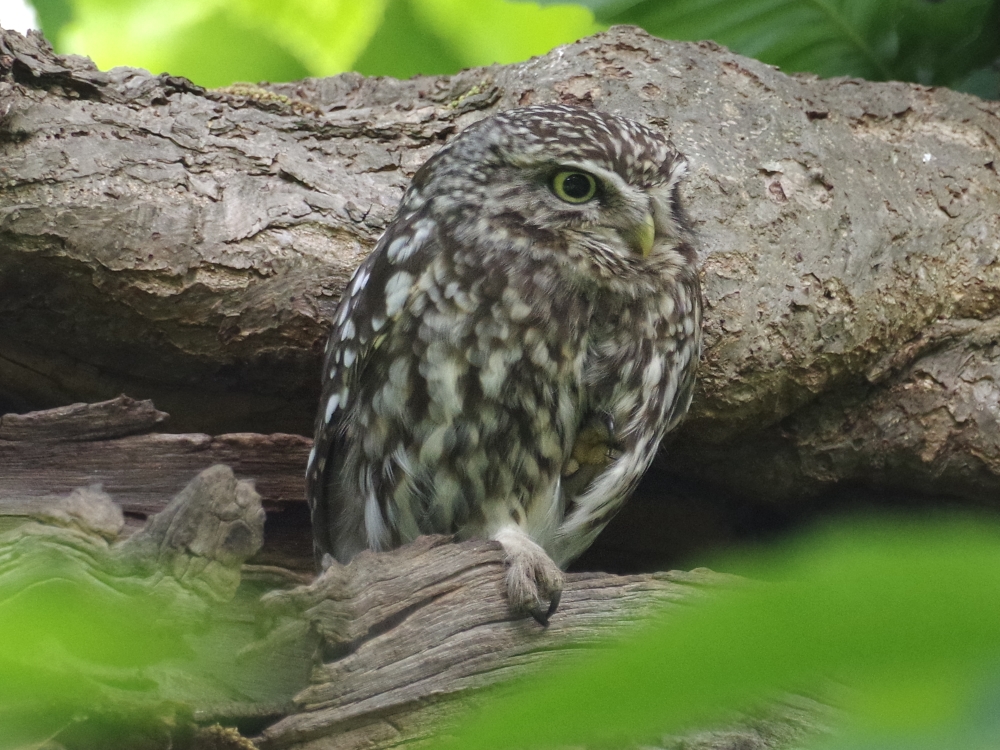
The female Little Owl at the leaf yard looked down serenely from her nest hole.


Paul found a very small bumblebee on the path near Peter Pan, and put it on a bramble flower. After it had recovered from its surprise, it started looking for nectar.


It looked like a Buff-Tailed Bumblebee, the commonest species in the park, but it was only two-thirds of their normal size.

Thursday, 8 June 2017

The white-faced Blackbird is now completely addicted to sultanas. She flew into the Italian Garden when she saw me and perched on the base of an urn to receive her treat. Then she followed me along the path and had three more helpings.


Surely they aren't bad for her. Blackbirds eat berries as part of their normal diet.

The female Little Owl was out in front of her hole, and had a bit of scratch before the arrival of a Magpie drove her in. Sorry about this rather shaky video. It needed a great deal of zoom and I didn't have a tripod, and the only way I could hold the camera anything like steady enough was to sit on the ground and brace my elbows against my knees.


A young Great Tit beside the Long Water was following its parents around, clamouring for food.


A Wren posed dramatically on an oak twig.


The four Mandarin ducklings on the Long Water are still in good order.


They are growing fast. Here is a close-up of one.


There are two chicks in the Coot nest on the post where the small electric launch is moored.


The Mute Swans who gave the Greylag Geese such a hard time were off their nest, and a Moorhen chick was standing on it, on one leg and with a king-of-the-castle attitude.


A visit to St James's Park to see the Black Swan was inconclusive. It was right on the far side of the lake, too far away to notice me, and when I crossed the lake it went round the island and disappeared. Will have to go back for this.

However, it was pleasing to see some Red Crested Pochard ducklings there, still quite a rare sight though getting commoner. In Kensington Gardens, they have only succeeded once in raising two young.


Little Grebes are much commoner in St James's Park than in our park, because the lake is stocked with small fish to feed the White Pelicans.


There was also an odd Greylag with a large white patch on its breast, and dark blue eyes.


Greylags quite often have a white patch on their forehead that makes people mistake them for White-Fronted Geese. This one was on the landing stage at the Diana fountain. It too has dark blue eyes.


Rabbits are still seldom seen in their usual place around the Henry Moore sculpture. The foxes are hitting them hard, and the usual outbreak of myxomatosis last autumn accounted for a good many. But there are usually lots of young ones at this time of year -- as many as 35 have been seen together here. Today a solitary adult was slowly munching a large leaf.

Wednesday, 7 June 2017

The young Starlings in the plane trees by the boathouses were being fed by their parents. The exchange is remarkably quick.


The parents were bringing small white larvae which they found in the surrounding trees.


The two young Carrion Crows near the Henry Moore sculpture were also being fed, in this case with a peanut that I had given their mother.


There was a moment of peace as a Great Tit and a Blue Tit ate pine nuts they had taken from my hand.


The wind had brought down twigs from a willow tree beside the Serpentine, and a Greylag Goose was eating the leaves, which are considered a delicacy by geese and swans.


The combined broods of Canada Geese were grazing a few yards away.


There has been no further drama with the Mute Swans' cygnets.


However, one of the goslings of the Egyptian Geese at the Dell was taken by the notorious pigeon-eating Lesser Black-Backed Gull. A pair of crows tried to steal the victim, without success.


The Great Crested Grebe chick on the island was safe under the bushes, dozing beside its parent on the nest.


The female Little Owl at the leaf yard came out of her hole, in spite of the blustery wind.


Later the wind died down, and the male emerged too. Paul got this pleasing sunlit picture of him.


There is a newly arrived Black Swan on the lake St James's Park, in addition to the two permanent residents. Naturally we are wondering whether it's our old friend from last year. Fran went to see, and reports that he came straight over to her and took a digestive biscuit. Here are two pictures she took. He does look very like our swan.


The dark marks on his bill weren't there last year, but could easily be the result of wear and tear.


I will go over and take a look when I have a moment.

Tuesday, 6 June 2017

It was a windy day, and the Rose-Ringed Parakeets were having trouble hanging on to their branches.


It rained steadily all morning. A Blackbird carried some dripping wet twigs to a late nest. Perhaps the pair had lost their first brood and were trying again.


That is certainly what happened to the Coots nesting on the basket near the bridge. They are stubbornly producing a second clutch of eggs.


Glad to say that the three Greylag goslings survived the attack by the Mute Swan yesterday, and were grazing on the edge of the Serpentine as if nothing had happened.The one that was seized has no visible injuries.


The new Egyptian Goose family near the Dell restaurant were examining a patch of windblown scum.


This Lesser Black-Backed Gull is coming up to its third summer and has grown some of its adult dark grey plumage. Its eyes are changing from brown to the pale green that gives adults that cruel gaze.


A one-year-old Grey Heron, just beginning to get its adult white face, looked for perch in one of the Italian Garden ponds. There aren't many, as the herons and Cormorants have eaten most of them, but quite a few large carp remain.


A gang of Mallard drakes were trotting around on the grass near the leaf yard.


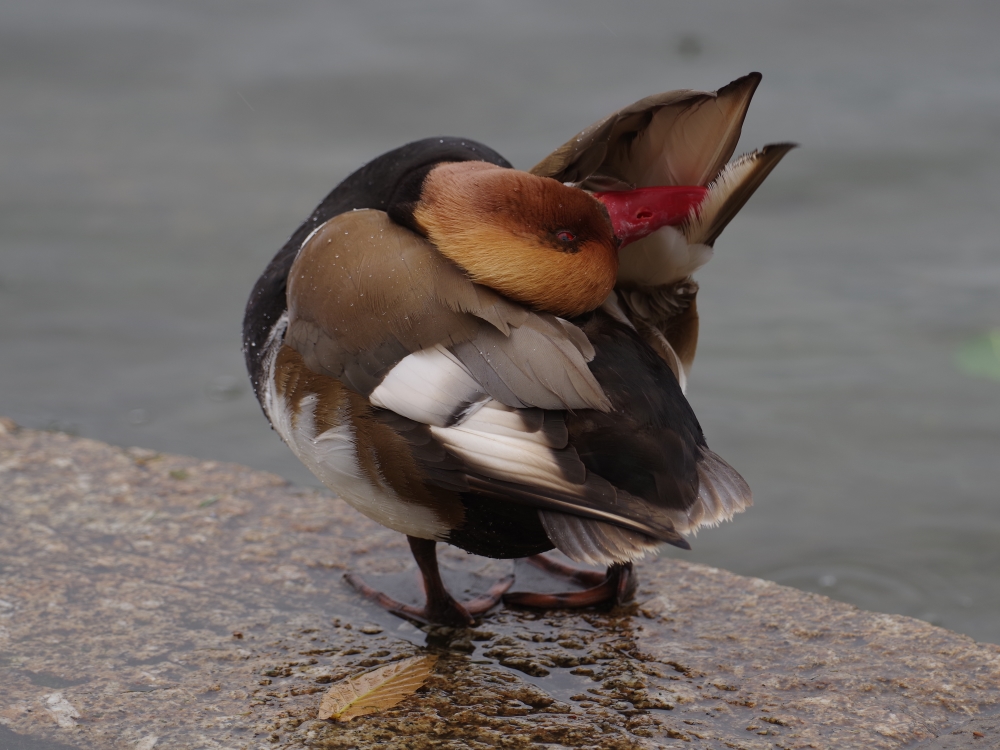
A preening Red-Crested Pochard added a bit of colour to a dull day.


The weather brought the flying insects down low over the water, and the Swifts came down to chase them.


A Dunnock prowled around in the shadows under the bushes in the leaf yard, among a litter of twigs and small branches brought down by the wind.


On a bush at Peter Pan, a damp young Blue Tit called for food.


The weather brightened up in the afternoon, and a sunny spell gave a view of the Great Crested Grebes' nest on the fallen poplar in the Long Water.


The male Little Owl came out of his hole for a few minutes, but he didn't like the wind and quickly went back inside.

Monday, 5 June 2017

The Greylag Goose family with three goslings unwisely visited the raft where the Mute Swan was on her nest with two cygnets. There were attracted by the tasty plants.


The swans pinned them into a corner, but then lost interest and the goslings could have escaped, but unfortunately their mother was by now on the wrong side of the raft and they tried to get to her, and were blocked by the fence. The male swan attacked two of the goslings and nearly caught one, but it escaped. Attempts to lure the swans away by throwing bread into the water failed. When I left, the goslings were still stuck. Here are some scenes from the episode.


The other Greylag family was also here, but stayed well out of trouble.


To add insult to injury, the gander chased the gander of the trapped family up the lake.


A pair of Pochards are often seen around these rafts. Almost all the Pochards on the lake are winter visitors, but these ones are resident. They have never tried to breed, as far as I know.


The rafts are also a hunting ground for the Grey Wagtails nesting nearby in the Dell. There is now a young one, which was there with its mother.


But, as you can see from this video, it is now old enough to hunt for itself.


This is one of the young Moorhens from the latest nest on the raft. Their absurdly large feet don't hinder them from running very fast.


The young Great Crested Grebe on the island was very active, swimming all round the nest and diving under the basket to come up on the other side.


Here you can see it diving, and following its father in the open water. Thanks again to the kind staff of Bluebird Boats for taking me out to see the nest.


A Cormorant sprawled inelegantly on a post at Peter Pan.


A young Starling looked out of its nest hole in one of the plane trees near the boathouses.


The Ring-Necked Parakeets are still eating dandelion leaves, though these are now coarse, hairy and bitter.


If you make dandelion leaves into a salad, choose only very young ones in early spring. They are good with a plain vinaigrette dressing.

The male Little Owl was out on a branch on his usual tree near the leaf yard. There was no sign of others, but it was a cool and windy day and unlikely to tempt them out.