Monday, 12 October 2015

A Black-Headed Gull made a low pass over the Serpentine to pick up a rat-tailed maggot, missed it, wheeled around, and dived in vertically to make sure of the catch.


This time it got its meal.


The playful young Herring Gull had chosen a sweet chestnut as today's toy, and was happily throwing it around on the south shore of the Serpentine.


The Great Crested Grebes from the fallen poplar were busy feeding their chicks near the bridge.


Again, the grebes from the island came out to challenge them in a half-hearted way, but soon gave up. Having chicks gives a pair a moral advantage, and they can win most of their territorial disputes without even trying.

The female Little Owl was in this year's nest tree, calling angrily because a Magpie was annoying her from another branch.


When I went past later she was being pestered by a squirrel. The life of an owl is not an easy one.

In the same tree, a Blue Tit was paying very close attention to a twig, climbing round it and poking at the same place. There must have been some unusually appetising insects here.


Lower down, a Coal Tit was examining the chestnuts. Evidently these have insects on them too.


The fading of the summer flowers had left a honeybee no choice but a dandelion.


This handsome medium-sized mushroom was growing alone in open grass near the top of Buck Hill. I tried to identify it on the web, but again failed. It is about 5 inches tall on a long thin white stem with no ring, and the pale brown cap is rather flat and slightly darker in the centre.


Update: Mario says that it's another Stubble Rosegill, quite old so that the cap has gone flat. This seems to be a highly variable species, whose cap may be white, grey or brown.

Sunday, 11 October 2015

One of the young Grey Wagtails was using a post under the bridge as a station for catching insects, flying out whenever one passed and returning to the post.


A pair of Greylag Geese came down on the lake. It is quite a graceful descent, waterskiing on webbed feet to soften the contact with the water.


Cormorants can't do this as well, because their feet are set farther back and only a little skiing is possible before they splash down.


I have never seen a Cormorant come down on land, but they must be able to because you see them on quite tall posts and jetties in the river, which they couldn't possibly have jumped up to. It is probably a very clumsy business. I doubt that they can take off from flat land, as their takeoff from water involves quite a long run.

But no water bird lands less gracefully than the elegant Great Crested Grebe, whose legs are set so far back that they are no use at all here. It loses height, dangling its feet, and the moment its toes touch the water it folds its wings and crashes in a shower of spray. And, of course, it is almost helpless on land -- the price for having legs so thoroughly modified for fast swimming.

The older brood of Great Crested Grebes on the Long Water are mostly fishing for themselves now. Here is one of them under water near the Italian Garden.


Their parents still feed them occasionally, but if the young birds get too demanding they are chased away.


A young Herring Gull was trying to stand on one of the buoys surrounding the Lido swimming area. Every time it came down on one, the buoy rotated and it had to jump off.


A juvenile Black-Headed Gull was trying the same game.


Note how its primary feathers are an even dark colour all along. On a Herring Gull of the same age, however dark t was, the inner primaries would have pale tips. This is the only reliable way of telling the two species apart at this age, before their dark or light grey adult feathers have begun to grow on their backs.

The male Little Owl was in this year's nest tree. He gave me the briefest of glances and went back into a doze.


These mushrooms are young Poplar Fieldcaps, Agrocybe cylindracea. They announce their identity by growing under poplars, unlike other Fieldcaps which, as the name suggests, grow in grass. These are under the Lombardy poplar overlooking the water at Peter Pan.


This is the tree that has dropped a branch into the water. It is also leaning over more and more, and it is likely to fall into the lake during the next gale.

Saturday, 10 October 2015

The Great Crested Grebe family from the fallen poplar were over one of the submerged baskets of twigs near the bridge, with the parents hauling up small perch by the dozen to feed their young.


All were completely ignoring the territorial challenges of the grebes from the island, who think they own the baskets. In the intervals of being fed the chicks were rushing around happily in all directions, chasing each other and playing at fishing.


Eventually this idyllic scene was interrupted by a Cormorant which wanted to fish in the basket and chased them all away.

Just along the shore, a Coot had picked up one of the numerous rat-tailed maggots that are floating in the lake. Seeing this, a Black-Headed Gull swooped on it, but it was too late -- the Coot had already crash-dived.


The pair of Mute Swans on the Long Water were eating the leaves of the fallen poplar branch. They preferred the ones that were under water, as the ones in the air were already beginning to dry up.


At the east end of the Serpentine, a Mallard was eating nettles. I haven't seen this before.


The Pied Wagtail at the Lido restaurant was running around under the feet of the people at the tables. It caught a small fly.


The female Little Owl was on the pair's usual branch in last year's nest tree.


The productive patch of wood chippings under the plane tree near the Physical Energy statue has a third species of mushroom, the White Domecap, Lyophyllum conatum. A ring of these almost completely surrounded one of the trees.


And here, between the Little Owls' nest tree and the leaf yard, is what I think is a Red Cracked Bolete, Boletus chrysenteron, but the cap is not cracked enough to make that identification certain.


Update: Wendy, who runs the excellent Wino Wendy's Wildlife World blog, had a post today about fungi in which she had found and named some beautiful and often strange ones, but that left a tail of unidentified fungal objects that baffled her and me. If anyone can identify any of these, she would be very grateful for a comment on the blog.

Friday, 9 October 2015

Some Moorhens at Peter Pan were fighting in their curious way, lying back and kicking each other.


A Coot, seeing a fight, of course had to join in, and chased one of the Moorhens away.


The Great Crested Grebe family from the fallen poplar were on the Serpentine under the bridge again, with the parents fishing in the wire baskets and bringing up small perch for the chicks. This parent decided that one of the chicks had had enough, and chased it away. The chick dived, a grebe's normal action when chased. But that's no use if your pursuer is a grebe too.


A Peregrine circled over the Serpentine and glided away in the direction of the Metropole Hilton hotel, the favourite daytime station of the pair.


A family of Long-Tailed Tits was crossing the gap in the bushes at the Vista, pausing for a look around before coming out into the dangerous open.


There were not many small birds to be seen in the leaf yard. Perhaps they had seen the Peregrine before I did. But a Nuthatch came down to the fence to take food.


A Carrion Crow was rooting about in a waste bin beside the Serpentine, scattering food wrappings on the ground. To its joy, it found part of a cheese and chutney sandwich, and carried it away.


The female Little Owl was in last year's nest tree, stretching her wings above her head.


The male owl was also out, but mostly hidden by leaves.

These irregular violet mushrooms were growing on the patch of wood chippings near the Physical Energy statue where I photographed the Stubble Rosegill yesterday. I looked through several web pages but couldn't work out what they are.


It seems that the trees from which these chippings were cut already contained the mycelium of both these mushroom species, and spreading chippings around is a way of spreading fungi. The first Stubble Rosegill I photographed some time ago was on another patch of chippings. Some species of fungi cause rot in trees, so perhaps using chippings as mulch here is a bad idea.

Update: Mario tells me that they are Wood Blewits (Clitocybe nuda). And he has also identified a new species in this remarkable pile of wood chippings -- see Saturday's post above.

Thursday, 8 October 2015

When you see a Black-Headed Gull with a plastic ring you always hope that it's from somewhere excitingly distant like Finland. But when I looked this one up on the web I found that it was from Reading, where the gull had been ringed by the Cotswold Water Park Ringing Group. It is a first-year bird, and won't have been any farther afield.


A gang of Cormorants was working its way through the rich fishing ground near the Italian Garden. The large number on the lake recently will have severely reduced the fish population. When it's no longer worth their effort most of them will go away until next year.


The Great Crested Grebe family from the fallen poplar tree were fishing near the bridge, with the young ones actively helping, or perhaps hindering, their parents. One stopped to have a preen, here seen from the bridge parapet.


One of the record number of Red Crested Pochards was also preening, with his fluffy red headgear looking very bright in the sunlight.


The sunshine had also brought people on to the terrace of the Lido restaurant, and some Starlings were waiting on the weathervane for someone to leave a table so that they could descend on the leftovers.


The family of Magpies near the Henry Moore sculpture were passing the time by squabbling about nothing in particular.


A Blackbird was eating rowan berries in one of the trees on Buck Hill.


The male Little Owl was perched on the edge of last year's nest hole, which the owls prefer to this year's one as a daytime shelter.


He was agitated by the sight of a Sparrowhawk passing high overhead, and flew up to his branch and back several times. When it had gone, he settled down on the branch and started preening, a soothing activity for a nervous bird.

Wednesday, 7 October 2015

The Diana fountain was deserted on a rainy day. A Pied Wagtail was trotting confidently over one of the little bridges across the channel.


A young Herring Gull had taken advantage of the peaceful scene. The carefully filtered water is the best drink in the park, and gulls, like children, enjoy paddling in the rapids.


A Black-Headed Gull had caught another rat-tailed maggot near the bridge, and another gull was chasing it, trying to make it drop its meal.


The older brood of Great Crested Grebes on the Long Water are now trying to fly. This one almost got airborne for a moment.


The younger ones were practising, or playing at, fishing. This one had caught a stick, which it quickly discarded and dived again.


A Grey Heron had found that the fallen poplar branch at Peter Pan is a good place to stand.


The odd couple of a Canada-Greylag hybrid and a pure Greylag were walking around together at the back of the Lido. They have been together for several years and seems devoted to each other.


The female Little Owl was out in the drizzle on last year's nest tree.


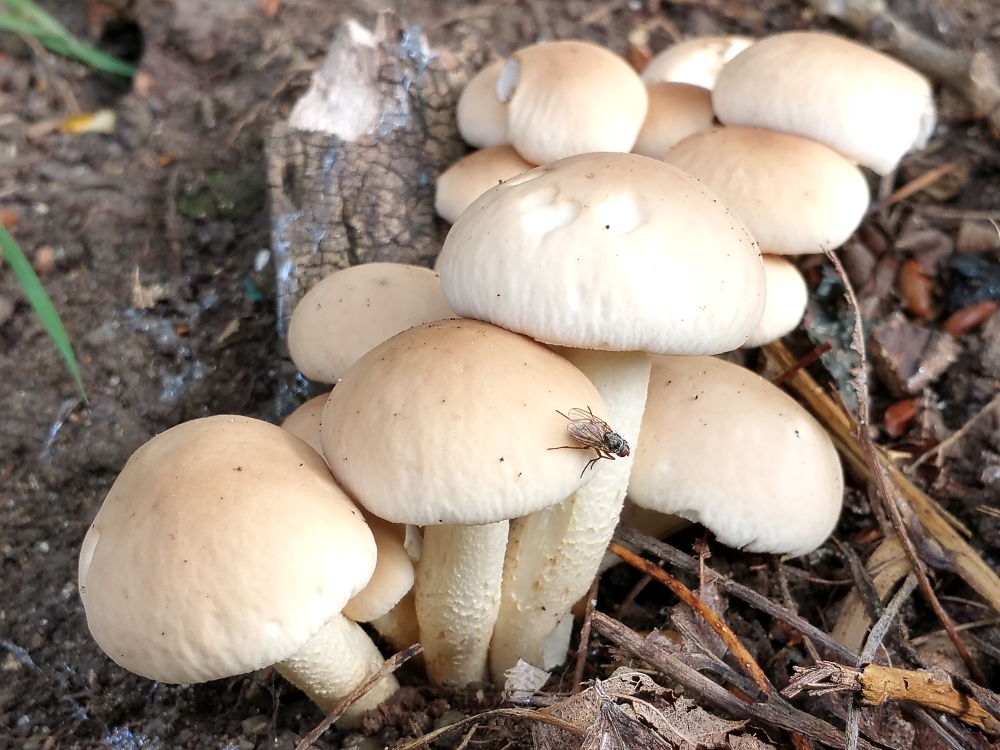
The bed of wood chips under the plane trees near the Physical Engery statue continues to produce a fine crop of Stubble Rosegill mushrooms, Volvariella gliocephala. The second word means 'glue-headed', and you can see that debris is sticking to the cap. I tried to pull the larger bits off to make a better picture, but they wouldn't come away.