Wednesday, 14 August 2013

The family of Great Crested Grebes have emerged from the shelter of the island, and were being fed in the open water between the island and the small boathouses. They are now too large for both of them to sit on a parent's back. Here their father has shaken them off and is stretching his wings, which have grown stiff in holding a large chick.


Ulrike, who often comments on this blog, thought that yesterday's picture of a grebe's swimming action were too academic. So here is a brief YouTube video of a grebe swimming under water. It is the only good clip I could find, and shows the Western Grebe -- Aechmophorus occidentalis, the big American species -- in California.


Back home, here is the Zebra Finch that turned up unexpectedly in the Flower Walk a few days ago. This picture was taken by one of the gardeners, Bernard Horowski, who kindly sent it to me.


The bird is a female. It hasn't been seen for several days and may no longer be with us.

The ripening blackberries have attracted a fair number of Wood Pigeons.


These birds spend a lot of time climbing along thin twigs that are not up to their considerable weight, and often seem to be completely floundering in a bush. This one spent several minutes in finding a secure foothold so that it could reach out and grab its prize.

One of the Hobbies was calling from a tree near the Queen's Temple. It didn't emerge into sight. We shall have the family until some time in September, when they migrate to sub-Saharan Africa. They travel with the Swallows and other hirundines, eating a fair number of them on the way.

A female Mandarin poses nonchalantly on one leg on a post.

Tuesday, 13 August 2013

Several Great Crested Grebes were fishing right at the edge of the Serpentine, a sign that the new season's fish have finally grown to a reasonable size and are quite numerous. This is also good news for grebe chicks. There are are only two of these at the moment, at the island (I think the half-grown one which was fishing on its own has not survived, though it would be good to be proved wrong). But there are now four nests on the go, and the grebes have been sitting on all of these for several straight days, so it looks as if they all have eggs. Better late than never.

The technique that grebes use for catching small fish in shallow water is quite different from their normal technique. They cruise around constantly looking under the surface to spot a little school of fish.


Having seen one, they make a quick horizontal lunge rather than a proper dive.


You can see from this picture that the grebe's legs are sticking out at right angles, a position that no web-footed bird would ever adopt. But for a grebe, with its unique turbine-blade toes, this is the beginning of the powerful thrust that propels it forward faster than any other foot-propelled bird.

The complete cycle is shown in this sequence photographed against a measuring grid.


It is from Christoffer Johansson and Ulla M. Lindhe Norberg, Lift-based paddling in diving grebe, a paper published by the Department of Zoology of Göteborg University in 2001, which you can see here.

The grebe in these pictures was reared from an egg by the researchers and filmed in a pool in a laboratory; they threw a live fish into the water to get it to swim past the camera. However, it is not going nearly as fast as it would when hunting in the wild; the paper quotes 1 metre per second, which is about 2¼ mph. A Great Crested Grebe can easily manage three times that speed, maybe more, and it is lilkely that its swimming stroke looks different at maximum speed.

After all that academic stuff you deserve a picture of a fluffy Mallard duckling.


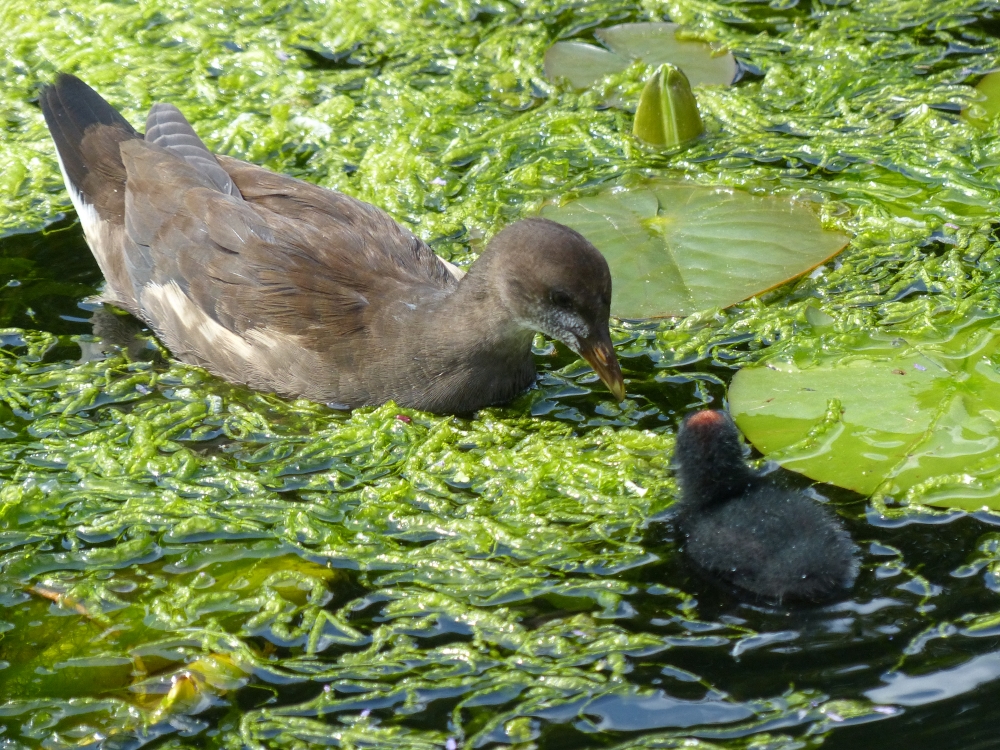
This is from a brand-new brood on one of the ponds in the Italian Garden. The babies are still small enough to fit back into the egg. They were on the same pond as the other Mallard brood, and the two mothers were eyeing each other with a certain hostility. The ponds are heavily overgrown with weed, which is at the moment supporting two broods of Mallards, two of Moorhens and one of Coots, plus the solitary young Mute Swan that seems to have made the place its home.

Monday, 12 August 2013

Stirrings in the bushes beside the ticket office of the Lido turned out to be several Dunnocks.


Evidently they have bred. They have been in this spot for several years, and it is one of the best places to see Dunnocks because you can get on both sides of the hedge. There are probably quite a lot of Dunnocks in the park, but almost all remain unseen deep in the bushes.

One pair of birds that has definitely bred is the Wrens in the little shrubbery at the southwest corner of the Serpentine bridge. Two young birds were making a remarkable amount of noise begging to be fed -- wrens are amazingly loud for their tiny size. Here is one of them.


A pair of Blackbirds in the Dell have had two young, though these are now large enough to forage for themselves and have stopped bothering their parents. Here one of them enjoys an apple  discarded by a visitor; the two were taking turns at pecking at this unexpected treat.


This Moorhen was walking along the edge of the waterfall in the Dell, leaning over the edge and hauling up clumps of algae growing under the lip of the fall.


The sure-footed bird kept its grip on the slippery stone with a fast current flowing over it. Of course if it were swept away it would simply take to the air. But I have never seen a Moorhen fall off anything it chose to climb on.

The Reed Warbler family could be heard in the reeds near the Diana fountain, with an occasional glimpse of an adult flying out and plunging into the reeds again.

The two Great Crested Grebe chicks were in their usual place next to the isalnd, and there are now three nests on the go: one on the island and two on the Long Water. All the birds are months behind their usual summer schedule (except for the weatherproof Tawny Owls, who were nowhere to be seen today).

Sunday, 11 August 2013

Another sign of the approach of autumn: a Wood Pigeon was eating elderberries, hanging recklessly upside down from a thin twig.


The rowan berries are almost ripe, and I visited the trees at the top of Buck Hill to see if they had attracted any Mistle Thrushes, but there was no sign of these yet. Rowan berries are also a favourite food of Waxwings, but the trees in the park seem to fruit too early for any to be left when these winter visitors arrive. Perhaps this explains the relative rarity of these birds in the park -- though we had some late arrivals on 8 April this year, when they were already on their migration to Scandinavia.

The number of Herring Gulls and Lesser Black-Backed Gulls is rising, with the arrival of more juveniles of (I think) both species on the Serpentine. Some of the Mallard ducklings are now large enough to be out of danger from them. The Mandarin still has her brood of four: here they are resting on the edge of the Long Water near the bridge.


Although she takes her ducklings on to the exposed open water of the Serpentine, she does seem to be aware of danger. I watched her crossing the lake near the bridge, going along the line of wooden posts. A Herring Gull landed on a post in front of her, and she quickly turned sharp right and took her family under the bridge.

The two Great Crested Grebe chicks were in their usual place at the northwest corner of the island. The nest at the northeast corner is still occupied, with no sign of hatching yet.


So is the nest in the fallen poplar on the Long Water. The pair opposite Peter Pan have reoccupied one of their old nest sites, but these birds have had so many failed attempts that I very much doubt whether anything will come of this one.

However, there are still plenty of fish for them. Here a grebe has caught one of last year's perch, about 4 inches long, and there are small fish for the chicks too.


Last year's fish are now large enough to be interesting, but not irresistible, to Cormorants, and the number of these is increasing only slowly -- there were just four today.

No futher sight of the Little Owl despite several visits to his tree and the adjacent ones.

Saturday, 10 August 2013

The Little Owl, not much seen recently, appeared on his nest tree.


We know that this one is the male, because he stayed calmly staring at us for some time. The female is much shyer and would have darted into her hole as soon as she was noticed.

The London Bird Club Wiki reported a Little Owl crossing the lake near the bridge, heading for Kensington Gardens, yesterday at dusk. This would be a different owl, which has been seen near the Serpentine Gallery several times. On once occasion it was picking up bits of paper tissue, suggesting that it is one of a pair and they were building their nest.

The same observer, Matt Reed, also heard the male Tawny Owl hooting repeatedly to the west of his nest tree. A search of the area this morning didn't find him. But it is not all that useful to look in a place where an owl was yesterday.

The single young swan on the Long Water is at last beginning to develop proper wings.


This bird is about three months old. It  will take another month to become airworthy.

Speaking of airworthiness, today the six young Egyptian Geese at the Round Pond were frightened by the sight of a distant dog and ran, rather than flew, into the water.  Their wings are now fully developed, but they will need practice before they can trust them as a means of escape.

Egyptians can run very fast, much better than ordinary geese and ducks. This very young one grabbed a bit of bread that a full-grown Canada Goose was about to take.


It did this several times while I watched, sprinting fearlessly around the heavy adults.

Here is a bumblebee on a dahlia in the Flower Walk.

Friday, 9 August 2013

Reed Warblers have bred in the reed bed near the Diana fountain. Scratchy begging cries could be heard from the middle of the larger of the two sections of reeds, while adults whizzed along the whole length of the bed, presumably looking for insects for their young. It was very hard to get more than a momentary glimpse of these restless, busy birds.


This is not the first time that Reed Warblers have bred in the park. Last summer they bred in the small reed bedon the Long Water next to the bridge, an oddly cramped site from which they moved as soon as the young birds could fly. Now that some of the beds are consolidating and slowly spreading into the many areas where the planted reeds died, it is becoming a better habitat, and I think that this year has been the first when we had three singing males.

My suspicion that someone has dumped goldfish in the Italian Garden was confirmed when a couple of them emerged from a clump of plants in the northwest pond in the Italian Gardens. This explains why the Grey Herons were so interested in the pond a few months ago, though it is too deep for them to stand and they didn't succeed in catching anything from the edge, and eventually gave up and left.


They were in the pond nearest the gate, so there was less distance to carry the bucket. It was also used to dump an unwanted batch of goldfish -- at least 40 of them -- in 2007. These were killed (deliberately and unnecessarily) when the ponds were drained.

There was also a silver fish which I saw only momentarily, but it had dark vertical bands on it like a perch. However, it is more likely that it was an oddly marked carp.

In the same pond, a Moorhen chick sitting on a stem of purple loosestrife was contemplating a bumblebee.


And in the next pond a Coot surfaced directly underneath one of its chicks. The chick was not disturbed by this, and paddled off calmly.


Coots have difficulty diving because they are intractably buoyant. They have to paddle furiously, head down, to stay under and gather weed from the bottom. As soon as they stop paddling they surface stern first. It is not an elegant performance.

Thursday, 8 August 2013

One of the teenage Moorhens on the Italian Garden pond was feeding little bits of algae to one of the new chicks. They are, in fact, brothers or sisters. But whether it was caused by fraternal feeling or the teenager was imitating the grown-ups is hard to say.


On the next pond, where there is a family of Coots with five chicks, things were less harmonious, but just as sensible in terms of securing the survival of as many chicks as possible. This adult is chasing off the largest chick because it has been getting all the food, so that the smaller chicks can have their turn.


I have also seen Great Crested Grebes chasing away their strongest chick. Do birds have a concept of fairness? Impossible to tell what is going on in their heads.

There is yet another Great Crested Grebes' nest built and occupied opposite Peter Pan, under a willow bush just south of the line of posts. But so many nests have been made and abandoned here that I doubt whether they will get as far as laying eggs. The other nest on the east side of the Long Water and the absurdly situated one on the fallen tree are still both occupied.

Near the Serpentine island, the two young grebe chicks were romping all over their father's back.


I think he was rather annoyed, because after a while he stood up in the water and tipped them off -- he was in a safe place under overhanging bushes. He left them in the water for a few minutes before letting them climb on again, after which they were noticeably quieter. Their mother was a short way off, searching for small fish.

The six young Egyptian Geese on the Round Pond are nearly flying. Someone who was here yesterday said that she had seen them charging about flapping, but they had not managed any more than a short hop. Fortunately, all their wings seem to be growing straight. Here one of them lies in an exggeratedly relaxed pose to preen its new flight feathers.