An early sign of the approach of autumn: a Blackbird finds a ripe blackberry.
He ate it himself. But there are plenty of Blackbirds with families in the bushes. Here is a young one which was chasing its mother around near the bridge calling for food.
Other songbirds are more grown up now. The young Great Tits are gradually beginning to find their own insects, and are making less demand on their parents -- you can tell this simply because they are making less noise. Most of the young ones will now come down to take food off your hand.
This teenage Robin in the Flower Walk has also come to my hand on several days, staying to take several pine nuts or sunflower seeds.
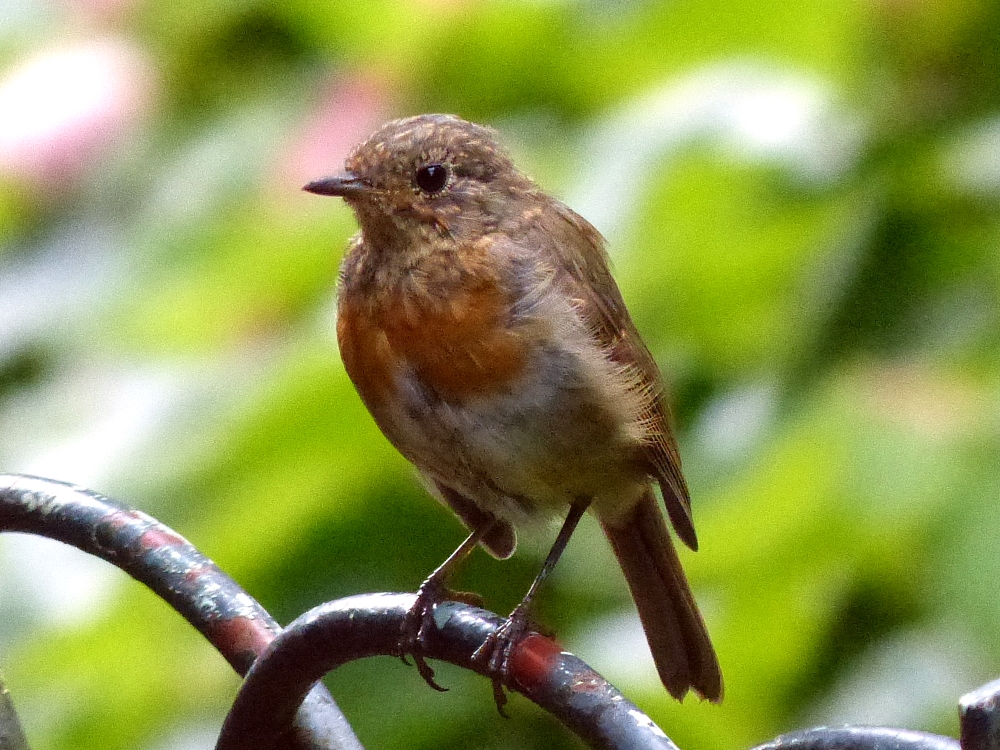
As you can see, it is already beginning to grow the red feathers of adulthood. Soon it will no longer be tolerated by adults, since the red breast of a rival Robin makes an adult literally 'see red', and drive the intruder out of its territory. (I didn't use the metaphor of 'a red rag to a bull'. Cattle can't see red, as their eyes have colour receptors only for yellow and violet, and to them the matador's cape looks grey. If he waved a high-visibilty jacket instead they could see it very clearly, but might not charge as they find the bright colour frightening.)
The Mallard duckling that was trapped in the wire netting yesterday is alive and well. However, all four ducklings had recklessly climbed back into the same enclosure today. Their mother was sitting on top of the knocked-down plants that allow them to get in and out, keeping the Moorhens at bay in case they should want to start any rough stuff.
The solitary cygnet of the Mute Swans on the Long Water has grown rapidly in recent days and is now almost as large as its parents.
If there were a prize for unsuitable nest sites, this Great Crested Grebe would win it.
It is on the tip of a Lombardy poplar that fell into the Long Water several years ago. However, a pair of grebes nested at the end of another fallen poplar last year somehow managed to raise three chicks.
The two new grebe chicks were still at the Serpentine island today, riding on one parent's back and being fed by the other.
Wednesday, 7 August 2013
Tuesday, 6 August 2013
At last we have some more Great Crested Grebe chicks. There are two of them, and they are from an unseen nest behind the baskets on the northwest corner of the island.
Just after I took this picture, the chick in the water scrambled up its mother's back, and the father arrived with a small fish of exactly the right size. I am not showing this picture because all you can see of the chicks is a confused tangle of its mother's wing feathers. Having babies ruins grebes' wings, but they moult their flight feathers soon afterwards and can fly again before there might be frosty weather that would drive them off the lake and on to the Thames.
The other grebes' nest on the island, on the northeast corner, is still going along, and so is the one on the Long Water near the Vista.
There was a drama in the Italian Garden, fortunately with a happy ending. All the Moorhen family -- parents, three teenagers and five small chicks -- were in the same pond as the Mallard with four ducklings. The Moorhens had pushed over a clump of purple loosestrife, which lay over the top of the wire netting to form a bridge, and one of the ducklings had managed to scramble up it, followed by its mother.
Then the duckling jumped off the plants, and was inside the enclosure. This displeased the Moorhens, and an adult attacked it ...
... and so did one of the teenagers. The duckling was now in a panic to get out. But, lacking the big prehensile feet of a Moorhen, it couldn't climb up the wire netting, and it couldn't get through the mesh, although it tried several times. Its mother flew out of the enclosure and tried to call it out, but the Moorhens were now in possession of the bridge and it couldn't get past them.
I was watching this with a man with a young family, and we were all concerned with the duckling's fate. The man managed to hold his little daughter out at arm's length so that she could stamp down the netting at one of the corner posts. But the duckling was now too flustered to find this exit.
Eventually it made a desperate effort to get through the netting on the side towards the shore, and stuck halfway after it had got its wings through, so there was no returning. The man bravely took off his shoes and socks and waded into the slimy pond, and I gave him a pair of wirecutters that I always carry so that he could free the trapped bird. But his approach frightened the duckling into a last struggle, and it got through the mesh and skittered away, to everyone's relief.
The Mandarin with four ducklings is taking them around the Serpentine, and so far they have survived being in this exposed place. She looks after them carefully, but couldn't always shield them from a diving gull. She was at the Lido swimming area standing on one of the white plastic buoys, and somehow one of the ducklings had managed to get inside the swimming area, perhaps by diving under the buoys. The mother duck showed good sense in getting it out. She swam along the line of buoys to the jetty. There is a gap under this, and when she called, sure enough the duckling came racing out and joined the others.
Just after I took this picture, the chick in the water scrambled up its mother's back, and the father arrived with a small fish of exactly the right size. I am not showing this picture because all you can see of the chicks is a confused tangle of its mother's wing feathers. Having babies ruins grebes' wings, but they moult their flight feathers soon afterwards and can fly again before there might be frosty weather that would drive them off the lake and on to the Thames.
The other grebes' nest on the island, on the northeast corner, is still going along, and so is the one on the Long Water near the Vista.
There was a drama in the Italian Garden, fortunately with a happy ending. All the Moorhen family -- parents, three teenagers and five small chicks -- were in the same pond as the Mallard with four ducklings. The Moorhens had pushed over a clump of purple loosestrife, which lay over the top of the wire netting to form a bridge, and one of the ducklings had managed to scramble up it, followed by its mother.
Then the duckling jumped off the plants, and was inside the enclosure. This displeased the Moorhens, and an adult attacked it ...
... and so did one of the teenagers. The duckling was now in a panic to get out. But, lacking the big prehensile feet of a Moorhen, it couldn't climb up the wire netting, and it couldn't get through the mesh, although it tried several times. Its mother flew out of the enclosure and tried to call it out, but the Moorhens were now in possession of the bridge and it couldn't get past them.
I was watching this with a man with a young family, and we were all concerned with the duckling's fate. The man managed to hold his little daughter out at arm's length so that she could stamp down the netting at one of the corner posts. But the duckling was now too flustered to find this exit.
Eventually it made a desperate effort to get through the netting on the side towards the shore, and stuck halfway after it had got its wings through, so there was no returning. The man bravely took off his shoes and socks and waded into the slimy pond, and I gave him a pair of wirecutters that I always carry so that he could free the trapped bird. But his approach frightened the duckling into a last struggle, and it got through the mesh and skittered away, to everyone's relief.
The Mandarin with four ducklings is taking them around the Serpentine, and so far they have survived being in this exposed place. She looks after them carefully, but couldn't always shield them from a diving gull. She was at the Lido swimming area standing on one of the white plastic buoys, and somehow one of the ducklings had managed to get inside the swimming area, perhaps by diving under the buoys. The mother duck showed good sense in getting it out. She swam along the line of buoys to the jetty. There is a gap under this, and when she called, sure enough the duckling came racing out and joined the others.
Monday, 5 August 2013
The long running soap opera of the Great Crested Grebes had another episode today, with a new nest on the east side of the Long Water just north of the Vista. Here it is, taken from too far away for a good picture.
Another pair were displaying to each other opposite Peter Pan before cruising off side by side to look for nesting places under the willow trees. Maybe nothing will come of either attempt, but it is not too late: grebes have nested here at this time before and raised young. Meanwhile, the nest of the northeast corner of the Serpentine island is still occupied. These are the birds who raised the one and only chick this year -- which I have not seen for several days; I hope it's all right. The nest is extremely difficult to see because it is behind the line of floating plant baskets. These baskets drift slowly from side to side in the sluggish current, and you have to wait till the gap passes in front of the nest.
The Mandarin still has her four ducklings and had taken them on to the Serpentine, where she stood on the edge contemplating her brood with visible satisfaction.
The pigeon-eating Lesser Black-Backed Gull was nearby, bit fortunately seemed more interested in pursuing pigeons, with no success while I watched.
Here is today's shot of the black and white Mallard and her pale mate, who is now in total eclipse. At a casual glance you would think that she is the drake and he is female, but the yellow bill shows who is who. The black and white duck, being female, stays the same colour all the time. Both of them have moulted their flight feathers and are waiting for new ones to grow.
On the Italian Garden pond, one of the three teenage moorhens was eating small parasites off a sibling.
I also saw them amicably sharing a bit of bread, one bird eating each end. And they are swimming about among the younger brood without any conflict with them or with their parents. It is a more peaceful scene than one usually sees in the unsentimental and often harsh world of birds.
Another pair were displaying to each other opposite Peter Pan before cruising off side by side to look for nesting places under the willow trees. Maybe nothing will come of either attempt, but it is not too late: grebes have nested here at this time before and raised young. Meanwhile, the nest of the northeast corner of the Serpentine island is still occupied. These are the birds who raised the one and only chick this year -- which I have not seen for several days; I hope it's all right. The nest is extremely difficult to see because it is behind the line of floating plant baskets. These baskets drift slowly from side to side in the sluggish current, and you have to wait till the gap passes in front of the nest.
The Mandarin still has her four ducklings and had taken them on to the Serpentine, where she stood on the edge contemplating her brood with visible satisfaction.
The pigeon-eating Lesser Black-Backed Gull was nearby, bit fortunately seemed more interested in pursuing pigeons, with no success while I watched.
Here is today's shot of the black and white Mallard and her pale mate, who is now in total eclipse. At a casual glance you would think that she is the drake and he is female, but the yellow bill shows who is who. The black and white duck, being female, stays the same colour all the time. Both of them have moulted their flight feathers and are waiting for new ones to grow.
On the Italian Garden pond, one of the three teenage moorhens was eating small parasites off a sibling.
I also saw them amicably sharing a bit of bread, one bird eating each end. And they are swimming about among the younger brood without any conflict with them or with their parents. It is a more peaceful scene than one usually sees in the unsentimental and often harsh world of birds.
Sunday, 4 August 2013
There are now 27 Mallard ducklings in the park: 19 on the main lakes and Italian Garden ponds, and 8 on the Round Pond. Here is one on the Long Water enjoying a splash.
The four Mandarin ducklings were also on the Long Water. They are still very small -- and of course will never be very large -- and are still at risk of gull attack. Their mother has the sense to keep them under the bushes most of the time.
A new brood of five Coot chicks has appeared unexpectedly on one of the Italian Garden ponds. As usual, they have completely trashed a lot of water plants, and have even pulled up some waterlilies to make their nest.
The eight Moorhen chicks -- five new ones and three older ones with the same parents -- are still on their pond.
And so are the four Mallard ducklings, though the family had wandered into the same pond as the lone Mute Swan, which was threatening them in a desultory way. Well, they can leave if the swan becomes a serious nuisance.
I saw two Hobbies flying between trees near the Queen's Temple, though they sped off before I could get a picture. In a nearby lime tree, a Magpie was making a fuss. It might have been scolding the young Hobby while its parents were away hunting, but I couldn't see far enough into the tree to make sure.
This young Pied Wagtail is often seen around the Lido, often using the posts and netting around the reed beds as a station from which is darts out to catch insects.
It is odd that it remains here on its own rather than joining the main flock of Pied Wagtails on the Parade Ground.
The four Mandarin ducklings were also on the Long Water. They are still very small -- and of course will never be very large -- and are still at risk of gull attack. Their mother has the sense to keep them under the bushes most of the time.
A new brood of five Coot chicks has appeared unexpectedly on one of the Italian Garden ponds. As usual, they have completely trashed a lot of water plants, and have even pulled up some waterlilies to make their nest.
The eight Moorhen chicks -- five new ones and three older ones with the same parents -- are still on their pond.
And so are the four Mallard ducklings, though the family had wandered into the same pond as the lone Mute Swan, which was threatening them in a desultory way. Well, they can leave if the swan becomes a serious nuisance.
I saw two Hobbies flying between trees near the Queen's Temple, though they sped off before I could get a picture. In a nearby lime tree, a Magpie was making a fuss. It might have been scolding the young Hobby while its parents were away hunting, but I couldn't see far enough into the tree to make sure.
This young Pied Wagtail is often seen around the Lido, often using the posts and netting around the reed beds as a station from which is darts out to catch insects.
It is odd that it remains here on its own rather than joining the main flock of Pied Wagtails on the Parade Ground.
Saturday, 3 August 2013
On a sunny Saturday there are so many people in the park that it's hard to see much. The Mallard ducklings in the Italian Garden were busily rooting about in the waterlily leaves. You can see some insects on the leaves, but they were paying more attention to the undersides of the leaves, where no doubt there were other small creatures.
It has been an amazingly good year for Mallard ducklings. Not only are there a lot of broods, but far more of them are surviving than usual. This is almost entirely due to the small number of big gulls on the lake. Today I saw only half a dozen Lesser Black-Backs and one Herring Gull, all of them on the Serpentine, away from the Long Water where most of the ducklings are.
The teenage Moorhens in the Italian Garden have discovered that if they climb up the water plants, these will bend over and make a comfortable place for them to rest. They are making rather a mess of the ornamental clumps.
The Hobbies are still in the trees around the Vista on the west side of the Long Water. I heard them calling but, as usual, couldn't find where they were perched. A search for owls also failed to find any.
The five Canada-Greylag hybrid geese have joined up into a gang, and were swaggering about the Serpentine pushing Greylags out of the way. I was surprised to see them acting aggressively, since normally they blend into the Greylag flock and are treated as equals. But something seems to have alienated them. Only three of them, the attractively speckled ones, are siblings, and the others are from two different broods and have been in the park for longer.
The little pool at the top of the waterfall in the Dell, which used to be a bathing and drinking place for small birds, was ruined by gardeners pulling up all the bushes which had sheltered it and substituting ugly annuals. However, it is still used by larger and less timid birds, such as this Wood Pigeon which came down for a bathe.
A young Magpie also came to drink there.
It has been an amazingly good year for Mallard ducklings. Not only are there a lot of broods, but far more of them are surviving than usual. This is almost entirely due to the small number of big gulls on the lake. Today I saw only half a dozen Lesser Black-Backs and one Herring Gull, all of them on the Serpentine, away from the Long Water where most of the ducklings are.
The teenage Moorhens in the Italian Garden have discovered that if they climb up the water plants, these will bend over and make a comfortable place for them to rest. They are making rather a mess of the ornamental clumps.
The Hobbies are still in the trees around the Vista on the west side of the Long Water. I heard them calling but, as usual, couldn't find where they were perched. A search for owls also failed to find any.
The five Canada-Greylag hybrid geese have joined up into a gang, and were swaggering about the Serpentine pushing Greylags out of the way. I was surprised to see them acting aggressively, since normally they blend into the Greylag flock and are treated as equals. But something seems to have alienated them. Only three of them, the attractively speckled ones, are siblings, and the others are from two different broods and have been in the park for longer.
The little pool at the top of the waterfall in the Dell, which used to be a bathing and drinking place for small birds, was ruined by gardeners pulling up all the bushes which had sheltered it and substituting ugly annuals. However, it is still used by larger and less timid birds, such as this Wood Pigeon which came down for a bathe.
A young Magpie also came to drink there.
Friday, 2 August 2013
Two more broods of Moorhens have appeared on the Serpentine. I had wondered why I saw so few when I was doing my monthly count a few days ago; evidently they were busy. There are three half-grown chicks at the Serpentine island, which must have been hidden in the bushes for several weeks. And there are six brand-new chicks under the boat hire platform. This family ventured out briefly and were promptly attacked by a Lesser Black-Backed Gull, but a fierce squawking leap by their mother saved the day, and they all scuttled back under the platform.
All the chicks of the two broods on the Italian Garden pond are still alive. You can see some of them behind this adult nimbly climbing out of the wire netting enclosure to fetch the young ones some food.
The older ones are able to fend for themselves.
The four Mallard ducklings on the same pond are still in good shape, and there is yet another brood of five Mallard ducklings a few weeks old on the Long Water -- they were on the grass on the west side of the bridge. This is not the brood of five half-grown Mallards I saw on the other side of the bridge yesterday, as these swam past when I was looking at the younger chicks.
The seemingly endless start-stop story of the Great Crested Grebes' nests continues. The one on the Long Water that I photographed two days ago has fallen apart -- it had seemed to be in an unsuitable and exposed place -- and the same pair are now building another nest a few yards away, conventionally in the shelter of a willow tree. It is a soggy mess, but that is what grebes' nests are like.
The blonde Egyptian Goose was preening herself on the edge of the Serpentine, and stretched out an elegant pale wing for my inspection.
I have still not seen her flying. She should be an interesting sight in the air, not at all like the strongly contrasted brown, white and black look of a normal coloured Egyptian Goose.
Here is a bumble bee on a sea holly flower -- the flower is Eryngium bourgatii, I think, but I wouldn't dare to guess the species of the bee.
All the chicks of the two broods on the Italian Garden pond are still alive. You can see some of them behind this adult nimbly climbing out of the wire netting enclosure to fetch the young ones some food.
The older ones are able to fend for themselves.
The four Mallard ducklings on the same pond are still in good shape, and there is yet another brood of five Mallard ducklings a few weeks old on the Long Water -- they were on the grass on the west side of the bridge. This is not the brood of five half-grown Mallards I saw on the other side of the bridge yesterday, as these swam past when I was looking at the younger chicks.
The seemingly endless start-stop story of the Great Crested Grebes' nests continues. The one on the Long Water that I photographed two days ago has fallen apart -- it had seemed to be in an unsuitable and exposed place -- and the same pair are now building another nest a few yards away, conventionally in the shelter of a willow tree. It is a soggy mess, but that is what grebes' nests are like.
The blonde Egyptian Goose was preening herself on the edge of the Serpentine, and stretched out an elegant pale wing for my inspection.
I have still not seen her flying. She should be an interesting sight in the air, not at all like the strongly contrasted brown, white and black look of a normal coloured Egyptian Goose.
Here is a bumble bee on a sea holly flower -- the flower is Eryngium bourgatii, I think, but I wouldn't dare to guess the species of the bee.
Thursday, 1 August 2013
Two Lesser Black-Backed Gulls were circling over the Italian Garden, and the Mallard had sensibly herded her ducklings into the shelter of a clump of reeds.
The Moorhens in the same pond had done the same with their chicks. This is not a surprise with Moorhens, birds that are good at skulking in cover when danger threatens. But Mallards are often remarkably careless about big gulls waiting to snatch their young.
You might think that, if only the offspring of clever, wary Mallards survive, natural selection would have produced a race of super-intelligent ducks who today might be driving around in BMWs while we crouch furtively in the reeds. But no doubt reversion to the norm ensures that ducks don't get to this stage.
This Song Thrush holding a mixed bag of worms and insects crossed the path in the Flower Walk as I came into the park.
When I went back the same way a few hours later, it was also carrying food across the path. Evidently the pair are bringing up a very late brood. The male is a familiar sight and sound in spring, singing from a tree near the crossing of the path from the Albert Memorial.
The Green Woodpecker on Buck Hill came out and obligingly perched on a tree trunk to be photographed -- normally they rush round the back of the tree as soon as they see you.
It's a pity that the bird was in deep shade. This picture would have been better on a cloudy day.
This butterly is a Meadow Brown, Maniola jurtina, a very common British species.
They are very active butterflies and only perch for a brief second; and when they do, they always fold up their wings, so it is almost impossible to get a photograph of their quiet but beautiful wing pattern. There are lots of them at the moment, so I will keep trying.
The Moorhens in the same pond had done the same with their chicks. This is not a surprise with Moorhens, birds that are good at skulking in cover when danger threatens. But Mallards are often remarkably careless about big gulls waiting to snatch their young.
You might think that, if only the offspring of clever, wary Mallards survive, natural selection would have produced a race of super-intelligent ducks who today might be driving around in BMWs while we crouch furtively in the reeds. But no doubt reversion to the norm ensures that ducks don't get to this stage.
This Song Thrush holding a mixed bag of worms and insects crossed the path in the Flower Walk as I came into the park.
When I went back the same way a few hours later, it was also carrying food across the path. Evidently the pair are bringing up a very late brood. The male is a familiar sight and sound in spring, singing from a tree near the crossing of the path from the Albert Memorial.
The Green Woodpecker on Buck Hill came out and obligingly perched on a tree trunk to be photographed -- normally they rush round the back of the tree as soon as they see you.
It's a pity that the bird was in deep shade. This picture would have been better on a cloudy day.
This butterly is a Meadow Brown, Maniola jurtina, a very common British species.
They are very active butterflies and only perch for a brief second; and when they do, they always fold up their wings, so it is almost impossible to get a photograph of their quiet but beautiful wing pattern. There are lots of them at the moment, so I will keep trying.


