A pleasant day, but nothing unusual to see. There was a lot of cawing from an aerial dogfight over Kensington Gardens, and when that happens you hastily take pictures before looking to see which birds are involved, hoping that it will be a dispute between a Carrion Crow and a bird of prey. But it turned out to be an ordinary crow-on-crow dispute and the pictures were trivial.
In the Italian Garden two small Mallard ducklings had somehow managed to scrabble up the near vertical, 1 foot tall lip of the pond. Here their mother looks at them proudly while a third duckling is unable to make the climb.
The fourth one was dozing among the water lilies and took no part in the expedition.
The Great Crested Grebes' second nest on the Serpentine island can only be glimpsed momentarily as the baskets drift from side to side, and it is distant and overshadowed, so clear pictures are impossible. The sitting bird, on the right in the picture, had its wings raised as if eggs had hatched already and the chicks were on its back.
This was probably a misleading impression, as I had not seen a new nest there before Wednesday. However, while the young grebe from that nest was still being fed, for the last few weeks only one parent was visible at a time. It is possible that the young one was kicked out to fend for itself when the new clutch of eggs began to hatch. Or this may be a load of speculative nonsense. Will keep watching.
A small skein of Greylag Geese were flying up and down the Serpentine to test their new wing feathers.
Some of the geese here are still unable to fly. But this one has a full set of primaries with the tips crossed over its tail, and could have joined the flight if it had not been vainly trying to eat a crabapple which had fallen off its tree and rolled into the lake.
Friday, 26 July 2013
Thursday, 25 July 2013
Four Mandarin ducklings have appeared on the Long Water, the first brood in three years if I remember rightly. Note the distinctive double eye stripe which will develop into the complex eye pattern of the adult.
It seemed odd that the Mallards had been having a successful year, but none of the other species, but that is now rectified. However, these little birds will need a lot of luck if they are to pull through. So far the dangerous big gulls have not paid much attention to the Long Water.
Mandarins are rather aggressive, and it seems to start early. One of the ducklings chased away an adult Mallard which had come too close to the brood.
Meanwhile, on the pond in the Italian Gardens, the mother Mallard's strategy of keeping her ducklings in the water lily patch seems to be working so far. She still has four, and there have been no losses for more than a week. Here one of them sleeps peacefully with its little wing resting on a leaf.
The ducklings are quite well concealed by the strong texture of the leaves and flowers. In camouflage, pattern is more effective as a disguise than colour.
This Mute Swan cygnet is having a hard time getting down the little step into the lake. It couldn't step down four inches, and had to resort to sliding on its belly.
Previously I had watched the cygnets waddling awkwardly around, and had been struck by the way they were just as ungainly on land as enormous adult swans. Luckily they will probably never have to run, as they are well protected by the ferocity of their parents.
A Cormorant was washing itself near the Serpentine island, a frantic process involving alternate diving and violent flapping.
It seemed odd that the Mallards had been having a successful year, but none of the other species, but that is now rectified. However, these little birds will need a lot of luck if they are to pull through. So far the dangerous big gulls have not paid much attention to the Long Water.
Mandarins are rather aggressive, and it seems to start early. One of the ducklings chased away an adult Mallard which had come too close to the brood.
Meanwhile, on the pond in the Italian Gardens, the mother Mallard's strategy of keeping her ducklings in the water lily patch seems to be working so far. She still has four, and there have been no losses for more than a week. Here one of them sleeps peacefully with its little wing resting on a leaf.
The ducklings are quite well concealed by the strong texture of the leaves and flowers. In camouflage, pattern is more effective as a disguise than colour.
This Mute Swan cygnet is having a hard time getting down the little step into the lake. It couldn't step down four inches, and had to resort to sliding on its belly.
Previously I had watched the cygnets waddling awkwardly around, and had been struck by the way they were just as ungainly on land as enormous adult swans. Luckily they will probably never have to run, as they are well protected by the ferocity of their parents.
A Cormorant was washing itself near the Serpentine island, a frantic process involving alternate diving and violent flapping.
Wednesday, 24 July 2013
The pair of Great Crested Grebes who had one chick, and have just kicked it out to fend for itself, are, as I suspected, nesting again, almost in the same place as before on the northeast corner of the island. You can get occasional glimpses of the nest through a gap between two wire baskets.
So there are two grebes' nests now. The one opposite Peter Pan is still going strong, and I saw the pair mating, almost hidden by the leaves of the weeping willow in which they nested.
The first juvenile Black-Headed Gull of the year has turned up at Peter Pan.
These small gulls mature much faster than larger ones such as Herring Gulls, and get fully adult plumage in their second year. Only the colour of their legs and feet gives away their age, as it gradually changes over several years from marmalade to beetroot. Herring Gulls and Lesser Black-Backed Gulls take four years to attain a fully adult appearance.
A Little Owl was again in the first sweet chestnut tree to the west of the nest tree. It must have been the female, as she is much shyer than her mate and vanishes if you look at her. This time, as soon as she saw people near her tree, she flew fifty yards farther west into the next chestnut tree in the line -- there is a gap in the line here where two of the old trees have died. This is the longest flight I have seen her take. Earlier this morning, one of the Little Owls was heard calling incessantly as if something was annoying it.
The three young Moorhens are still doing well in the Italian Garden pond. Here they have all decided to cry out at once.
The sunlight caught this Egyptian Goose at just the right angle to light up the brilliant iridescent green of its secondary wing feathers.
So there are two grebes' nests now. The one opposite Peter Pan is still going strong, and I saw the pair mating, almost hidden by the leaves of the weeping willow in which they nested.
The first juvenile Black-Headed Gull of the year has turned up at Peter Pan.
These small gulls mature much faster than larger ones such as Herring Gulls, and get fully adult plumage in their second year. Only the colour of their legs and feet gives away their age, as it gradually changes over several years from marmalade to beetroot. Herring Gulls and Lesser Black-Backed Gulls take four years to attain a fully adult appearance.
A Little Owl was again in the first sweet chestnut tree to the west of the nest tree. It must have been the female, as she is much shyer than her mate and vanishes if you look at her. This time, as soon as she saw people near her tree, she flew fifty yards farther west into the next chestnut tree in the line -- there is a gap in the line here where two of the old trees have died. This is the longest flight I have seen her take. Earlier this morning, one of the Little Owls was heard calling incessantly as if something was annoying it.
The three young Moorhens are still doing well in the Italian Garden pond. Here they have all decided to cry out at once.
The sunlight caught this Egyptian Goose at just the right angle to light up the brilliant iridescent green of its secondary wing feathers.
Tuesday, 23 July 2013
The single young Great Crested Grebe is now independent, and was fishing by itself near the bridge. While I watched it caught two small fish.
The first weeks of independence are a dangerous time for young grebes, as they don't yet have an adult's hunting skill or local knowledge. But this one had come to the right place, near one of the baskets of twigs that have become a fish nursery, and seemed to be doing very well. I saw its parents diving under the baskets around the island where their nest had been. I wonder whether they are thinking of starting another nest, and that is why they have kicked their offspring out rather early. There is still plenty of time for a second brood. At present, the only grebes' nest that is a going concern is the one on the Long Water opposite Peter Pan.
There are now several juvenile Lesser Black-Backed Gulls on the lake, brought in by their parents from their breeding ground to live on the rich pickings of the park. This picture shows the unbroken run of grey primaries that distinguishes a young Lesser Black-Back from a young Herring Gull, which has white-tipped inner primaries.
Actually they are easy to identify at the moment because they are still hanging around with their parents.
The three young Moorhens in the Italian Garden pond, which are only a month old, are already beginning to grow flight feathers. Here you can see them emerging in the blue wrappers that keep the barbs of the feathers from getting stuck as they come out.
At first sight this picture seems ordinary enough: a Canada Goose moving through the water rather quickly.
But if you look closer you will see a ball of fluff attached to its tail. This is a Mallard duckling, and it has bitten the goose on the behind to make it go away. The incident started on shore, when someone was giving bread to the geese and a brood of five young Mallards waded in fearlessly, running under the big geese and getting quite a lot of food. This annoyed the geese, which started pecking at them. And this little bird lost its temper and went for its tormentor, causing it to flee hastily. I don't think the goose knew what had happened to it.
The first weeks of independence are a dangerous time for young grebes, as they don't yet have an adult's hunting skill or local knowledge. But this one had come to the right place, near one of the baskets of twigs that have become a fish nursery, and seemed to be doing very well. I saw its parents diving under the baskets around the island where their nest had been. I wonder whether they are thinking of starting another nest, and that is why they have kicked their offspring out rather early. There is still plenty of time for a second brood. At present, the only grebes' nest that is a going concern is the one on the Long Water opposite Peter Pan.
There are now several juvenile Lesser Black-Backed Gulls on the lake, brought in by their parents from their breeding ground to live on the rich pickings of the park. This picture shows the unbroken run of grey primaries that distinguishes a young Lesser Black-Back from a young Herring Gull, which has white-tipped inner primaries.
Actually they are easy to identify at the moment because they are still hanging around with their parents.
The three young Moorhens in the Italian Garden pond, which are only a month old, are already beginning to grow flight feathers. Here you can see them emerging in the blue wrappers that keep the barbs of the feathers from getting stuck as they come out.
At first sight this picture seems ordinary enough: a Canada Goose moving through the water rather quickly.
But if you look closer you will see a ball of fluff attached to its tail. This is a Mallard duckling, and it has bitten the goose on the behind to make it go away. The incident started on shore, when someone was giving bread to the geese and a brood of five young Mallards waded in fearlessly, running under the big geese and getting quite a lot of food. This annoyed the geese, which started pecking at them. And this little bird lost its temper and went for its tormentor, causing it to flee hastily. I don't think the goose knew what had happened to it.
Monday, 22 July 2013
The Hobby family are now often to be seen and heard in Kensington Gardens and have taken to perching in tall trees between the Queen's Temple and the Vista. There were three of them here this morning, presumably the parents and one young bird. However, they have proved impossible to see in these high places, hidden by foliage. You hear them calling, or see one fly overhead and landing in a tree, and you know where they are to within a few feet, but they are still invisible.
The female Little Owl was seen in the next sweet chestnut tree to the west of the one where she nested. But she only stayed out for a few moments, and although I paid several visits to the tree she didn't come out again. So it was a day of missed picture opportunities.
However, there were other birds to see. This Grey Heron stood on the fence around one of the reed beds, nonchalantly displaying its ability to keep its balance. Then it wobbled, and flapped desperately to stay on ...
... and eventually fell into the reeds with an angry squawk.
One of the blonde Egyptian Geese was preening her elegant ash-coloured wings, several shades lighter than the dark brownish grey of normal coloured birds.
The young blonde Egyptian hatched this year seems to have even lighter coloured wings, but they may darken with time.
A young Long-Tailed Tit was scratching its ear in the Flower Walk.
There was also a large band of Blue Tits flying down the Flower Walk together. At most times these birds are fairly evenly distributed in the shrubberies, mingling with the other species of tit and other small birds. But at times they go off together in a flock, like Long-Tailed Tits.
All the male ducks are in eclipse, losing all their gaudy splendour. Here is a male Mallard looking as brown as a female.
But the female ducks are looking as good as ever, because the new feathers that are growing in are the same colour as the old ones that are falling out.
The female Little Owl was seen in the next sweet chestnut tree to the west of the one where she nested. But she only stayed out for a few moments, and although I paid several visits to the tree she didn't come out again. So it was a day of missed picture opportunities.
However, there were other birds to see. This Grey Heron stood on the fence around one of the reed beds, nonchalantly displaying its ability to keep its balance. Then it wobbled, and flapped desperately to stay on ...
... and eventually fell into the reeds with an angry squawk.
One of the blonde Egyptian Geese was preening her elegant ash-coloured wings, several shades lighter than the dark brownish grey of normal coloured birds.
The young blonde Egyptian hatched this year seems to have even lighter coloured wings, but they may darken with time.
A young Long-Tailed Tit was scratching its ear in the Flower Walk.
There was also a large band of Blue Tits flying down the Flower Walk together. At most times these birds are fairly evenly distributed in the shrubberies, mingling with the other species of tit and other small birds. But at times they go off together in a flock, like Long-Tailed Tits.
All the male ducks are in eclipse, losing all their gaudy splendour. Here is a male Mallard looking as brown as a female.
But the female ducks are looking as good as ever, because the new feathers that are growing in are the same colour as the old ones that are falling out.
Sunday, 21 July 2013
The House Martins on the embassies in Knightsbridge are still busily visiting their nests. This nest had two parents flying in and out alternately every minute, which suggests that the chicks are quite large and will be flying soon.
The Mallard in the Italian Gardens pond still has her four ducklings. Here they are playing among the water lilies.
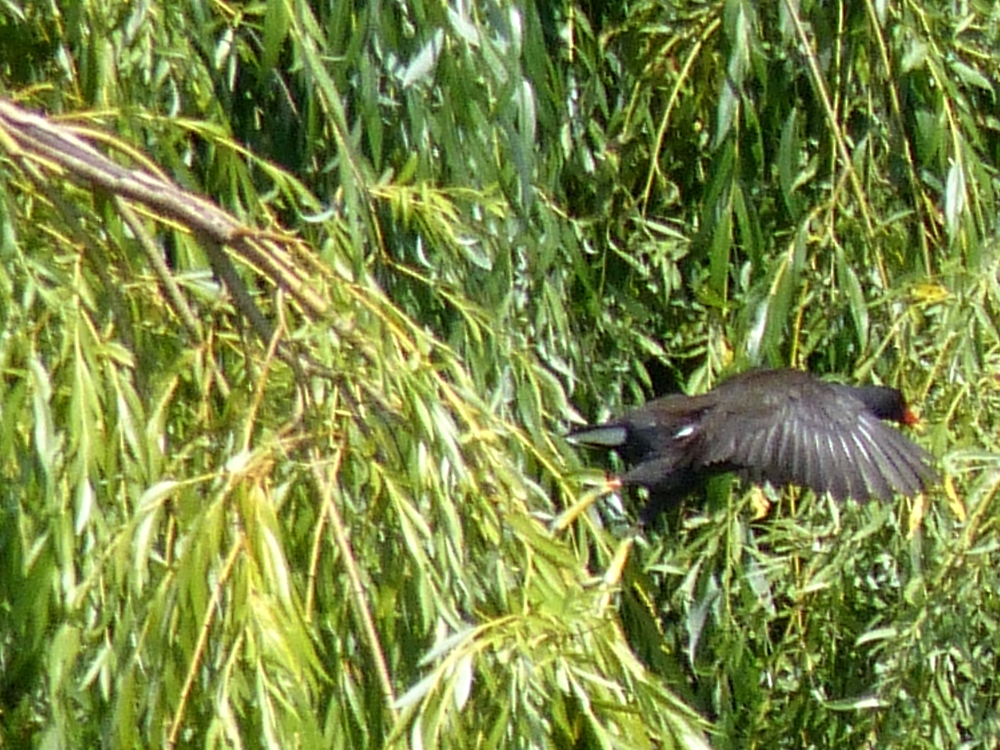
This willow tree across the Long Water from Peter Pan has Moorhens constantly climbing up and down a diagonal branch. Evidently there is a nest at the top, about 20 ft above the ground. Here one of the birds flies off the bottom end of the branch.
There is also often a Grey Heron in the same tree, probably with designs on the Moorhen chicks. But I don't see how it can possibly get at them: herons can perch on trees but not climb about inside them. It will be quite difficult for the chicks to emerge when the time comes, as they will have to bounce down the branches inside the tree somehow, and won't be able to return to the nest. However, these very small birds should be able to fall any distance uninjured, even if they hit a branch on the way down.
Here one of the young Greylag Geese tries to pull down the netting around a reed bed so that it can get to the lush blades of reeds and grass inside.
The geese must be getting tired of trying to feed on the dry yellow grass parched by the recent hot weather. I pulled out some fresh grass from the net for them, and the young birds ate it with gusto.
I saw an odd incident at the east end of the Serpentine. I was looking at a juvenile Lesser Black-Backed Gull chasing a parent around screaming for food. They didn't come close enough for a good picture. But as I watched, the juvenile bird came down on the shore on the opposite side of the lake, and started rolling around on the ground as if it were injured or struggling. I hurried round to find what was wrong. By the time I arrived the gull was standing up normally. I met a worried man who said that a woman had told him that the bird had a broken leg, and he wanted to telephone for help. But at that moment the gull trotted along the ground with a perfectly normal gait, took off, and went back to harrying its parent. I can't think what it was doing when it landed. Could it have had a bit of string wrapped round its leg which it was shaking off?
The Mallard in the Italian Gardens pond still has her four ducklings. Here they are playing among the water lilies.
This willow tree across the Long Water from Peter Pan has Moorhens constantly climbing up and down a diagonal branch. Evidently there is a nest at the top, about 20 ft above the ground. Here one of the birds flies off the bottom end of the branch.
There is also often a Grey Heron in the same tree, probably with designs on the Moorhen chicks. But I don't see how it can possibly get at them: herons can perch on trees but not climb about inside them. It will be quite difficult for the chicks to emerge when the time comes, as they will have to bounce down the branches inside the tree somehow, and won't be able to return to the nest. However, these very small birds should be able to fall any distance uninjured, even if they hit a branch on the way down.
Here one of the young Greylag Geese tries to pull down the netting around a reed bed so that it can get to the lush blades of reeds and grass inside.
The geese must be getting tired of trying to feed on the dry yellow grass parched by the recent hot weather. I pulled out some fresh grass from the net for them, and the young birds ate it with gusto.
I saw an odd incident at the east end of the Serpentine. I was looking at a juvenile Lesser Black-Backed Gull chasing a parent around screaming for food. They didn't come close enough for a good picture. But as I watched, the juvenile bird came down on the shore on the opposite side of the lake, and started rolling around on the ground as if it were injured or struggling. I hurried round to find what was wrong. By the time I arrived the gull was standing up normally. I met a worried man who said that a woman had told him that the bird had a broken leg, and he wanted to telephone for help. But at that moment the gull trotted along the ground with a perfectly normal gait, took off, and went back to harrying its parent. I can't think what it was doing when it landed. Could it have had a bit of string wrapped round its leg which it was shaking off?
Saturday, 20 July 2013
On a mostly cloudy day a spell of sunshine brought out two birds to sunbathe: a Blackbird ...
... and a young Robin, still in gingery juvenile plumage.
The two birds were inches apart, but took no notice of each other.
A female Peregrine passed over Kensington Gardens, circling westwards on the east wind.
The Mallard on the pond in the Italian Garden has kept her four ducklings safe for several days now by herding them into one of the clumps of water plants. They are still small enough to go through the wire netting. On the Serpentine there are five young Mallards which are now probably big enough to be safe from attack by gulls. And broods of four and two are often to be seen at Peter Pan. It has been an unusually good year for them -- but curiously not for any of the other species of duck on the lake (unless you count Egyptian Geese, whose status is rather uncertain but they are related to Shelducks).
The three young Moorhens in another Italian Garden pond have adopted an interesting feeding method. Some vandal has thrown one of the wooden duckboards into the middle of the pond, where it is floating upside down. The birds stand on this and haul clumps of algae on to it. Then they go through the algae to pick out the insects.
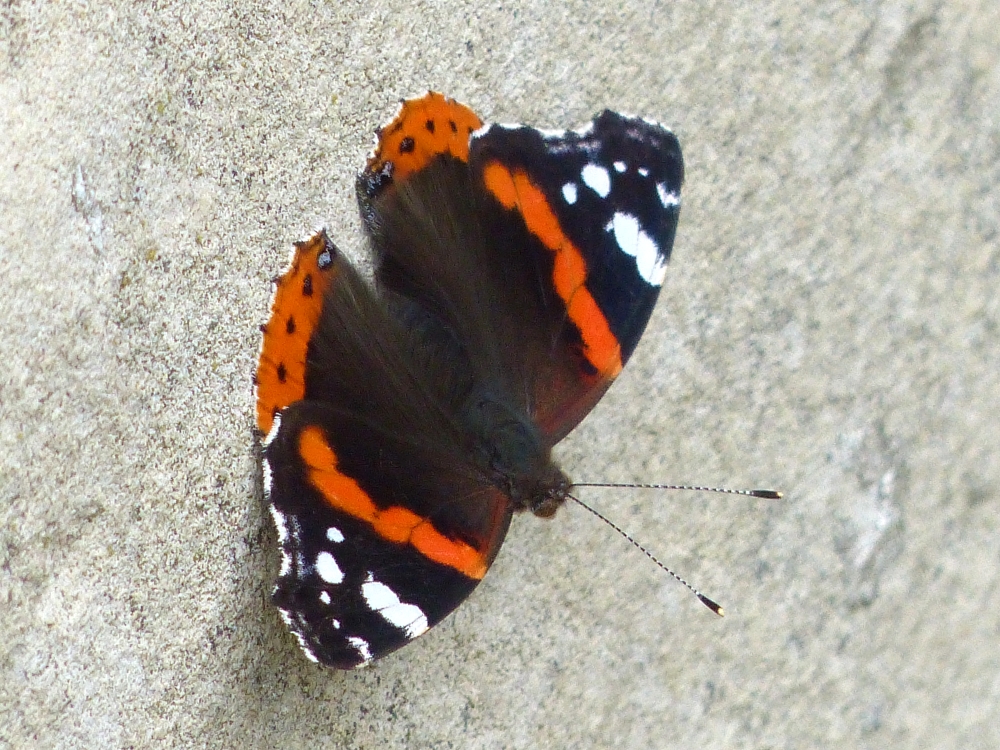
This butterfly is a Red Admiral, which sounds very masculine, but taxonomically speaking it has two girls' names, Vanessa atalanta.
The name Vanessa was made up by Jonathan Swift as a nickname for his pupil Esther Vanhomrigh. Atalanta is the name of a mythical heroine, an athlete and warrior who, among other things, was the only woman to sail with Jason on the Argo.
... and a young Robin, still in gingery juvenile plumage.
The two birds were inches apart, but took no notice of each other.
A female Peregrine passed over Kensington Gardens, circling westwards on the east wind.
The Mallard on the pond in the Italian Garden has kept her four ducklings safe for several days now by herding them into one of the clumps of water plants. They are still small enough to go through the wire netting. On the Serpentine there are five young Mallards which are now probably big enough to be safe from attack by gulls. And broods of four and two are often to be seen at Peter Pan. It has been an unusually good year for them -- but curiously not for any of the other species of duck on the lake (unless you count Egyptian Geese, whose status is rather uncertain but they are related to Shelducks).
The three young Moorhens in another Italian Garden pond have adopted an interesting feeding method. Some vandal has thrown one of the wooden duckboards into the middle of the pond, where it is floating upside down. The birds stand on this and haul clumps of algae on to it. Then they go through the algae to pick out the insects.
This butterfly is a Red Admiral, which sounds very masculine, but taxonomically speaking it has two girls' names, Vanessa atalanta.
The name Vanessa was made up by Jonathan Swift as a nickname for his pupil Esther Vanhomrigh. Atalanta is the name of a mythical heroine, an athlete and warrior who, among other things, was the only woman to sail with Jason on the Argo.