Thursday, 14 March 2013


A shoal of perch under the parapet of the Italian Garden attracted first a Great Crested Grebe and then three Cormorants, always alert to the success of other fishing birds. Here one of them stands on the edge of the peculiar water filter that was part of the Victorian mechanism of the fountains.


One could not say that Cormorants are beautiful birds, but this one is looking quite glossy. It is just coming into breeding plumage. The pale patch below its wing at the top of its leg is the beginning of a white patch that will remain until midsummer. The white feathers around the neck are also more numerous at this time.

The Great Crested Grebes are not in a hurry and can simply take a nap until they get a chance to go fishing again.


The pair of Mandarins on the Long Water noticed someone feeding the ducks in front of Peter Pan, and came over for their share. The females in particular are quite aggressive and will chase a larger Mallard if annoyed.


The mysterious Barnacle Goose and the three Canada-Greylag hybrids with speckled heads, both of which are normally on the Serpentine, came on to the Long Water. All are quite used to park life and were pursuing some French tourists begging for bread. Foreign visitors are astonished by the boldness of the park birds.

There is a very small Greylag Goose on the Serpentine, as you can see from its size in relation to a couple of Black-Headed Gulls.


It has the white line along the lower edge of its folded wings that indicates an adult, so evidently this is as big as it is going to get.

There were five rabbits on the Vista by the Henry Moore sculpture. Is the population finally recovering after the crash a few years ago?

Still no sign of the Tawny Owls, but several people are watching for them daily, and there will be news here as soon as they reappear.

Wednesday, 13 March 2013


An unsettled day of sunshine, snow and hail. On the south shore of the Serpentine, a flock of Black-Headed Gulls swirls up amid the flakes behind some grazing some Canada and Greylag Geese.


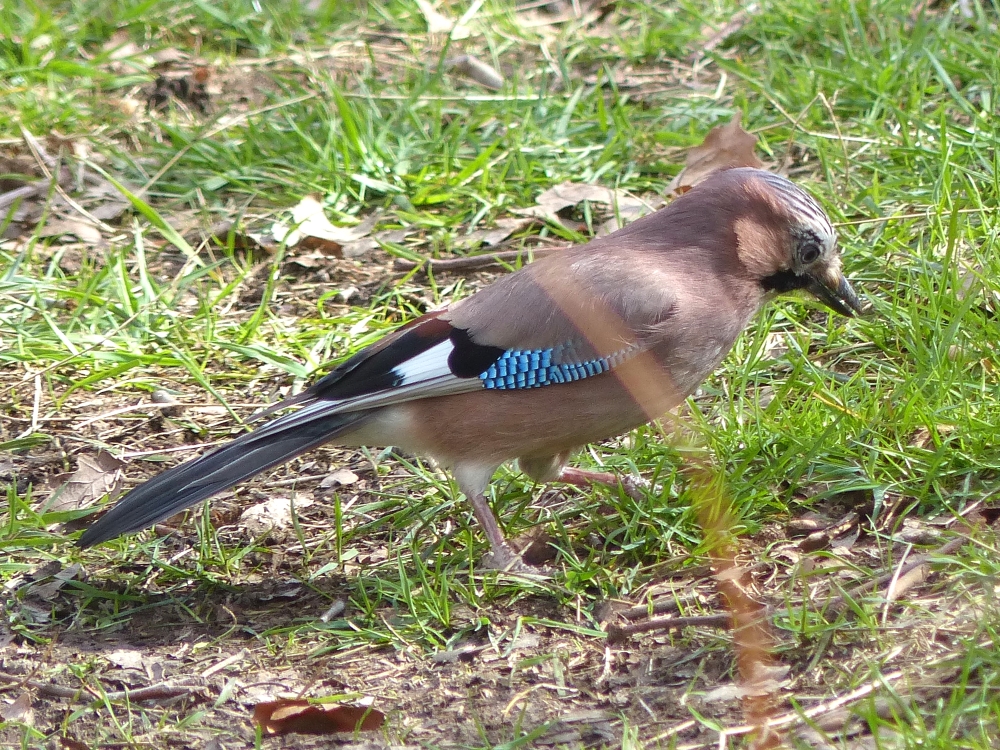
During a sunny spell, a Jay prospects for worms near the Serpentine Gallery.


I had just given it a peanut, which it had prudently put aside in a tree for later while it continued with the search. Jays cache large amounts of food, and have an impressive ability to remember where they put thousands of nuts.

The very dark Great Crested Grebe appeared on the Long Water. Not only is he dark, but he has a particularly enormous crest.


I am sure that this is a very senior bird, and I am surprised not to have seen him on the lake before. Perhaps he has been displaced from some place where he had been for years, growing steadily darker and shaggier. He doesn't seem to have a mate.

Another pair of grebes have been hanging around near the willow tree next to the Serpentine bridge, clearly with the intention of reserving this prime nesting site. And today they started to build their nest.


Construction begins by vaguely throwing bits of twig and algae over a just-submerged forked branch until some of them stick fast and a random heap begins to form. It doesn't get any more organised than that. They will be satisfied when the heap is solid enough to sit on. Since the nest is built without any proper structure, it sags continuously off the branch and has to be topped up with fresh debris every day to keep it above water -- which at least keeps the top surface fresh, in a soggy kind of way. The stuff laid down on previous days slumps down into an underwater tangle whose mass helps to keep the nest stable.

There are now two pairs of Song Thrushes and one pair of Mistle Thrushes in the trees near the Serpentine Gallery and across the road. They are not yet showing any sign of nesting, and will probably not do so until the leaves appear to give them a bit of cover from Magpies and Carrion Crows -- not to mention the female Sparrowhawk who quarters this area every morning.

Still no sign of activity from the Tawny Owls, but we live in hope.

Tuesday, 12 March 2013


A bright day with a sharp wind. The sunlight brought out the lovely iridescence of a male Starling's plumage.


You can tell he is male from the blue base to his beak; on a female this would be pinkish. This bird, who has a BTO ring on his right leg, has been hanging around the leaf yard for several years trying to grab the food from my hand when I am feeding the small birds. Experience has taught him that if he comes in over my shoulder I won't see him till it's too late, so in he dives, scattering the food and often pecking a hole in my hand. I try vainly to discourage these raids, but the wily bird knows that he will always get through in the end.

This Tufted Duck, under the willow tree next to the Italian Garden, looks as if she was nesting.


She isn't. It's a Coots' nest, and she was just trying it out in the absence of the tenants. Tufted Ducks nest on land anyway.

The pair of Mandarins who have been under the willow tree on the east side of the Long Water are still there. If they decide to nest, it will be in a tree hole -- a good secure spot, but as when the ducklings emerge they will have a perilous trek to the water, and will be exposed to the ravenous gulls at all times. It is rare for any to survive on the Long Water, though they have a much better breeding record in the Regent's Canal.

Here another young creature takes a risk. This naive little rabbit wandered unconcernedly through a grim line of three Grey Herons that were hunting for rats in the shrubbery.


Fortunately the herons decided that it had grown a little too large to swallow, and left it alone.

On the edge of the Serpentine, a Pied Wagtail was strolling around as the choppy waves broke on the shore, casually trotting out of harm's way when the water surged too near.


Still no sign of a Tawny Owl. But owl pellets are turning up at the base of the nest tree, at least showing that it is occupied.

Monday, 11 March 2013


A cold day with a biting northeast wind, and after a brisk trot round the lake I was glad to hurry home. Snow flurries didn't deter the Shovellers on the Long Water from their endless circling.


In the leaf yard the Song Thrush was rather subdued but sang a phrase or two from time to time. There was also a Nuthatch singing, and Great Spotted Woodpeckers calling to each other, but not drumming. On the edge of the enclosure a patch of Feral Pigeon feathers showed that the female Sparrowhawk had been on one of her frequent raids.


Male Sparrowhawks are considerably smaller than the females, and not large enough to deal with a full-sized pigeon. I haven't seen the male for some time, though a few years ago an entire family with two young flew over the Long Water. With Sparrowhawks, Peregrines and Lesser Black-Backed Gulls -- and occasionally a Great Black-Back -- after them, the park pigeons have plenty of enemies. But they are so prolific that these predators never make a noticeable reduction in their numbers.

This unusual Mallard drake has been on the lake for several years, and is one of two such ducks, probably brothers. His back is lighter than usual, almost ivory, and his head is brown with a faint reddish iridescence and no trace of the usual green.


The iridescent green of the head of a normal Mallard is not a normal colour, but is an interference effect, caused by tiny ridges on the feathers having a spacing related to the wavelength of green light. We see the sides of the head as blue because the feathers here are at an angle to us, making the ridges appear closer together; blue light has a shorter wavelength than green. Since this duck's head shows no green or blue, its feathers must therefore have a slightly different structure from normal ones. The reddish colour of the slight iridescence shows that the ridges on the feathers must be coarser than normal, since red light has a longer wavelength than green.

A Black-Headed Gull in full breeding plumage was standing on top of the marble fountain in the Italian Garden. This is quite an old bird, as can be seen from the deep beetroot colour of its legs and bill. Although these gulls develop adult plumage in their first year, it takes their legs several years to change from juvenile marmalade colour through orange-red to beetroot.


Still no sign of the male Tawny Owl. I also went around the place north of the Albert Memorial where the family unexpectedly showed up on 23 March last year, but there was nothing there either.

Sunday, 10 March 2013


On a nasty wintry day it was cheering to see a pair of Carrion Crows enjoying themselves, tumbling about in the updraughts caused by the freezing northeast wind gusting over the dome of the Albert Hall.


There is no doubt that crows fly for fun on windy days. One of the best places to see this is to the north of Battersea Park, where the crows divide their time between this park and the grounds of the Royal Hospital on the other side of the river, doing aerobatics and cawing with delight as they cross the windswept open water.

A search by several people for the Tawny Owl was unsuccessful, but at least the Little Owl could be heard calling in the leaf yard.

At the east end of the Serpentine, the larger of the two pigeon-eating Lesser Black-Backed Gulls had claimed another kill. Fortunately the victim was quite dead by the time this rather gruesome picture was taken.


Nearby, the two Great Crested Grebes who have been battling with Coots for the possession of a nest site were doing their best to dismantle the Coots' twiggy construction.


This does not necessarily show that they mean to reclaim the site. Grebes have a habit of pulling their inveterate enemies' nests to pieces, and I have seen one swim under water to a Coot's nest and pull twigs out of the bottom while the Coot was actually sitting on it.

A Wren was hopping around unobtrusively on one of the ornamental rockeries in the Dell, blending nicely into the background of weathered stone.


The Diana fountain enclosure had a fair number of Sunday visitors, the humans sharing the space with 50-odd Egyptian Geese, 16 Wood Pigeons and a pair of Pied Wagtails, all the species getting on with their business without taking the least notice of each other. Pied Wagtails allow people to get within a few feet of them as long as the people seem to be otherwise engaged. But turn and look at the wary little bird and it is off in a flash.

Saturday, 9 March 2013


On another grey day, there was a feeling that things were on hold before spring begins properly. The Grey Herons on the Serpentine island, after several false starts, are not really serious about nesting yet. Here one of them stands in an absurdly small nest which doesn't seem to have got any larger over the past few days.


The Great Crested Grebes at the east end of the Serpentine, whose nest was taken by Coots, have lost enthusiasm for recovering it, but the Coots have deserted it too, and the grebes are now just sitting in front of the site every day.


When the mood takes them they will probably start from scratch somewhere else in the reed bed, behind the netting if they have any sense. The net only reaches to water level and is easily dived under.

But the Starlings do seem to be taking things more seriously, and there are now three pairs visiting holes on the trees next to the small boat houses, where I photographed one on Thursday.

And once Mallard drakes, those insatiable creatures, get the idea that it is the mating season, there is no stopping them. A disturbance in the water around one of them revealed nothing until suddenly a female duck popped up like a cork alongside.


She had been held entirely under the water. It was our old friend the black and white duck who, despite appearances, is female (or so the drake thinks, anyway). Being a female duck is no fun at all at this time of year.

The Tufted Ducks are flying about in small groups, which seems to be part of their courtship ritual. It looks as if there is competition between the drakes giving a show of strong and agile flying, but it may just be that several of them are chasing a female. The drakes are also trying to impress the females by holding their heads up very high in an absurdly stiff-looking posture. However, even if they did decide to breed this year -- which they haven't for some time on the lake -- their season is later than that of the larger ducks, so all this display is not a sign of imminent nesting.

The number of Common Gulls has fallen considerably. Evidently they are off to northern Europe for the breeding season. The Black-Headed Gulls will soon be departing as well.

No sign of activity from the Tawny Owls yet, but everyone is hoping for a sighting in the next few days. Little Owls have been heard calling several times in the leaf yard in recent days, but their breeding season begins later, as they are birds of southern Europe and need a bit of warmth to encourage them. They were introduced in the 19th century and have now settled in well and become common, but you can see from their habit of sheltering in holes facing the sun that they would really like the climate to be a bit warmer.

A pair of Red Crested Pochards lend a bit of colour to the proceedings.

Friday, 8 March 2013


A dark wet day. A routine visit to the Tawny Owls' Tree showed that the lowest hole in the hollow trunk is now the nest of a pair of Ring-Necked Parakeets. It is only about 8 ft off the ground, but very hard to photograph as the birds streak in and out without warning. However, it may be possible to get a pcture of a juvenile parakeet, something I have not yet seen.

There was a brisk Coot fight on the Long Water.


While the spectacle is entertaining, these aggressive birds do actually sometimes injure each other, unlike Great Crested Grebes whose splashy wrestling bouts never hurt anything except the pride of the loser, and even that is quickly forgotten when he can swim off and be consoled by a head-shaking display with his mate.

Some newly arrived Great Crested Grebes were having a standoff in the middle of the Serpentine. I think that two pairs had flown in and were being challenged by the pair from the west end of the island. Here, in a very distant shot, you can see that one of the newcomers is very dark, with only a trace of the usual white face. The effect is probably exaggerated by the miserable light.


I think that this is a sign of age. Some years ago there were a couple of grebes whom I observed for five years -- they always nested under the willow tree near the bridge, and raised several broods. The male of the pair was dark when first seen and became darker every year, though he never became as sombre as the bird pictured here. Again, I must try to get a better photograph.

A pair of Mandarins have reappeared on the Long Water. Here they are sheltering under a willow tree on the east side.


The Mandarins may be permanent residents, and take cover in the shrubberies where we can't see them. Or they may be flying in and out between the Long Water and the Regent's Canal, where several pairs breed successfully. The canal is not so troubled by big gulls as the Long Water, and there is plenty of cover along the banks. They seem to be able to get their ducklings up the sheer sides of the canal somehow.

The Robin in the hazel thicket opposite the southeast corner of the leaf yard has a mate.


He chases away the other small birds when you try to feed them (at least, I suppose it is 'he', you really can't tell with robins). His mate, at the bottom right of the picture, is much less aggressive, and once she was knocked off my hand by an impatient Blue Tit.