Saturday, 14 July 2012


The Great Black-Backed Gull was on the Long Water again, in its usual place on the posts opposite the Peter Pan statue. Here it was joined by the Odd Couple, a pair of a Canada-Greylag hybrid and a Greylag. They have been together for several years. Presumably the hybrid is sterile, so we can't expect any three-quarter Greylag goslings.


The Greylags with new goslings were near the Bluebird boat hire cabin, where some people were feeding and photographing them. The Mute Swans with four cygnets were there too, but their young are no longer tiny and fluffy and cute, and were being ignored. The male swan tried to muscle his way in, but was seen off with furious hissing.


On the edge of the Serpentine, a brood of five Mallard ducklings were sheltering in a clump of plants while their mother preened herself. These too proved irresistible to the photographers, including me.


The Willow Warbler showed itself briefly at the Lido, dashing between two flower beds. I just had time to notice its pale yellow sides. Overhead, half a dozen House Martins were catching the copious insects, with a Pied Wagtail hunting at a lower altitude.

I went to the Round Pond: another four House Martins and a solitary Swift. Two Lesser Black-Backed Gulls were chasing pigeons, but didn't manage to catch any while I was there. Some of the Greylag Geese, now able to fly again after their moult, had moved up here from the Serpentine, which is increasingly disturbed by the Olympic building site and the hideous thumping and mooing of amplified pop music from the concert enclosure.

But in the areas where the park is not being desecrated by buildings, the persistent rain has made it amazingly green. Here the beautiful mixture of grasses in front of the Queen's Temple takes a purple tint from the flower heads of the picturesquely named Yorkshire Fog grass.

Friday, 13 July 2012


Another Moorhen family has emerged from one of the benches at the edge of the Vista. I could see only two chicks.


Some visitors were feeding them with nasty-looking snacks out of packets, but Moorhens will eat anything. There is already a family of Coots here, and competition for food was brisk. Seeing this, the Mute Swans from the Lido muscled in with their seven cygnets and the small birds were driven into the long grass.

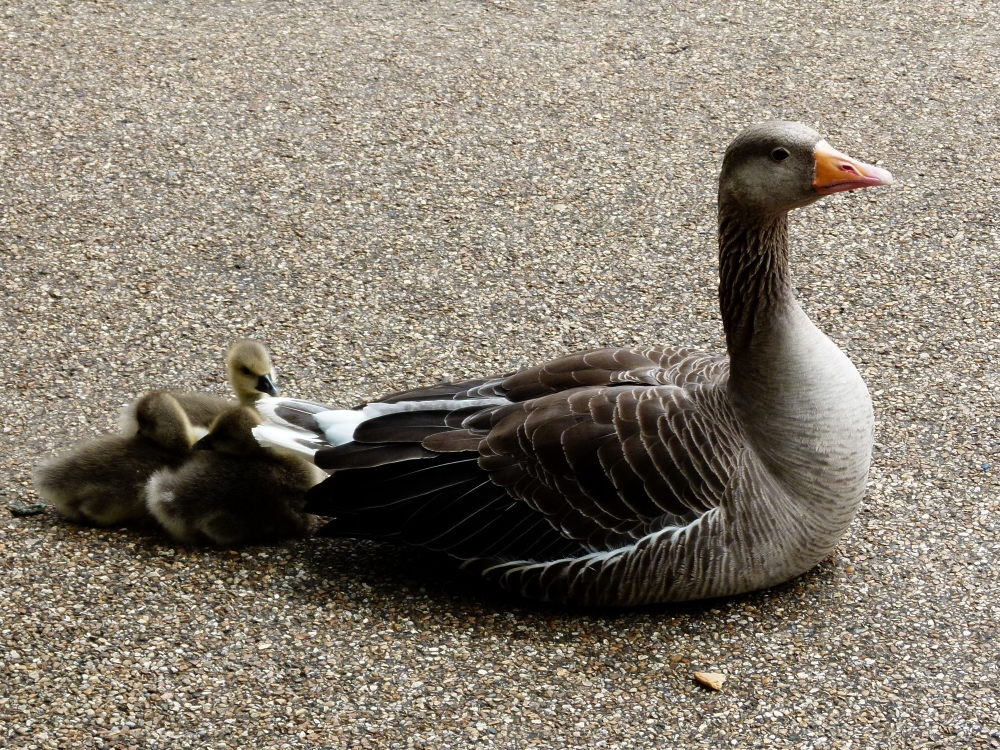
While I was passing the Serpentine island, a brisk wind got up. Here the Greylag goslings shelter in the lee of their mother.


The Reed Warbler at the bottom end of the Serpentine was singing loudly, but as usual remained invisible in the thick reeds.

In the Diana enclosure, a flock of Starlings was running around on the grass looking for wireworms. Suddenly they took off and rushed into a tree. The pigeons nearby also fled to cover. I looked around to see why, and there was the predatory Lesser Black-Backed Gull gliding in over the fence. It took a couple of turns around, looking for stragglers, and then sloped off to the Lido restaurant in search of scraps. It settled in the water but was promptly chased away by a Coot, so back it came, patrolling the edge of the lake as far as the bridge. And so to the Diana fountain once more, and the Starlings, which had returned to the grass, were scattered again.

This is the same pigeon-eating gull as shown in yesterday's photograph. There is only one Lesser-Black Backed Gull in this corner of the lake, which makes it easy to see how it patrols its territory.

There was hunting on a smaller scale beside the Long Water.


There are always a lot of ladybirds in this area. They have a nest in the public lavatory near the Italian Garden, and in cold weather you can see them trotting all over the walls.

Thursday, 12 July 2012


There are two Great Black-Backed Gulls on the lake, though I have not yet managed to see them together. One of them was sitting on the posts near Peter Pan, as in yesterday's picture, but despite its looming presence several broods of ducklings were out on the water. Even these half-grown ones are not out of danger, since Great Black-Backs routinely take birds up to and beyond the size of Feral Pigeons. 


One of the Lesser Black-Backs that also takes pigeons (I think there are now three of them) has started hunting them at the opposite corner of the Serpentine, near the bridge. Here it is devouring its prey.


The three Greylag goslings had to be hastily chivvied into the water when a man approached with a Jack Russell. He did manage to keep his dog under control, unlike many dog owners who think that letting their pets chase geese is funny.


Even when they were in the water, the young birds were harried by a Herring Gull, which was also trying to snatch one of the baby Great Crested Grebes. It failed in both attempts, and was attacked by a parent grebe and driven off.

The abandoned Coots' nest in the Italian Garden has been taken over by a pair of Moorhens, I think the same pair that made two unsuccessful nests on the edge of the reed bed, not far enough in to have good cover.


This nest is equally unlikely to succeed. If aggressive Coots can't manage it, Moorhens never will. Meanwhile, the Coots' second nest on another of the garden pools is still intact. They have managed to raise chicks in equally exposed spots in the Italian Gardens, so they have a chance.

Wednesday, 11 July 2012


A Great Black-Backed Gull, probably the same one as was seen on 1 July, was standing on the posts opposite the Peter Pan statue. Compare the size of this enormous bird with that of the Cormorant in front of it. This is the biggest gull in the world, with a wingspan of up to 5 ft 7 in (1.7 m).


A short distance away there was a group of five teenage Mandarin Ducks. These were certainly not hatched on the Long Water, and were probably from the Regents' Canal, the favourite local breeding place of these birds. They are probably descended from captive Mandarins on Regent's Park Lake, but have now become completely native.


The Willow Warbler was singing on the west side of the Lido, in a shrubbery near the edge of the Diana fountain. I got a momentary glimpse of this elusive bird, but some people frightened it off before I could photograph it.

I also tried to get a picture of the Goldcrest family in the Dell, also without success. But how liberating it is to have a digital camera, so that you can waste 50 shots and quietly delete your failures without the humiliation of other people seeing them.

The large carp in the Dell were clearly visible.


A party of Grey Herons had given up trying to catch them, and were on the grass nearby enjoying a brief sunny interval.

Tuesday, 10 July 2012


The Coots nesting in the plants in the Italian Gardens now have seven eggs. The plant boxes here are meant to restore the original planting scheme of the garden made in the 1860s, when there were clumps of tall irises and other water plants. However, until the garden was built the polluted and smelly waters of the Westbourne river flowed into the top of the lake, so there were not nearly as many birds -- let alone the 120-odd Coots that the lake now harbours. The Westbourne was then rerouted in a pipe along the north edge of the park and enters the Serpentine down the valley of the Tyburn Brook, behind the Ranger's Lodge (this little stream is not the Tyburn River, which is a mile to the east). The lake is fed from a borehole.

Another trace of the past is the teazles which grow along the east side of the Long Water. These tall and heraldic-looking things were planted in the clearing by the Rudolf Steiner bench in an effort to attract goldfinches, which are fond of the seeds. It failed, and goldfinches remain rare in the park; but the teazles have prospered and spread. 


At the Serpentine island, the Great Crested Grebe family was out on the water next to a new brood of Mallard ducklings. A Herring Gull swooped around the corner of the island, bent on lunch. The grebes dived as one and surfaced behind the wire plant baskets. The mother Mallard just managed to herd her babies under the post and chain in time, and the gull was forced to sheer off.


The eight young Egyptian Geese on the Serpentine have now grown their flight feathers. Here one of them stretches out a long wing. They have all grown perfectly, unlike the ten young Egyptians on the Round Pond, three of which have angel wing and will never fly. This supports the idea that the malformation is hereditary, and perhaps due to inbreeding.


Many of the Mallards are now moulting their wing feathers. Since the males are also going into eclipse, they look very tatty indeed. The female black and white duck has not yet moulted. Here you can see her strangely marked wings with pure white primaries. The tips are badly frayed: white feathers are not as strong as dark ones, which are strengthened by the melanin that gives them their colour.

Monday, 9 July 2012


Several large flocks of Long-Tailed Tits were roaming around the park, including one of at least 50 in the 'Bird Sanctuary' -- that is, the belt of shrubbery around the greenhouses at the back of the Rima fountain. These gregarious birds merge their families and share the care of the young, an unusual trait in birds; Canada Geese do it too. This young bird is looking very scruffy as its adult plumage begins to emerge under its juvenile fluff.


A family of Goldcrests in the Dell was audible but, as usual with these tiny birds, impossible to photograph.

A young Pied Wagtail was running around on the tarmac at the edge of the Serpentine. It paused to give me a quizzical look before a runner frightened it away and it sped off uttering its tweeting flight call.


Not far away, a female Tufted Duck, a bird of understated elegance, was preening herself. This picture shows that a duck's field of view extends over the top of its head, a useful feature when predators come from above.


And here is a Great Crested Grebe just surfacing from a hunting expedition among the dense algae. They eat not only fish, but any small aquatic creatures that they find clinging to water plants.


I also went to the Round Pond, where there were a few Swifts and House Martins and the usual 60-odd Mute Swans but little else. The geese are down on the main lake regrowing their flight feathers, but I was surprised to find no gulls of any species.

Sunday, 8 July 2012


There was another family of Greylag Geese with three goslings on the Serpentine, never too young to start begging for food from the visitors.


A Mute Swan that got too close was promptly seen off.


There is also a Song Thrush family in the shrubbery between the Diana fountain and the bridge. Uncertain how many young birds there were, since they were kept well in cover while their mother foraged and their father sang, but judging from the cheeping noises there were at least two and probably three. These birds are perfectly camouflaged as they hop around in the leaf litter.


The Great Crested Grebe family were again on the south side of the Serpentine island, the side away from the land. There are only two chicks now, but they are growing fast and will soon be out of danger from gulls. The young are very noticeable with their loud piping cries, but can dive in a flash when threatened. All grebes are very vocal, since they may find themselves separated by hundreds of yards after a dive, and have to keep in touch. They are also keen-eyed. The chicks can certainly distinguish their parents from other adults at least 50 yards away. You can tell this when several families are near each other, because the chicks fall silent when their parents dive and start calling for food as soon as they reappear.

Returning to the subject of the information that can be gained from reading birds' rings, Roy Sanderson reports that a Black-Headed Gull which he ringed here on 11 January 2012, and was subsequently reported as still here by a member of the public on 1 February, was found in Rotterdam in the Netherlands on 27 February -- 200 miles away in straight line but it had probably wandered about considerably on the way.