Friday, 22 June 2012


An afternoon usefully spent with Nigel Reeve, the Royal Parks ecologist, recording the GPS coordinates of the various trees used by Tawny and Little Owls, and also the dead tree where there is a Treecreeper's nest. The information will now go into the park database, and will be used to keep tree cutting in the area to a minimum. This is particularly important because all the trees in question are old and hollow and likely to be thought dangerous.

The birds were obliging. The Little Owl showed up for a moment in the sweet chestnut tree where I last photographed him on 1 May.

When we went past the reeds on the Long Water where the Reed Warblers are probably nesting, the male gave us a brief burst of song. There are also damselflies in the plants around this spot. Here is an Azure Damselfly -- I think, but insects are not my thing and it might be a Common Blue looking a bit pale.


Elsewhere, the imprudent Moorhens that nested twice in the reeds near the Italian Gardens too close to the edge, and lost their eggs as a result, are having a third try, again too far out. If I can see them to take this picture, so can a hungry gull.


The algae in the Long Water have formed tall towers reaching from the bottom to the surface, a remarkable sight when viewed from the bridge. By looking at them you get a sense of how deep the water is in the middle of the lake, maybe as much as 20 ft allowing for the shortening effect of refraction.


At this point the valley of the former river Westbourne, which was dammed in 1727 to make the lake, is still fairly narrow and V-shaped. Father downstream, in the Serpentine, it opens out into a little plain where once the river meandered through a series of fishponds.

Thursday, 21 June 2012


At last, a sight of Great Crested Grebe chicks. The pair at the east end of the Serpentine island have at least two, which can dimly be seen in this bad photograph taken at long range on a dull day. Their father is sitting on the nest with the babies on his back, and they are poking their little heads out on either side of his neck.


Grebe chicks can swim and dive from the moment they hatch, as they need to because they often fall out of the nest or off their parents' back when being carried. However, they can't really walk. Even an adult grebe is very uncertain on its feet, which are set so far back on its body that it has to stand in an odd hunched position. The babies are quadrupeds: they crawl about using their wings as front legs, as can be seen in this picture taken last year.


Here, by contrast, is one of the Coot chicks from the nest in the netting near the Lido. Its enormous feet are already doing good service as it hops nimbly over the slime.


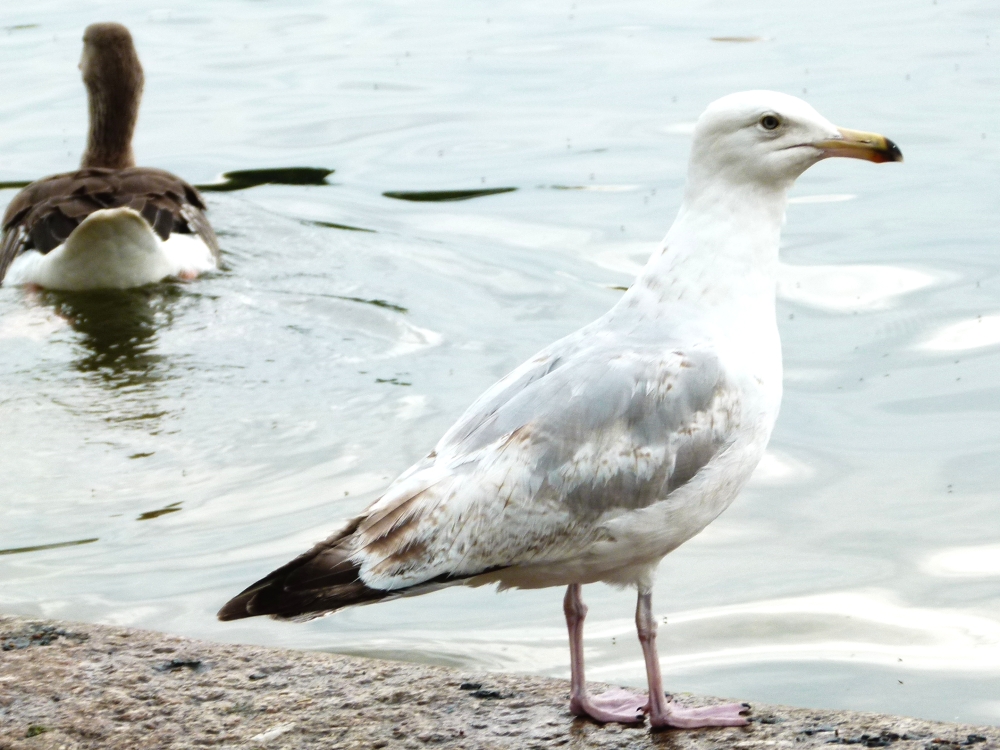
The three chicks from this nest are all alive, despite the hungry glances of this Herring Gull a short way along the shore. This is a second-summer bird, losing its tweedy juvenile plumage and beginning to show adult pale grey on its back. It takes Herring Gulls four years to get fully adult plumage.


Reed Warblers were singing from the reeds at the bottom end of the Serpentine and west of the Lido. I am not sure whether the second of these was the one who has been singing just the other side of the bridge. It is possible that there are three pairs.

Wednesday, 20 June 2012


The Great Crested Grebes' nest on the Serpentine isalnd is hatching out again. It's very hard to see what's going on through binoculars, and well nigh impossible to photograph. Let's hope these birds have better luck this time. There are fewer Grey Herons than there were when they lost their first brood, and the heron nest close to theirs has been abandoned.

Andrew reports that he heard one of the Little Owls calling yesterday, from the chestnut trees where they were in April. He couldn't see it, hardly surprising as he was looking for a small, perfectly camouflaged bird in dense foliage.

Speaking of perfect camouflage, spot the Treecreeper in this picture.


A Mallard on the Long Water has five ducklings. She was keeping them well into the side of the lake under the bushes as a Lesser Black-Backed Gull flew up the lake.

The Magpies near Rudolf Steiner's bench overlooking the Long Water from Buck Hill are constantly chased by two noisy youngsters clamouring for food.


I met Roy Sanderson negotiating the enormous detour around the Olympic building site. He had been counting House Martins' nests on the French and Kuwaiti embassies, and brought the welcome news that the birds have started recolonising the French embassy. He saw five pairs of birds attending nests, two on the French embassy, three on the Kuwaiti building. I went there later and saw four nests being attended to on the Kuwaiti side, and one on the French side. It is very difficult counting active nests, as a pair of birds may go away and hunt over the lake for a while, and not be counted. There are six nests on the Kuwaiti embassy, but they were built in previous years and may not all be occupied.

Here a Canada Goose flaps its very tatty wings, but you can see the blue wrappings of its emerging primary feathers.

Tuesday, 19 June 2012


There is a pair of Reed Warblers in the Long Water reedbed next to the bridge. I saw both of them momentarily, and after that a lot of movement in one spot in the reeds, showing that they are building a nest. Usually there are one or two Reed Warblers every summer, but I have never seen any sign of nesting before in this park.

There was a young Blackcap on the east side of the Long Water chasing its mother and begging for food.

The Canada Geese, which moult a little later than the Greylags, are now also beginning to grow their new flight feathers. And the Mute Swans are beginning to moult too. Here a first-year swan with a bit of grey still showing preens itself; note its tatty wings.


These already bad-tempered birds are made more irritable still by moulting, and I saw an old male chasing a couple of moorhens that had not threatened him in any way.

Here a pair of mallards enjoy the duckweed on the Rima fountain.


And in the Dell, a pigeon (a proper birder would call it a Feral Rock Dove) explores some early mushrooms before deciding that they are not edible.


One seldom sees edible mushrooms of any kind in the park, apart from occasional stands of Giant Puffballs in the shrubbery. I think that this is not because they don't grow, but because when they do, in the autumn, knowledgeable mushroom fans come into the park at dawn and pick them before anyone else gets the chance. Mostly they are Italians and Russians, great mushroom gathering nations.

Monday, 18 June 2012


The indomitable Coots in the Italian Garden, after a couple of days mourning for their lost chicks, have reoccupied their nest and got their gonads back in gear and are hard at work making more chicks. They are not glamorous birds, but you have to admire them.


The geese on the lake are now well into regrowing their wing feathers. Here is the wing of a Greylag. The packaging on the feathers is drying up and splitting, and the new feathers are spreading out.


The branch that fell off the willow tree near the bridge is, improbably, still alive in spite of being snapped almost all the way through. It is the cambium layer under the bark that carries the sap to nourish the branch; the wood in the middle is just a mechanical support. Evidently enough of the outer layers of the branch has remained unbroken to allow sap to get through and keep the leaves green. This is excellent news for water birds, since the branches in the water will provide nest sites and good cover. For years the tree was a reliable nesting place for Great Crested Grebes, but after the branch they used was broken when the bridge was being repaired, they lost their site and had to make do with very insecure places. Now -- if only the quantity of fish in the lake would increase -- they can return in comfort.


One of the workmen re-erecting the Henry Moore statue is a birdwatcher. I saw him standing on the scaffolding surveying the lake through binoculars.

Sunday, 17 June 2012


The Coots have had mixed fortunes in their breeding season. The pair who nested in the Italian Garden and lost their brood to a gull have now abandoned their nest and were nowhere to be seen. The pair from the netting near the Lido have kept their brood of three, thanks to having chosen a very well protected place. And the pair who eccentrically nested on a bottle crate under the terrace of the Dell restaurant have hatched at least one chick, whose little red head can be seen in this distant shot in the middle of the sunlit side of the nest.


The male Mandarins on the Long Water, so fine a month ago, are now going into eclipse and look sadly tatty. But they will be glorious again.


The male Willow Warbler was singing again from the back of the Lido, though he was impossible to see. There is certainly a nest somehere here.

The bottom of the lake is now a continuous carpet of algae. When the sun shines and warms the shallow water, photosynthesis speeds up and little bubbles of oxygen form on the underside of the strands. After a while they grow large and numerous enough to raise the strands to the surface.


This is why algal blooms seem to appear so quickly in sunny weather. The algae have been there all the time, but now they become visible.

Heaven knows what state the lake will be in by August. Perhaps they could replace the Olympic swimming events with a bog snorkelling race.

Saturday, 16 June 2012


There are two singing Reed Warblers, on on the Long Water near the bridge, the other right at the bottom end of the Serpentine in the reeds south of the outflow.

The Coots in the Italian Garden pond have lost all their chicks, though as far as I can see there was never more than one alive at any one time. No eggs were left in the nest of the original seven. This is the work of gulls; the Coots were well protected from other predators, as the water is too deep for Grey Herons and they are out of the reach of humans. They showed no inclination to leave the nest. If earlier years are a precedent, they will start again soon.

I went to the embassies to check on the House Martins. Again, plenty of activity on the Kuwaiti embassy and none on the French. Are the birds ever going to reoccupy what used to be their favourite place?

At the Lido restaurant there was a rather beautiful blond young Starling. I wonder whether it will turn the usual dark colour when it grows up.


Another young Starling was being literally spoon fed by a diner.


There is room for only a few Starling nests in the bandstand on Buck Hill, since the attempt to block up the eaves has left only a few holes. Here a bird performs a difficult landing to get into a downward-facing hole.


Other Starlings have nested in holes in nearby trees, and there was a sound of loud scolding from several birds. After a while a Mapgpie and a Carrion Crow came out, defeated by the harassment, and flew some distance away.

I went to the Round Pond, which was whirling with Swifts and House Martins. The ten young Egyptian Geese were in good order, diving busily to pick algae off the bottom of the pond. There was also a young Pied Wagtail foraging on its own, with no parent in sight.