It was another dank wet day. The weather kept most people out of the park and, more importantly, their dogs. A group of Mute Swans felt safe enough to come right on to the shore of the Serpentine to graze.
The dominant swan on the island chased off a rival.
Another pair flew up the lake.
There is just enough left of the swan island on the Long Water for a pair of Canada Geese to stand. They have tried to nest here in previous years but have always been evicted by the swans.
A pair of Egyptian Geese took possession of a sawn-off treetop.
I haven't seen this Canada x Greylag hybrid goose for a long time, and thought it was gone. But here it is on the Serpentine, looking elderly and walking with a slight limp but still capable of running out of the way when a car came past.
A Moorhen in the Dell felt it wasn't wet enough and had a splash to get properly soaked.
A Great Crested Grebe lurked elegantly under the bridge.
The rain delighted the thrushes on the Parade Ground by bringing up worms. Apparently these have now climbed to the surface of the newly laid turf, for a Mistle Thrush was searching a fresh green area.
A Redwing preferred one of the remaining bits of bare ground.
A Jay perched on a yew branch. The little brown things are flowers. Yews have no need of pretty flowers to attract insects as they are wind pollinated, and male trees release enormous amounts of pollen which can cause headaches, lethargy, aching joints, itching, and skin rashes, and trigger asthma attacks.
A Great Tit looked out from a broken twig.
A Robin preferred a rose bush.
Sunday, 23 February 2020
A Great Tit sang in a bush. This is the classic two-note song described in books, but in fact Great Tit songs can have anything from one to eleven notes, and vary a lot. If you hear a song you can't identify, it's probably a Great Tit.
The Coal Tit near the bridge came out to be fed.
The Long-Tailed Tits in the Rose Garden were busy building their nest in the gorse, often pausing in a thorny bush on their way to collect materials.
The gorse is even spikier, but that doesn't worry them. The bird is standing on the partly completed nest, but I couldn't get a sight of this without disturbing them.
A Blackbird came out from under the gorse.
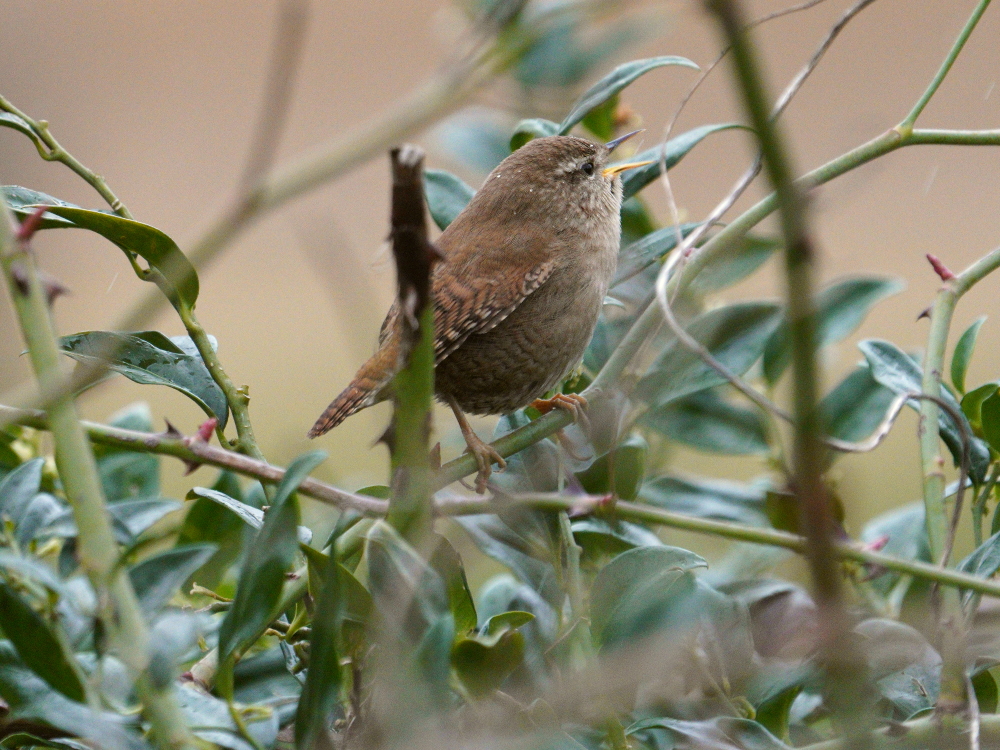
A Wren sang on an adjacent bush ...
... and a Robin hopped around on the ground.
Another Robin on a bench in the Flower Walk picked up what looked like crumbs from someone's lunch.
The Goldcrest in the leaf yard was dashing about in the yew tree.
A Redwing in the enclosure east of the bandstand forgot it was being watched and came quite close to the camera.
The Mute Swans on the island, frustrated on not being able to get through the gate, took it out on a Canada Goose that was minding its own business.
A little fleet of Tufted Ducks cruised around the east end of the Serpentine.
One of the dark Mallard drakes dozed under the willow tree next to the bridge.
Saturday, 22 February 2020
A windy day didn't deter the Carrion Crows in the Dell from looking for worms among the flailing daffodils.
A Blue Tit had to hang on tight to the swaying twig as it ate a pine nut.
One of the pair of Long-Tailed Tits nesting in a gorse bush in the Rose Garden was bringing material to the nest, but halted in a thorny bush to sit out a strong gust.
In the lime tree near the Henry Moore sculpture, the rising wind soon drove the Little Owl back into the hole and I was lucky to get a picture.
More turf has been laid at the Redwings' usual place on the Parade Ground, so they have moved east, crossing the path into a small enclosure.
The Grey Herons' nest at the east end of the island had a bird in it again today, but it flew down to be with its mate on the ground. It looks as if this nest will be the next one to get going -- but how slow our herons are compared to those in the other parks.
A heron waited on a post at the bridge, expecting to be fed.
Another view of the Lesser Black-Backed Gull pair on the Long Water, which have regained their place on the raft. The pale one on the right seems just within the limit of variation of the pale British race, but it's hard to judge as the colour changes with the angle of the light.
Four Coots fought on the Serpentine.
These Mute Swans usually nest in the middle of the island, but now that a new pond has been put in there the gates are shut to keep the swans from destroying the reeds. They will just have to nest on the edge, a reasonably safe place as foxes are reluctant to swim to the island.
But a fox did cross last year, and killed a goose and a young heron.
A quick visit to the Round Pond to check on the Black Swan.
The contemplation of Egyptian Geese is a form of meditation.
Primroses are out in the usual place near the bridge. Planted years ago by an old Australian gardener long since retired, they come up every year.
A tree near the Italian Garden has a constantly renewed memorial to some sad but unknown death here. The ribbon is used to attach a bunch of flowers. But the person who remembers has also had the good idea of planting some miniature narcissus bulbs around the tree, a fine act of unlicensed gardening.
Friday, 21 February 2020
One of the Coots nesting under the balcony of the Dell restaurant was trying to rebuild the storm-damaged nest, without much success as the wind is still brisk and the waves choppy. Strong winds are expected for another week, but Coots don't read the weather forecast.
A Moorhen checked a floating crisp packet for any remaining fragments.
This is the same Grey Heron nest as shown in yesterday's blog, still occupied. The heron looks heavenward as if for inspiration.
The Black-Headed Gull with ring number EZ73323 is still on its favourite post, but it's beginning to get the black head of its breeding plumage and will be away soon to its breeding ground.
Bill Haines, who ringed it, now has permission to put plastic rings on Black-Headed Gulls. These will be orange, not a colour seen on any other of this species that visit the park. I hope to find out from him where his ringed birds are seen in summer, which may be anywhere between Essex and St Petersburg.
There are still a few cotoneaster berries left from last autumn, and a Wood Pigeon was trying to reach the last ones.
A pair of Feral Pigeons had other things on their mind.
The pigeon-eating Lesser Black-Backed Gull and his mate have been together for several days now.
There is another pair on the Long Water. The one on the left is very pale even by the standards of English Lesser Black-Backs, which are lighter coloured than Continental ones, and might be a Herring Gull hybrid or even a Yellow-Legged Gull.
I think this is the pair I have seen several times on the raft, where they looked as if they were thinking of nesting. But at the moment a pair of Greylag Geese are in possession of the raft.
The Redwings were at the west end of their patch on the Parade Ground. One of them was so busy catching worms that it forgot it was being watched and came quite near. This sequence shows it catching six worms in three minutes.
I didn't get any worthwhile bird videos today, so here are some irrelevant ones.
The Household Cavalry drilled in Rotten Row while a party of officers looked on. For those puzzled by the title of this video, which sounds like a menial task in a sordid alley, the household is the Royal Household, and these are the Queen's mounted guards. Rotten Row was originally called the Route du Roi, the King's road, and was made in the reign of William IV to connect his new Kensington Palace to the old Whitehall Palace (which no longer exists). It has now been covered with sand to serve as a broad horse ride. The gorgeous but bizarre uniforms are not medieval. They were designed by the Prince Regent, a fancy dress enthusiast, in the early 19th century.
A curious method of dog training, if indeed it is training -- shining a green laser pointer for the dog to chase. It has to be green because dogs can't see red. It all looks quite serious, and the man is wearing a body cam. Puzzled by this.
Thursday, 20 February 2020
It was only a short visit to the park today, as it started to rain torrentially in the middle of the day. But there was time to visit the Redwings on the Parade Ground ...
... and see a Carrion Crow ...
... and a pair of Greylag Geese strolling among the daffodils.
These remain uneaten, as all parts of the plant are poisonous. People occasionally mistake daffodil bulbs for small onions. They produce nasty symptoms, but there are no records of fatalities. I've seen squirrels digging up all kinds of bulbs, but they may be able to choose which of them are edible.
A few Long-Tailed Tits could be seen around the lake.
These are now going around in pair, rather than the big winter flocks, for it's time for them to start the long process of building their complicated nests.
The Tufted Ducks are also pairing up. They have bred here in the last two years, and some of their young definitely managed to avoid the hungry gulls in 2018.
Great Crested Grebes are almost always seen in pairs, as they mate for life. This is the pair at the east end of the Serpentine, now both very dark. The start grey and darken with age, unlike us.
Another Grey Heron nest was occupied, at the east end of the island. But so far only one nest actually has eggs in it and a permanently sitting bird, which was just visible again today.
A close-up of a heron on the shore.
Magpies bathe for a short time ...
... come out on to a branch to shake themselves dry and preen ...
... and then repeat the process several times.
A Mistle Thrush preferred a puddle as a bathing place.
A Blackbird had a frantic splash in the little pool at the top of the Dell waterfall.
A pair of Mallards just stood on the edge of the waterfall, enjoying the sensation of water running over their feet.
To cheer up today's grey pictures, here is one sent to me by Tinúviel showing a flock of Black-Tailed Godwits in her native Extremadura in the west of Spain, a wonderful place for birds.
This and the next picture were taken by her bird guide Jesús Porras, whose attitude to wildlife is intrepid to say the least.