Monday, 25 June 2018

The careless Mallard mother at Peter Pan has paid the price of her inattention, and has only one duckling left.


She was dangerously close to the posts, on which a line of Herring Gulls stood. One of them was eyeing a nesting Coot, hoping for some eggs or chicks to appear. Needless to say, no Coot nest here has ever succeeded, but that doesn't stop them trying.


The Long Water Mute Swan family were on the gravel bank, along with several Red-Crested Pochards, which arrive and leave unpredictably, coming from Regent's Park or St James's Park.


Others were in the middle of the lake eating water weed.


The white Mallard drake and the blonde female preened on the edge of the Serpentine.


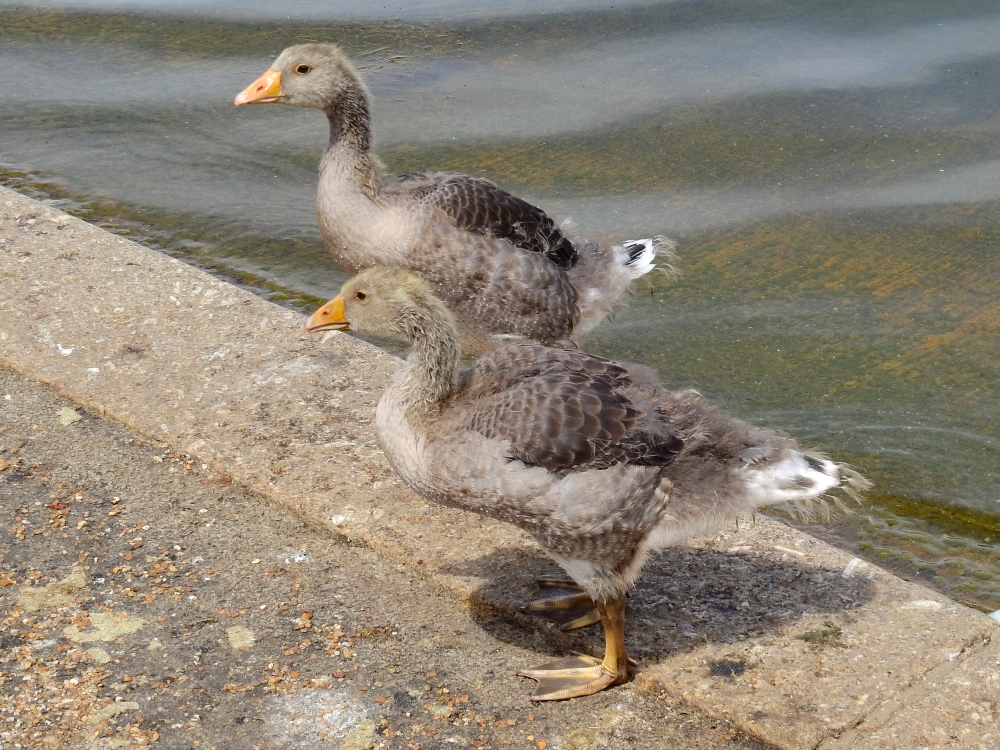
This is the Greylag gosling accidentally adopted by the Canada Geese with 14 goslings of their own. It's still accepted by its step-parents, but the moment will surely come when they realise it's not theirs. It's big enough to survive on its own, but will always be handicapped by the fact that it believes it's a Canada and will try vainly to associate with them.


The Great Crested Grebe chicks were in the middle, begging loudly while their father took no notice and preened.


They will be sent off soon to fend for themselves. This is a testing time for a young grebe, but there were plenty of small fish at the edge of the lake, and these are relatively easy for an inexperienced bird to catch before it gains the skill to deal with larger prey.

A Moorhen took it easy on the edge of the lake. They are remarkably calm about people walking past inches away.


There was a Grey Heron in the upper nest again today. It wasn't doing anything, and was probably just using the nest as a place to rest.


Another heron was peering through the weed on the Long Water. There are certainly fish sheltering under the floating weed, but seeing them must be difficult.


The clamorous young Great Tits were quieter today. Perhaps some of them are beginning to find insects for themselves. But there were still fledglings calling near the bridge ...


... and parents coming out of the bushes to demand pine nuts for them.


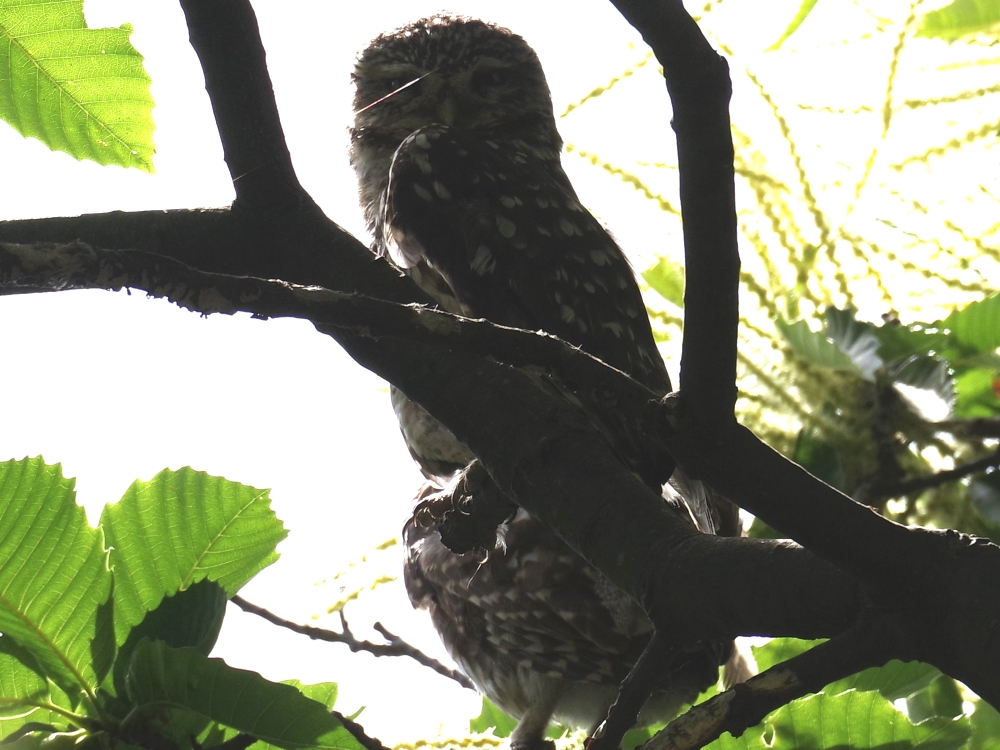
The male Little Owl near the leaf yard basked in the hot sunshine at the top of the nest tree.


A male Emperor dragonfly rested for a few seconds on a reed.


A Small White butterfly drank nectar from a thistle.

Sunday, 24 June 2018

The two Little Owls near the leaf yard were together in the upper chestnut tree, but absolutely refused to get into a good position for a picture.


Later the male owl flew into the lower tree and posed obligingly.


A young Long-Tailed Tit begged for food. It was in a big family group, in which adults cooperate to feed the young.


This young male Blackbird has grown almost all his black plumage. But he won't get a smart yellow bill and eye ring till next year.


Beside the little pool at the top of the Dell waterfall, a male Wood Pigeon tried to court a female by bowing and cooing. But she wasn't interested and flew away.


A young Grey Heron lost its balance while walking along the rige of the boathouse roof.


The Mute Swan family on the Long Water were touting for food at the Vista.


The Egyptian Goose family first seen on the gravel bank came across the Long Water. There are still five goslings, and it's possible that this pair will manage to raise their young for the first time ever, after several years of failure. That would be largely due to the small number of Herring Gulls on the Long Water.


A lot of Herring Gulls stood on the posts just the other side of the bridge. They prefer the open Serpentine, where there is more opportunity for scavenging along the edge but, even allowing for this, they are going to the Long Water less often than they used to.


The female Mallard who hangs around the shallow water at Peter Pan lets her ducklings wander all over the place. She also has the lack of gulls on the Long Water to thank for their survival.


The Mallard mother at the island has been much more attentive, and has managed to keep three in difficult conditions.


A Common Blue Damselfly managed to perch on an iron railing by clinging to a bit of leaf stuck to a cobweb.


A Greenbottle fly stood on a leaf. The sunlight makes an odd pattern in the multiple lenses of its compound eye, with the brightest part around the edge of the reflecting area.

Saturday, 23 June 2018

A Pied Wagtail at the Round Pond gathered insects for its nestlings. I think they nest in the main block of Kensington Palace, as I have seen them flying up to the roof there.


There were House Matins, Sand Martins and Swifts flying over the pond.


The Egyptian Goose family here with seven goslings were in good order.


The eldest Greylag goslings on the Serpentine are beginning to get their adult appearance.


A Mute Swan with young cygnets ventured uner the bridge on to the Long Water, a dangerous place for them as the dominant pair of swans are guarding it jealously.


The Great Crested Grebe chicks at the island are beginning to grow little black crests.


Cormorants are returning to the lake, a sign that this year's young fish are now large enough to interest them.


A top view of the duckboard in the Italian Gardens fountain which the Feral Pigeons like as a place to bathe and socialise.


On the next pool, a Carrion Crow used the duckboard to steal a bit of bread which someone had thrown to a Coot.


The female Little Owl at the leaf yard was in the chestnut tree just uphill from the nest tree.


Tinúviel sent me this picture of three big feathers. The one at the bottom is a Mute Swan primary. The one at the top is from a Great Bustard, and the enormous feather in the middle is from a Griffon Vulture.


There was a Comma butterfly in Kensington Gardens, only the second one I've seen this year.


A female Broad-Bodied Chaser dragonfly sunned herself on a grass stem beside the Long Water.


A male Black-Tailed Skimmer was also basking. They usually do this on the path, where the gravel rolled into the tarmac spoils the picture, and it's hard to find one on a plain background.


A White-Tailed Bumblebee examined a clover flower.


Jabir Belmehdi photographed a handsome beetle about an inch long in Kensington Gardens. There are so many species of beetle that I don't have a hope of identifying it myself.

Some pictures from Friday's visit to Rainham Marshes.

A Marsh Harrier, carrying prey which looks like a Moorhen, was harried by a Lapwing.


A group of Little Egrets.


A Little Grebe.


A Goldfinch.


A Reed Bunting.


A Sedge Warbler.


A Tufted Duck with ducklings. There were four, but they were wandering around and I could only get two into the frame.


So not a great day for birds. But it was better for insects.

The star of the show was a Common Emerald Damselfly.


There was also a female Blue-Tailed Damselfly, in subdued colours and without the blue tail of the male.


A Four-Spotted Chaser dragonfly.


Two Ruddy Darters, a female ...


... and a male.


He moved his head around, constantly on the watch for passing insects.


A Small Tortoiseshell butterfly.


A large hoverfly, Helophilus pendulus. This is sometimes called a Sun Fly, from a misreading of Helophilus, 'marsh lover', as Heliophilus, 'sun lover'. It basks in the sun, but no more than other insects do.


A colourful Drinker moth caterpillar ...


... and the black caterpillar of a Peacock butterfly.


The larva of a Bryony Ladybird.


Finally, back to vertebrates. A Marsh Frog ...


... and a Common Lizard.