It had been raining for hours when I got into the park, and even the ducks were beginning to look a bit wet. This is a Pochard drake.
The Great Crested Grebes were undeterred, and this pair were having an affectionate display.
There are only a few Cormorants now, a sign that they have more or less exhausted the lake's supply of suitable sized fish. However, this one near the bridge had caught a very large perch, which it was having some difficulty in swallowing. It took several minutes before it succeeded.
A Little Grebe appeared on the Long Water, under the dead willow tree near the Italian Garden.
I am not sure whether it is the same one as the bird seen on the Round Pond and Serpentine. It seems to have an off-white gape (the area at the base of its bill). The one seen before had a distinctly yellow gape. But this may be a trick of the light on a dim day.
A flock of Greylag Geese were scared off the north bank of the Serpentine by some idiot with a dog, and took refuge on the water.
The young Grey Wagtail turned up twice, first in the Italian Garden then running along the edge of the Serpentine.
The Ring-Necked Parakeets were unusually persistent in demanding food, and mobbed me when I was trying to feed the small birds. No doubt the colder weather is making them more hungry. This one is male, as you can see by the pink ring round his neck.
The female Tawny Owl was in her usual place on the beech tree, which is quite well sheltered from the rain.
There was no sign of either Little Owl, no wonder on such a raw and soggy day.
Sunday, 23 November 2014
Saturday, 22 November 2014
It was a dull grey day, which was a shame because there was a lot of activity in the rowan tree on Buck Hill. You can only get good photographs of birds in this tree when the sun is shining, so you will have to make do with poor ones.
There were five species of thrush in the tree at once:
There are a lot of Song Thrushes in the park; there must have been an arrival of migrants. Two of them, encouraged by the mild temperature, were singing at each other near the bridge.
A Dunnock was hopping around on the wall of the Sunken Garden.
The female Tawny Owl was in her usual place on the beech tree. She woke up when five photographers arrived and stared at them with mild curiosity.
The male Little Owl was also on his favourite branch, but in a slightly different place that made him harder to see among the twigs.
The female Little Owl was in the next tree, but we accidentally disturbed her and she flew away.
Here, as a change from so many grey pictures, is a splendid one taken by Andy Sunters, showing a Jay in full flight snatching a peanut from my fingers.
There were five species of thrush in the tree at once:
Song Thrush ...
... Mistle Thrush ...
... Blackbird ...
... Redwing ...
... and Fieldfare.
There are a lot of Song Thrushes in the park; there must have been an arrival of migrants. Two of them, encouraged by the mild temperature, were singing at each other near the bridge.
A Dunnock was hopping around on the wall of the Sunken Garden.
The female Tawny Owl was in her usual place on the beech tree. She woke up when five photographers arrived and stared at them with mild curiosity.
The male Little Owl was also on his favourite branch, but in a slightly different place that made him harder to see among the twigs.
The female Little Owl was in the next tree, but we accidentally disturbed her and she flew away.
Here, as a change from so many grey pictures, is a splendid one taken by Andy Sunters, showing a Jay in full flight snatching a peanut from my fingers.
Friday, 21 November 2014
It was a dark grey drizzly day, but the male Little Owl was out on his usual branch.
And the female Tawny Owl was on the beech tree. Again, by approaching the tree from an unexpected direction, I was able not to bring any Jays or Magpies with me, and she could doze undisturbed.
There was nothing unusual on the Long Water, or on the Serpentine except for a Herring Gull eating the remains of a pigeon, but I am pretty sure that this was just the leavings of one of the killed Lesser Black-Backed Gulls.
The remaining pictures were taken at the Round Pond.
There are at least 20 Common Gulls, which tend to prefer the Round Pond to the main lake.
Mixed with the crowd of four species of gull there were five Jackdaws, the most I have seen together in the park. Maybe my estimate that the total number in the park is six is too low.
I threw them some bits of biscuit, which they grabbed with great speed from under the noses of the gulls. They quickly realised that I was feeding them rather than just throwing food around, and became quite fearless, coming right up to my feet.
Two Pied Wagtails were sprinting along the edge of the pond.
They now seem to have adjusted to the fact that the rebuilding of the kerb has removed the little strip of concrete immediately next to the water, and are finding plenty of insects on the grass or the pavement, which is messy with goose droppings.
The water at the edge may be too deep for wagtails, but it is just right for bathing Starlings, which were having a fine time splashing about.
Two Shoveller drakes were circling on the water.
It has been a disappointing year for Shovellers. At present I can only find four on the Long Water, plus these two.
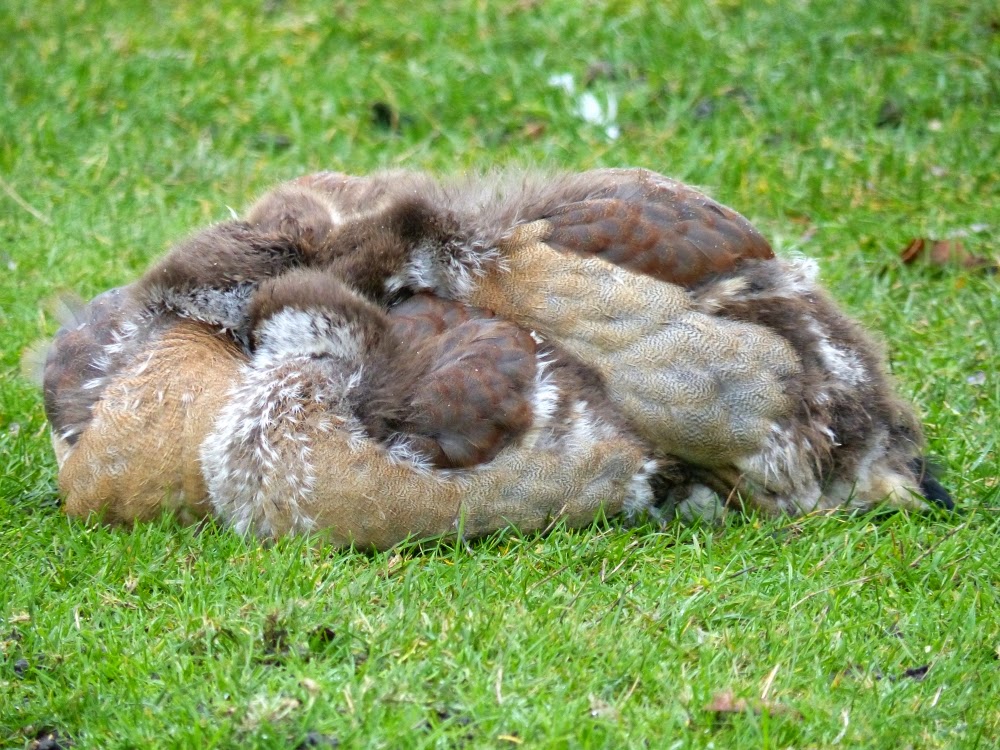
A casual visitor to the Round Pond would wonder what this amorphous fluffy object is. It is, of course, all eight young Egyptian Geese, huddled together to keep warm.
One of the gardeners reported seeing a Meadow Pipit in the rough grass at the southeast corner of Kensington Palace. This is going to be a wildflower meadow next spring, which would be a very agreeable habitat for this bird if it decided to stay. I shall keep my eye on this place.
And the female Tawny Owl was on the beech tree. Again, by approaching the tree from an unexpected direction, I was able not to bring any Jays or Magpies with me, and she could doze undisturbed.
There was nothing unusual on the Long Water, or on the Serpentine except for a Herring Gull eating the remains of a pigeon, but I am pretty sure that this was just the leavings of one of the killed Lesser Black-Backed Gulls.
The remaining pictures were taken at the Round Pond.
There are at least 20 Common Gulls, which tend to prefer the Round Pond to the main lake.
Mixed with the crowd of four species of gull there were five Jackdaws, the most I have seen together in the park. Maybe my estimate that the total number in the park is six is too low.
I threw them some bits of biscuit, which they grabbed with great speed from under the noses of the gulls. They quickly realised that I was feeding them rather than just throwing food around, and became quite fearless, coming right up to my feet.
Two Pied Wagtails were sprinting along the edge of the pond.
They now seem to have adjusted to the fact that the rebuilding of the kerb has removed the little strip of concrete immediately next to the water, and are finding plenty of insects on the grass or the pavement, which is messy with goose droppings.
The water at the edge may be too deep for wagtails, but it is just right for bathing Starlings, which were having a fine time splashing about.
Two Shoveller drakes were circling on the water.
It has been a disappointing year for Shovellers. At present I can only find four on the Long Water, plus these two.
A casual visitor to the Round Pond would wonder what this amorphous fluffy object is. It is, of course, all eight young Egyptian Geese, huddled together to keep warm.
One of the gardeners reported seeing a Meadow Pipit in the rough grass at the southeast corner of Kensington Palace. This is going to be a wildflower meadow next spring, which would be a very agreeable habitat for this bird if it decided to stay. I shall keep my eye on this place.
Thursday, 20 November 2014
A Dutch-ringed Black-Headed Gull turned up on the north shore of the Serpentine. I have not seen this one before. From the fairly dark colour of its legs it looks to be at least two years old. Will report it to the Dutch ringing organisation.
On the other side of the lake, a Grey Heron was landing on a post, with air brakes full on.
You can see from the way the feathers on the upper surface of the wings are ruffling that the airflow has detached from them and become turbulent, so the wings are no longer producing lift -- in aerodynamic language, they are 'stalled'. The heron, an expert at slow flight and precise landing, has judged this moment nicely so that it can drop on to the post, making what a helicopter pilot calls a 'zero-zero landing', reaching zero altitude and zero forward velocity at the same instant.
One of the young Great Crested Grebes at Peter Pan was stretching its wings, which are quite long but narrow, so that they don't produce much lift and the bird has to attain a high forward speed before they will support it in the air. That is why grebes have to make that frantic 50-yard takeoff run, and also why they come down so fast and splashily on the water.
Compare the broad wings of a Red-Crested Pochard, which provide lots of lift and allow it to take off after the shortest of runs.
This is one of the group that are staying on the island at the moment.
A Greylag Goose on the Serpentine had turned upside down during a vigorous washing session.
In the rowan tree on Buck Hill, a Song Thrush ...
... and a Mistle Thrush were eating berries.
You can see the difference in the pattern of their spots, which is the easiest way to tell them apart. Although a Mistle Thrush has a greyer back and paler face than a Song Thrush, and is larger -- the two pictures are about the right size relative to each other -- these differences are not always apparent, especially when you are seeing only one of them.
The stratagem of approaching the Tawny Owls' tree from the other side, so as not to bring a crowd of Jays and Magpies to annoy him, was effective and I found the male enjoying an untroubled doze. There were lots of noisy Ring-Necked Parakeets in the tree, but these didn't bother him.
The male Little Owl was in the chestnut tree next to his nest tree. The leaves are getting rather thin and he may abandon this place soon.
On the other side of the lake, a Grey Heron was landing on a post, with air brakes full on.
You can see from the way the feathers on the upper surface of the wings are ruffling that the airflow has detached from them and become turbulent, so the wings are no longer producing lift -- in aerodynamic language, they are 'stalled'. The heron, an expert at slow flight and precise landing, has judged this moment nicely so that it can drop on to the post, making what a helicopter pilot calls a 'zero-zero landing', reaching zero altitude and zero forward velocity at the same instant.
One of the young Great Crested Grebes at Peter Pan was stretching its wings, which are quite long but narrow, so that they don't produce much lift and the bird has to attain a high forward speed before they will support it in the air. That is why grebes have to make that frantic 50-yard takeoff run, and also why they come down so fast and splashily on the water.
Compare the broad wings of a Red-Crested Pochard, which provide lots of lift and allow it to take off after the shortest of runs.
This is one of the group that are staying on the island at the moment.
A Greylag Goose on the Serpentine had turned upside down during a vigorous washing session.
In the rowan tree on Buck Hill, a Song Thrush ...
... and a Mistle Thrush were eating berries.
You can see the difference in the pattern of their spots, which is the easiest way to tell them apart. Although a Mistle Thrush has a greyer back and paler face than a Song Thrush, and is larger -- the two pictures are about the right size relative to each other -- these differences are not always apparent, especially when you are seeing only one of them.
The stratagem of approaching the Tawny Owls' tree from the other side, so as not to bring a crowd of Jays and Magpies to annoy him, was effective and I found the male enjoying an untroubled doze. There were lots of noisy Ring-Necked Parakeets in the tree, but these didn't bother him.
The male Little Owl was in the chestnut tree next to his nest tree. The leaves are getting rather thin and he may abandon this place soon.
Wednesday, 19 November 2014
A Carrion Crow was having a bath in the Serpentine, following a ritual in which it kept getting out and shaking itself before plunging in again. Maybe this is effective in getting parasites out of its feathers.
More crows, as well as Magpies, Mistle Thrushes, Blackbirds, Wood Pigeons and Chaffinches, were constantly visiting the rowan tree on Buck Hill, and also this Song Thrush which was enthusiastically eating the berries.
Two of the wandering Jackdaws had turned up at the Round Pond and were looking for worms in the grass.
A Wren was perched on a traffic cone which for some reason is part of the furniture of the Lido restaurant.
A welcome return: a single male Mandarin showed up at Peter Pan. They haven't been seen for some time, and may have been skulking in the bushes on the opposite side of the lake.
I was told that not many Mandarins have been seen on the Regent's Canal, which is their main breeding area.
The two young Great Crested Grebes are spending a lot of time at Peter Pan, mingling with the ducks and swans in the shallow water just offshore. It is hard to see why they like this place, which is certainly no good for fishing. This one got too close to an aggressive Coot which pecked at it.
The male Little Owl was on his usual perch in the pair's nest tree.
And the female Tawny Owl was on her usual branch in the beech tree. But you will see that she has her eyes wide open again, and was about to fly back into her nest hole to evade some Magpies that were cackling at her.
I fear I am bringing trouble to the owls, because Jays follow me around soliciting peanuts, and Magpies follow the Jays trying to steal them, and when they get to the owls' tree they mob the owl. From now on I shall be approaching the tree from the other side to try to avoid this.
More crows, as well as Magpies, Mistle Thrushes, Blackbirds, Wood Pigeons and Chaffinches, were constantly visiting the rowan tree on Buck Hill, and also this Song Thrush which was enthusiastically eating the berries.
Two of the wandering Jackdaws had turned up at the Round Pond and were looking for worms in the grass.
A Wren was perched on a traffic cone which for some reason is part of the furniture of the Lido restaurant.
A welcome return: a single male Mandarin showed up at Peter Pan. They haven't been seen for some time, and may have been skulking in the bushes on the opposite side of the lake.
I was told that not many Mandarins have been seen on the Regent's Canal, which is their main breeding area.
The two young Great Crested Grebes are spending a lot of time at Peter Pan, mingling with the ducks and swans in the shallow water just offshore. It is hard to see why they like this place, which is certainly no good for fishing. This one got too close to an aggressive Coot which pecked at it.
The male Little Owl was on his usual perch in the pair's nest tree.
And the female Tawny Owl was on her usual branch in the beech tree. But you will see that she has her eyes wide open again, and was about to fly back into her nest hole to evade some Magpies that were cackling at her.
I fear I am bringing trouble to the owls, because Jays follow me around soliciting peanuts, and Magpies follow the Jays trying to steal them, and when they get to the owls' tree they mob the owl. From now on I shall be approaching the tree from the other side to try to avoid this.
Tuesday, 18 November 2014
Today's visitors to the rowan trees on Buck Hill included a Wood Pigeon ...
... and a Song Thrush.
Song Thrushes are heavily outnumbered by Mistle Thrushes here, and are also chased out of the tree by the Mistle Thrushes when these larger and more aggressive birds arrive.
The female Tawny Owl was in her usual place in the beech tree next to her nest tree, and was looking down in annoyance at a Magpie defying her on a lower branch.
But there was only one Magpie, and it soon went away and left her in peace. She was still there when I went past a couple of hours later.
The male Little Owl was in the chestnut tree next to his nest tree. His comfortable covered place will be bare soon, and he will have to find somewhere else. He may disappear into the leaf yard for the winter.
A Cormorant was washing itself vigorously on the Long Water.
The Little Grebe also appeared on the Long Water, but too far away for a picture.
A Great Crested Grebe was silhouetted by the evening light on the Serpentine.
The Pied Wagtails at the Round Pond, deprived by the recent works of the water edge they used to run along, have found that the gravel topping of the new pavement has small edible creatures between the stones, and have returned in good numbers. Here are four of them together.
Viewed from the Round Pond, a gaudy sunset made it look as if Barker's department store were on fire, with pigeons fleeing the blaze.
... and a Song Thrush.
Song Thrushes are heavily outnumbered by Mistle Thrushes here, and are also chased out of the tree by the Mistle Thrushes when these larger and more aggressive birds arrive.
The female Tawny Owl was in her usual place in the beech tree next to her nest tree, and was looking down in annoyance at a Magpie defying her on a lower branch.
But there was only one Magpie, and it soon went away and left her in peace. She was still there when I went past a couple of hours later.
The male Little Owl was in the chestnut tree next to his nest tree. His comfortable covered place will be bare soon, and he will have to find somewhere else. He may disappear into the leaf yard for the winter.
A Cormorant was washing itself vigorously on the Long Water.
The Little Grebe also appeared on the Long Water, but too far away for a picture.
A Great Crested Grebe was silhouetted by the evening light on the Serpentine.
The Pied Wagtails at the Round Pond, deprived by the recent works of the water edge they used to run along, have found that the gravel topping of the new pavement has small edible creatures between the stones, and have returned in good numbers. Here are four of them together.
Viewed from the Round Pond, a gaudy sunset made it look as if Barker's department store were on fire, with pigeons fleeing the blaze.


%2B1a.jpg)